
The timeline
968 dated events, era by era. Filter by war, faith, science, resistance or renewal.
01 · Vedic Rishis and the ItihasaSatya, Treta and Dvapara Yugas, to 3102 BCE (traditional reckoning)
- 1,97,29,49,127 years before 2026 CE (Puranic reckoning)
The present Kalpa, Shveta Varaha, beginsFaith
By the Surya Siddhanta and the Puranas, Brahma’s present day began this many years ago. We now stand in its 7th Manvantara, the Vaivasvata, in the 28th Mahayuga.
- Treta Yuga of the 24th Mahayuga (Puranic reckoning)
Shri Rama reigns at AyodhyaFaith
The Vayu Purana places Shri Rama in the Treta Yuga of the 24th Mahayuga. Maharshi Valmiki’s Ramayana tells his life as Itihasa, from Ayodhya to Lanka and back.
- Close of the Dvapara Yuga (traditional)
Maharshi Vyasa arranges the Veda in fourFaith
Krishna Dvaipayana divided the one Veda into Rik, Yajus, Saman and Atharvan and gave each to a disciple: Paila, Vaishampayana, Jaimini and Sumantu. He is called Veda Vyasa for this.
- 3138 BCE (traditional reckoning)
The Mahabharata war at KurukshetraWar
Eighteen days of battle on the field of the Kurus, 36 years before Kali Yuga by the traditional count. On its first morning Shri Krishna spoke the Bhagavad Gita to Arjuna.
- 3138 BCE (traditional reckoning)
Yudhishthira crowned at HastinapuraPolity
After the war Yudhishthira took the throne of the Kurus and performed the Ashvamedha, as the Ashvamedhika Parva records. He ruled for 36 years.
- 3102 BCE (traditional reckoning)
The sea takes DwarkaFaith
The Mausala Parva says the ocean covered Dwarka once Shri Krishna had left it. Arjuna led the survivors away to Indraprastha.
- 3102 BCE (traditional reckoning)
Parikshit takes the Kuru thronePolity
As the Pandavas set out on the Mahaprasthana, Arjuna’s grandson Parikshit was crowned. The Bhagavata Purana was first recited to him by Shuka on the Ganga bank.
- 18 February 3102 BCE (traditional reckoning)
Shri Krishna departs; Kali Yuga beginsFaith
Kali Yuga began with the departure of Shri Krishna. Aryabhata’s count, 3,600 years of Kali gone in 499 CE, fixes the start in 3102 BCE, and every panchang still reckons from it.
- 3076 BCE (Kashmiri reckoning)
The Saptarshi era begins in KashmirCulture
Kashmir counted years in the Laukika or Saptarshi era, started 25 years into Kali. Kalhana dated his Rajatarangini in it.
02 · The Sindhu–Sarasvati Civilisationc. 7000–1300 BCE
- c. 10,000 BCE and earlier
Painters at the Bhimbetka rock sheltersCulture
In the hills south of Bhopal, people painted hunts, dances and animals on more than 400 rock shelters. The oldest layers go back beyond the end of the Ice Age.
- c. 7000 BCE
Farmers settle at MehrgarhCulture
At the foot of the Bolan Pass, villagers grew barley and wheat and herded cattle, sheep and goats in mud-brick houses. It is among the oldest farming villages of South Asia.
- c. 7000–5500 BCE
Drilled teeth at MehrgarhScience
Eleven molars from Mehrgarh graves carry neat drilled holes, made on living people with flint bow-drills. The find, published in Nature in 2006, is the oldest known dentistry.
- c. 3300 BCE
Early towns along the Sindhu and SarasvatiCulture
Walled towns such as Kot Diji, Kalibangan and Harappa’s first levels rise, with standard pottery and the first signs that grow into the Indus script.
- c. 3000 BCE
Pit-dwellers of Burzahom in KashmirCulture
Above the Dal lake valley, Neolithic families lived in pits cut into the loess, used bone tools and buried dogs with their dead.
- c. 2800 BCE
A ploughed field at KalibanganScience
On the dry bed of the Ghaggar in Rajasthan, excavators found furrows in a criss-cross grid, the oldest ploughed field yet dug up. Farmers there still sow two crops this way.
- c. 2600 BCE
The great cities risePolity
Harappa, Mohenjo-daro, Rakhigarhi, Ganweriwala and Dholavira grow into planned cities of baked brick, with grid streets, covered drains and standard weights.
- c. 2500 BCE
The Great Bath at Mohenjo-daroFaith
A tank 12 metres long, sealed with gypsum mortar and bitumen, with steps at both ends. Ritual bathing at a sacred tank is still the custom at every tirtha.
- c. 2500–2400 BCE
The seated yogi seal of Mohenjo-daroFaith
A steatite seal shows a horned figure seated in a yogic posture among an elephant, tiger, rhino and buffalo. Many see in it Pashupati, lord of creatures; the script on it is still unread.
- c. 2500 BCE
Dholavira stores its waterScience
On Khadir island in the Rann of Kutch, the city cut stone reservoirs and dammed two seasonal streams to survive a dry land. A signboard of ten large signs lay fallen by its north gate.
- c. 2500 BCE
Fire altars at Kalibangan and LothalFaith
Rows of clay-lined fire pits with ash and a central stele were found on a raised platform at Kalibangan, and similar altars at Lothal. Worship with fire runs unbroken to the havan of today.
- c. 2500 BCE
A woman buried at RakhigarhiScience
Her genome, read and published in 2019, carries no Steppe ancestry. It ties the people of the cities to later populations of South Asia.
- c. 2400 BCE
The brick basin of LothalScience
A long brick-walled basin beside the Sabarmati estuary, which S. R. Rao identified as a dockyard, served a town of bead-makers and traders.
- c. 2300 BCE
Ships of Meluhha reach AkkadCulture
Sargon of Akkad boasted that ships from Meluhha moored at his capital. Indus seals, carnelian beads and weights turn up across Mesopotamia and the Gulf.
- c. 2200–1900 BCE
The Sarasvati fails; the cities thin outCulture
A long drought and shifting rivers dried the Ghaggar-Hakra, the Sarasvati of the Rigveda. Big cities emptied and people moved east toward the Ganga and south into Gujarat.
- c. 2000–1800 BCE
Chariot burials at SanauliWar
Near Baghpat in western Uttar Pradesh, ASI excavators in 2018 found warriors buried with solid-wheeled chariots, copper swords, shields and helmets.
- c. 1800–1500 BCE
Iron smelted in the Ganga valleyScience
Furnaces, slag and iron tools at Malhar near Chandauli and Raja Nala ka Tila show iron working in Bharat far earlier than once thought.
- c. 1900–1300 BCE
Late Harappan villages carry onCulture
The seals and big cities fade, but villages in Haryana, Punjab, western Uttar Pradesh and Gujarat keep the old crafts, weights and house plans.
03 · Janapadas and the Rise of Magadhac. 1300–321 BCE
- c. 1200–600 BCE
Painted Grey Ware towns of the Kuru landCulture
Hastinapura, Ahichchhatra, Mathura and Kurukshetra show a fine grey pottery painted in black. Their spread matches the lands the Mahabharata names.
- c. 1000 BCE onward
Megalith builders of the Deccan and the southCulture
Stone circles, cists and urn burials with iron weapons and black-and-red ware spread from Vidarbha to Tamil Nadu and Kerala.
- 877–777 BCE (Jain tradition)
Parshvanatha, the 23rd TirthankaraFaith
Born a prince of Kashi, Parshvanatha taught the fourfold restraint and attained nirvana on Sammed Shikhar in Jharkhand, which Jains still climb barefoot.
- c. 800 BCE
The Ganga floods HastinapuraPolity
The Puranas say the Ganga swept Hastinapura away in King Nichakshu’s time and he moved to Kaushambi. B. B. Lal’s dig in 1950–52 found a thick flood layer ending the town.
- c. 800–500 BCE (modern estimate)
Baudhayana states the rule of the diagonalScience
To build fire altars of exact shape, the Baudhayana Shulba Sutra gives the rule that the square on a rectangle’s diagonal equals the squares on its two sides, and a close value of the root of two.
- c. 600 BCE
Sixteen MahajanapadasPolity
The Anguttara Nikaya lists sixteen great states, from Gandhara and Kamboja to Anga and Magadha, Kashi, Kosala, Vatsa and Avanti among them.
- c. 6th century BCE
The Licchavi republic of VaishaliPolity
The Vajji confederacy was ruled by an assembly of clan heads that met in a hall at Vaishali. The Buddha praised it for meeting often and in concord.
- c. 6th century BCE
Punch-marked silver coinsCulture
Silver karshapanas stamped with suns, hills and animals came into use across the janapadas, the first coins of Bharat.
- by the 6th century BCE
Takshashila draws students from afarCulture
The Pali texts say the physician Jivaka trained seven years at Takshashila. Princes and Brahmin boys came there to learn the Vedas, archery and medicine.
- date debated; often placed c. 600 BCE
Sushruta teaches surgery at KashiScience
The Sushruta Samhita, taught by Divodasa Dhanvantari to Sushruta, describes over a hundred instruments and rebuilding a cut nose with a flap of cheek skin.
- 599 BCE (Jain tradition)
Vardhamana Mahavira born near VaishaliFaith
The 24th Tirthankara was born at Kundagrama to Siddhartha and Trishala. At thirty he left home for twelve years of austerity.
- c. 6th century BCE
A brick town at Keeladi on the VaigaiCulture
Excavations near Madurai since 2015 found brick houses, dye vats and potsherds scratched with Tamil-Brahmi names. Carbon dates reach back to about 580 BCE.
- c. 563 BCE (widely used dating)
Siddhartha Gautama born at LumbiniFaith
Born to the Shakya chief Shuddhodana and Mayadevi in a grove at Lumbini, he grew up at Kapilavastu.
- c. 544 BCE
Bimbisara takes the throne of MagadhaPolity
From Rajagriha, ringed by a stone wall over 40 km long, Bimbisara annexed Anga and made Magadha the rising power of the east.
- c. 528 BCE (widely used dating)
Bodhi at Bodh Gaya; first sermon at SarnathFaith
Under a pipal on the Niranjana the Buddha attained enlightenment, then set the wheel of Dhamma turning before five companions in the deer park at Sarnath.
- 527 BCE (Jain tradition)
Mahavira attains nirvana at PavapuriFaith
Mahavira left the body at Pavapuri on the night Jains mark as Diwali. The Vira Nirvana Samvat counts from this year.
- c. 518 BCE
Persia annexes Gandhara and the SindhuWar
Darius I of the Achaemenids listed Gandara, and soon Hindush on the lower Sindhu, among his satrapies in his inscriptions. Herodotus says Hindush paid the largest tribute, in gold dust.
- c. 492 BCE
Ajatashatru rules MagadhaPolity
Ajatashatru fought Kosala and broke the Vajji confederacy after a long war, fortifying the village of Pataligrama on the Ganga as his base.
- c. 483 BCE (widely used dating)
The Buddha’s parinirvana at KushinagarFaith
At eighty the Buddha passed away between two sal trees at Kushinagar. His relics were divided among eight claimants and enshrined in stupas.
- c. 483 BCE
First Buddhist council at RajagrihaFaith
Five hundred monks met in the Saptaparni cave under Ajatashatru’s patronage. Ananda recited the Sutta and Upali the Vinaya.
- c. 460 BCE
Pataliputra becomes the capitalPolity
Udayin, son of Ajatashatru, moved the Magadhan capital to Pataliputra where the Son meets the Ganga. It stayed the seat of empire for eight centuries.
- c. 413 BCE
Shishunaga ends the power of AvantiPolity
The Shishunaga line replaced the Haryankas. Shishunaga broke the Pradyota kings of Avanti and joined Malwa to Magadha.
- c. 5th–4th century BCE
Panini composes the AshtadhyayiCulture
From Shalatura near Attock, Panini set down Sanskrit grammar in about 4,000 sutras, built on 14 Shiva Sutras that the tradition says came from Mahadev’s damaru.
- c. 383 BCE
Second Buddhist council at VaishaliFaith
A century after the parinirvana, monks met at Vaishali under King Kalashoka to settle ten disputed points of monastic discipline.
- c. 345 BCE
Mahapadma Nanda builds the first great empirePolity
The Puranas call him the destroyer of all Kshatriyas. He conquered Kalinga, and his army, Greek writers heard, had 2,00,000 foot and 3,000 elephants.
- 327 BCE
The Ashvakas hold Massaga against AlexanderResistance
In the Swat valley the Ashvakas defended Massaga for days; Alexander was wounded. After their chief fell, his mother Cleophis led the defence until terms were made.
- 326 BCE
Porus fights Alexander on the JhelumWar
Paurava met the Macedonians on the Hydaspes with elephants and chariots in the monsoon rain. He lost the field, but Alexander returned his kingdom and enlarged it.
- 326 BCE
Alexander’s army refuses to cross the BeasResistance
Hearing of the Nanda army beyond the Ganga, the Macedonian soldiers would go no further than the Hyphasis. Alexander turned back.
- 325 BCE
The Malavas wound AlexanderResistance
Storming a town of the Malloi on the lower Ravi, Alexander took an arrow through the chest and nearly died. He left Bharat by the Makran coast that year.
04 · The Maurya Empire321–185 BCE
- c. 321 BCE
Chandragupta Maurya overthrows the NandasPolity
Guided by Chanakya, the young Chandragupta took Pataliputra and cleared the Greek garrisons from the Punjab, founding the Maurya empire.
- c. 4th century BCE
Kautilya’s ArthashastraCulture
A manual of statecraft in fifteen books: taxes, spies, forts, law courts, mines, war and treaties. The text, lost for centuries, was found in Mysore in 1905.
- c. 305–303 BCE
Seleucus cedes the western provincesWar
After war with Chandragupta, Seleucus Nicator gave up Arachosia, Gedrosia and the Paropamisadae, and received 500 war elephants. A marriage alliance sealed the peace.
- c. 302 BCE
Megasthenes at PataliputraWorld
The Seleucid envoy described a city 15 km long behind a timber palisade with 570 towers, and a land where, he wrote, famine was unknown.
- c. 300 BCE
The Sudarshana lake at GirnarScience
Chandragupta’s governor Pushyagupta dammed a stream below Girnar to make the Sudarshana lake; Ashoka’s officer Tushaspha added canals. Rudradaman’s inscription of 150 CE records both.
- c. 297 BCE (Jain tradition)
Chandragupta ends his days at ShravanabelagolaFaith
Jain tradition says Chandragupta gave up the throne, followed Acharya Bhadrabahu south during a twelve-year famine and fasted to death on Chandragiri hill.
- c. 297 BCE
Bindusara succeedsPolity
Greeks called him Amitrochates, from Amitraghata, slayer of foes. He held the empire into the Deccan and received the envoy Deimachus from Antiochus.
- c. 268 BCE
Ashoka is consecrated kingPolity
After a contested succession, Ashoka, who calls himself Devanampiya Piyadasi in his edicts, was formally anointed at Pataliputra.
- c. 261 BCE
The Kalinga warWar
Ashoka’s 13th Rock Edict says 1,50,000 were carried away from Kalinga and 1,00,000 killed. Kalinga’s stand moved the emperor to turn to Dhamma.
- c. 258 BCE onward
Ashoka’s edicts carved across BharatPolity
Rock and pillar edicts in Brahmi, Kharoshthi, Greek and Aramaic, from Kandahar to Karnataka, ask for respect to parents, Brahmins and shramanas, and mercy to animals.
- c. 257 BCE
Edict II names the Tamil kingdomsPolity
Ashoka lists the Cholas, Pandyas, Satiyaputras and Keralaputras as free neighbours, where he arranged medical care for people and animals.
- c. 257–250 BCE
Barabar caves given to the AjivikasFaith
In his 12th and 19th regnal years Ashoka gave caves cut in granite and polished to a mirror shine. The Lomas Rishi cave beside them has a carved doorway copied from a wooden hut.
- c. 250 BCE
Third Buddhist council at PataliputraFaith
Under Ashoka, Moggaliputta Tissa presided over a council that compiled the Kathavatthu. Missions then went out to Gandhara, the Himalaya, Suvarnabhumi and Lanka.
- c. 250 BCE
Mahinda and Sanghamitra sail to LankaFaith
Ashoka’s son and daughter carried the Dhamma to King Devanampiya Tissa; Sanghamitra brought a sapling of the Bodhi tree that still grows at Anuradhapura.
- c. 250 BCE
The lion capital at SarnathCulture
Four lions back to back on a drum of dharma-chakras crowned an Ashokan pillar at Sarnath. Since 1950 it is the State Emblem of India.
- c. 3rd century BCE
The first stupa at SanchiFaith
Ashoka raised a brick stupa and a polished pillar on the hill at Sanchi near Vidisha, the home of his queen Devi.
- c. 249 BCE
Ashoka visits LumbiniFaith
The Rummindei pillar says that in his 20th year the king came in person, worshipped here because the Buddha was born here, and exempted the village from tax.
- c. 232 BCE
Ashoka dies; the empire dividesPolity
After Ashoka the Maurya realm split among heirs; Dasharatha gave the Nagarjuni caves to the Ajivikas, and the provinces began to slip away.
05 · Shungas, Satavahanas, Kharavela and the Sangam Kingdoms185 BCE – 320 CE
- c. 185 BCE
Pushyamitra Shunga ends the Maurya linePolity
The commander-in-chief struck down the last Maurya, Brihadratha, at a review of the army and took the throne at Pataliputra.
- c. 2nd century BCE
Pushyamitra performs two AshvamedhasFaith
An inscription of his descendant Dhanadeva at Ayodhya calls Pushyamitra the performer of two horse sacrifices, the first great Vedic yajnas of a king in centuries.
- c. 150 BCE
Patanjali writes the MahabhashyaCulture
His great commentary on Panini mentions sacrifices for Pushyamitra and gives, as a grammar example of a recent event, “the Yavana besieged Saketa”.
- c. 150 BCE
Menander questions NagasenaFaith
The Indo-Greek king of Sagala (Sialkot) debated the monk Nagasena; their dialogue survives as the Milindapanha.
- c. 150–100 BCE
The carved railings of BharhutCulture
Under the Shungas, donors carved the Bharhut stupa railing with Jataka scenes, yakshas and yakshis, each panel labelled in Brahmi.
- c. 2nd century BCE
First caves cut at AjantaCulture
Monks cut the first chaitya halls, caves 9 and 10, into the horseshoe cliff above the Waghora. Cave 10 still carries paintings of this age.
- c. 2nd–1st century BCE
The Shivalinga of GudimallamFaith
Near Renigunta in Andhra, a linga of polished stone with a standing Shiva carved on its face has been in worship since this age, among the oldest lingas still in worship.
- c. 110 BCE
Heliodorus raises a Garuda pillar to VasudevaFaith
A Greek envoy of King Antialcidas, who calls himself a Bhagavata, set up a Garuda-dhvaja to Vasudeva, god of gods, at Vidisha. It still stands, known locally as Khamba Baba.
- c. 1st century BCE
Ghosundi: an enclosure for Sankarshana and VasudevaFaith
A Sanskrit inscription near Chittorgarh records a stone wall built around a place of worship of Bhagavan Sankarshana and Vasudeva, one of the oldest Vaishnava records.
- c. 2nd–1st century BCE
Kharavela of Kalinga humbles MagadhaResistance
His Hathigumpha inscription at Udayagiri says he defeated the king of Magadha and brought home the Kalinga Jina image a Nanda king had carried off.
- c. 1st century BCE
Queen Naganika’s record at NaneghatFaith
In a cave at the head of a trade pass, the Satavahana queen lists the yajnas of Satakarni I, two Ashvamedhas and a Rajasuya, with the fees paid in cows and coins. Its numerals are among the earliest of Bharat.
- c. 73 BCE
The Kanvas replace the ShungasPolity
Vasudeva Kanva, minister of the last Shunga king Devabhuti, took power at Pataliputra. His line ruled about 45 years.
- 57 BCE
The Vikram Samvat beginsCulture
Tradition links this era to King Vikramaditya of Ujjain and his victory over the Shakas. Early inscriptions call it the Krita and then the Malava era; most of North India still dates festivals by it.
- c. 1st century BCE
The gateways of SanchiCulture
Four stone toranas were raised round the Great Stupa. An inscription on the south gate says the ivory-workers of Vidisha carved one panel, under a Satakarni king.
- 31 BCE (Tamil tradition)
Thiruvalluvar, poet of the KuralCulture
The Tamil Nadu government’s Thiruvalluvar era counts from 31 BCE. His 1,330 couplets on virtue, wealth and love are recited in Tamil homes to this day.
- c. 1st century BCE–1st century CE
Roman ships at Arikamedu and MuzirisCulture
Using the monsoon winds, ships from Egypt reached the Tamil coast for pepper, pearls and muslin. Roman amphorae and coins lie in the soil at Arikamedu near Puducherry.
- c. 1st century CE
The great chaitya at KarlaCulture
Cut into the hill near Lonavala, the Karla hall runs about 45 metres deep under a ribbed vault of real teak beams that have held for two thousand years.
- c. 1st century CE
The Periplus maps the ports of BharatWorld
A Greek sailing guide names Barygaza (Bharuch), Muziris, Nelkynda and the Ganga mouth, and lists what each bought and sold.
- 78 CE
The Shaka era beginsCulture
The era later called Shalivahana Shaka starts this year. Aryabhata, Varahamihira and countless copper plates date by it, and India’s national calendar counts from it today.
- c. 1st century CE
Vima Kadphises puts Shiva on his coinsFaith
The Kushan king’s gold coins show Shiva with trident and Nandi, and give his title as Maheshvara, devotee of Mahadev.
- c. 125 CE
Gautamiputra Satakarni crushes NahapanaResistance
The Satavahana king destroyed the Kshaharata Shakas and restruck their silver at Jogaltembhi. His mother’s Nasik inscription calls him uprooter of Shakas, Yavanas and Pahlavas.
- c. 127 CE
Kanishka begins his reignPolity
The Rabatak inscription, found in Afghanistan in 1993, says Kanishka ruled to Saketa, Kaushambi, Pataliputra and Champa. Buddhist tradition places a council in Kashmir under him.
- c. 2nd century CE
Charaka’s compendium of medicineScience
Charaka, by one tradition physician at Kanishka’s court, edited Agnivesha’s treatise into the Charaka Samhita, the foundation text of Ayurvedic internal medicine.
- c. 2nd century CE
Karikala builds the Kallanai on the KaveriScience
The Chola king threw a dam of unhewn stone across the Kaveri near Thiruchirappalli. Rebuilt and raised, the Grand Anicut still feeds the delta.
- 150 CE
Rudradaman’s inscription at JunagadhCulture
Carved on the same rock as Ashoka’s edicts, it records the Sudarshana dam burst in a storm and rebuilt three times stronger. It is the first long inscription in classical Sanskrit.
- c. 2nd century CE
The marble stupa of AmaravatiCulture
On the Krishna in Andhra, the great stupa was cased in carved limestone panels under the Satavahanas. Many now sit in Chennai and the British Museum.
- c. 2nd century CE
Nagarjuna teaches the Middle WayFaith
The Andhra monk wrote the Mulamadhyamakakarika, the root of the Madhyamaka school of Mahayana. Tradition links him with Shriparvata on the Krishna.
- c. 2nd century CE
Senguttuvan consecrates KannagiFaith
The Silappatikaram tells how the Chera king brought stone from the Himalaya to carve Kannagi’s image, with Gajabahu of Lanka present. Gajabahu’s reign gives the date.
- c. 2nd century BCE–2nd century CE
Bharata’s NatyashastraCulture
In 36 chapters Bharata Muni sets out drama, dance, music, the stage and the theory of rasa. Every classical dance of Bharat still cites it.
- c. 2nd–4th century CE
Coins of the Yaudheya republicResistance
The warrior republic of the Sutlej–Yamuna country, beaten once by Rudradaman, rose again against the Kushans. Their coins read “victory to the Yaudheya gana” and show Kartikeya.
- c. 3rd century CE
The Bharashivas’ ten Ashvamedhas at KashiRenewal
Vakataka copper plates praise the Bharashiva Nagas, who carried the Shivalinga on their shoulders, bathed in Bhagirathi water won by valour, and performed ten Ashvamedhas.
- c. 3rd century CE
The Ikshvakus at NagarjunakondaFaith
In the Krishna valley, King Chamtamula performed the Ashvamedha while the royal women endowed Buddhist monasteries. The site now lies under the Nagarjuna Sagar reservoir.
- c. 250 CE
Vindhyashakti founds the Vakataka housePolity
From the Vidarbha country the Vakatakas rose to rule the Deccan; his son Pravarasena I performed four Ashvamedhas and took the title Samrat.
- c. 3rd–4th century CE (oldest folios, radiocarbon)
The Bakhshali manuscript writes zero as a dotScience
Birch-bark pages found near Peshawar in 1881 work sums with a dot for zero. Bodleian radiocarbon tests in 2017 dated some folios to the 3rd–4th century.
06 · The Gupta Age320–550 CE
- 319–320 CE
Chandragupta I starts the Gupta eraPolity
Married to the Licchavi princess Kumaradevi, whose name appears on his coins with his own, Chandragupta I took the title Maharajadhiraja. The Gupta era counts from 319–320.
- c. 335–375 CE
Samudragupta’s campaignsWar
He uprooted the kings of Aryavarta and marched south to Kanchi, freeing the southern kings after defeat. His Ashvamedha coins show the sacrificial horse before the yupa.
- c. 345 CE
Mayurasharma founds the Kadamba kingdomPolity
The Talagunda inscription says a Brahmin student insulted by a Pallava guard at Kanchi took up the sword and carved out a kingdom at Banavasi.
- c. 350 CE
Harishena’s praise on the Allahabad pillarCulture
On an Ashokan pillar, the court poet Harishena carved Samudragupta’s conquests king by king, naming over twenty rulers of north and south.
- c. 380 CE
Chandragupta II VikramadityaPolity
He married his daughter Prabhavatigupta to the Vakataka king, securing the Deccan; she later ruled the Vakataka realm as regent.
- 401 CE
The Varaha panel at UdayagiriFaith
Near Vidisha, beside a cave inscribed in Gupta year 82, the rock is carved with a giant Bhagwan Varaha lifting Bhudevi from the waters, with rows of rishis and devas watching.
- c. 402–411 CE
Faxian travels through BharatWorld
The Chinese monk walked from Gandhara to Pataliputra and Tamralipti copying Vinaya texts. He found Madhyadesha peaceful, with free hospitals and light taxes.
- c. 400 CE
The iron pillar of King ChandraScience
Over six tonnes of wrought iron, raised as a Vishnu-dhvaja, it has stood sixteen centuries without serious rust. It now stands at Mehrauli in Delhi.
- c. 409 CE
The Western Kshatrapas fall to the GuptasWar
Chandragupta II ended three centuries of Shaka rule in Malwa, Gujarat and Saurashtra and began issuing silver coins on their pattern.
- c. 5th century CE
Kalidasa writes Shakuntala and MeghadutaCulture
Tradition places Kalidasa among the nine gems of Vikramaditya’s Ujjain. His Raghuvamsha, Kumarasambhava and Abhijnana Shakuntalam set the model for Sanskrit poetry.
- 415 CE
Kumaragupta I takes the thronePolity
His forty-year reign was the high noon of Gupta peace; he too issued Ashvamedha coins and on others feeds a peacock, with Kartikeya on his peacock on the reverse.
- c. 427 CE
Nalanda mahavihara foundedCulture
Xuanzang names King Shakraditya, taken to be Kumaragupta I, as Nalanda’s first patron. It grew into a residential university of thousands of monks and teachers.
- 436 CE, repaired 473 CE
The silk-weavers’ sun temple at MandsaurFaith
A guild of silk weavers who had moved from Lata built a temple to Surya at Dashapura; a poet named Vatsabhatti wrote its inscription, which also records its repair a generation later.
- 453 or 466 CE (Jain tradition)
The Jain council at ValabhiFaith
Under Devarddhigani Kshamashramana the Shvetambara Agamas, carried till then by memory, were written down at Valabhi in Saurashtra.
- c. 455 CE
Skandagupta throws back the HunasResistance
His Bhitari pillar says that when he met the Hunas in battle the earth shook. The Gupta frontier held for another generation.
- 455–457 CE
Sudarshana lake rebuilt againRenewal
When the dam burst once more, Skandagupta’s governor Parnadatta and his son Chakrapalita rebuilt it, as the third inscription on the Junagadh rock records.
- c. 460–480 CE
Ajanta’s second flowering under HarishenaCulture
Ministers and feudatories of the Vakataka king Harishena cut most of Ajanta’s caves and painted them with Jataka tales and the Bodhisattva Padmapani.
- c. 475 CE
The Maitrakas found ValabhiPolity
Bhatarka, a Gupta general, founded a dynasty in Saurashtra. Valabhi became a seat of learning that the pilgrim Yijing ranked beside Nalanda.
- 499 CE
Aryabhata writes the AryabhatiyaScience
At 23, at Kusumapura, Aryabhata gave pi as 3.1416, a sine table, and the earth’s daily rotation, explaining eclipses by shadows of earth and moon.
- c. 500 CE
The Dashavatara temple at DeogarhFaith
On the Betwa in Lalitpur, a stone temple on a raised plinth carries panels of Vishnu on Shesha, Gajendra moksha and Nara-Narayana, among the earliest of North India.
- c. 5th century CE
The brick temple of BhitargaonFaith
Near Kanpur stands the oldest surviving brick temple of Bharat with a tall shikhara, its walls set with terracotta panels of gods.
- c. 500 CE
Huna Toramana reaches EranWar
A giant Varaha at Eran in Sagar carries an inscription of the first year of Toramana. The Hunas had pushed into central India.
- 505 CE
Varahamihira’s Pancha-siddhantikaScience
Working at Ujjain from an epoch of 505 CE, he summed up five astronomical systems; his Brihat Samhita covers rain, gems, temple building and well-digging.
- c. 515 CE
Mihirakula’s raidsWar
From Sakala the Huna king struck across the Punjab and Kashmir. Xuanzang and Kalhana both remember him for burning monasteries and cruelty.
- c. 528 CE
Yashodharman defeats MihirakulaResistance
The Aulikara king of Mandsaur raised victory pillars at Sondani saying Mihirakula bowed at his feet. Xuanzang credits Narasimhagupta Baladitya with another defeat of the Huna.
- c. 550 CE
Gupta power fadesPolity
Worn by the Huna wars, the empire broke into the Maukharis of Kannauj, the later Guptas of Magadha, the Maitrakas and others.
07 · The Age of Great Kingdomsc. 550–1000 CE
- 543 CE
Pulakeshin I fortifies VatapiPolity
An inscription on the Badami cliff, dated Shaka 465, records the fort built by the founder of the Chalukya house, who also performed the Ashvamedha.
- c. 570 CE
The Panchatantra reaches PersiaWorld
The physician Burzoe carried Vishnusharma’s animal fables to the Sasanian court of Khosrow I. As Kalila wa Dimna they travelled on into Arabic and Europe.
- c. 575–590 CE
Pallavas and Pandyas end the Kalabhra interregnumRenewal
Simhavishnu took the Kaveri country for the Pallavas of Kanchi, and Kadungon revived Pandya rule at Madurai, opening three centuries of temple building in the Tamil land.
- 578 CE
Mangalesha’s Vishnu cave at BadamiFaith
Cave 3, dated Shaka 500, holds Vishnu seated on Shesha, Trivikrama and Narasimha cut from the red sandstone, with traces of the original painting on the ceiling.
- c. 600–630 CE
Mahendravarman I cuts temples from rockFaith
At Mandagapattu the Pallava king boasts of a shrine to Brahma, Ishvara and Vishnu made without brick, timber, metal or mortar. He also wrote the farce Mattavilasa Prahasana.
- 606 CE
Harsha takes the throne of ThanesarPolity
After his brother’s murder, the sixteen-year-old Harshavardhana became king, later ruling from Kannauj. The Harsha era counts from this year.
- c. 610 CE
Pulakeshin II rules the DeccanPolity
After a civil war with his uncle Mangalesha, Pulakeshin II took the Chalukya throne and soon held the land from the Narmada to the Kaveri.
- c. 618–619 CE
Harsha checked on the NarmadaWar
The Aihole inscription says that when Harsha’s elephants fell in battle against Pulakeshin II, his harsha, his joy, melted away. The Narmada stayed the frontier.
- c. 7th century CE
Banabhatta writes the HarshacharitaCulture
Harsha’s court poet wrote his king’s life in ornate Sanskrit prose and the romance Kadambari, finished after his death by his son Bhushanabhatta.
- 628 CE
Brahmagupta gives the rules of zeroScience
At Bhillamala in Rajasthan, his Brahmasphuta Siddhanta sets out arithmetic with zero and negative numbers and solves quadratic equations.
- 629 CE
Bhaskara I comments on AryabhataScience
His commentary uses decimal place-value notation throughout, and his Mahabhaskariya gives a simple fraction that approximates the sine with striking accuracy.
- c. 630–643 CE
Xuanzang studies at NalandaWorld
The Chinese pilgrim spent about five years at Nalanda under the abbot Shilabhadra and toured the whole land, leaving the fullest account of seventh-century Bharat.
- 634 CE
The Aihole inscription counts from the Bharata warCulture
Ravikirti’s verses on the Meguti temple give the date twice: 3,735 years after the Bharata war, and Shaka 556. He names Kalidasa and Bharavi as poets of renown.
- 642 CE
Narasimhavarman I takes VatapiWar
Avenging Pulakeshin II’s siege of Kanchi, the Pallava king stormed the Chalukya capital; Pulakeshin died in the fighting. Narasimhavarman took the title Vatapikonda.
- 643 CE
Harsha’s assemblies at Kannauj and PrayagFaith
Xuanzang saw Harsha hold a great debate at Kannauj and then, at the Prayag sangam, give away his treasury to monks, Brahmins and the poor, as he did every five years.
- c. 643 CE
Bhaskaravarman of Kamarupa hosts XuanzangPolity
The king of Assam, Harsha’s ally, invited the pilgrim to Pragjyotishpura and escorted him to Harsha’s assembly with a great fleet up the Ganga.
- 647 CE
Harsha dies without an heirPolity
His empire broke up at once. The Tang envoy Wang Xuance, arriving to find a usurper on the throne, raised troops from Tibet and Nepal against him.
- c. 7th century CE
Appar and Sambandar sing the TevaramFaith
The Nayanars walked from temple to temple singing hymns to Shiva. The Periya Puranam says Appar turned King Mahendravarman from the Jain path back to Shiva.
- c. 630–668 CE
The rathas and reliefs of MamallapuramCulture
In the port named for Narasimhavarman Mamalla, sculptors cut the Pancha Rathas from single boulders and carved the great relief of the Descent of the Ganga.
- 673–685 CE
Yijing studies at NalandaWorld
Coming by sea through Srivijaya and Tamralipti, the Chinese monk spent about ten years at Nalanda and wrote down its daily rules and teaching.
- c. 700 CE
Rajasimha builds the Shore Temple and the KailasanathaFaith
Narasimhavarman II built in dressed stone: the Shore Temple facing the sea at Mamallapuram and the Kailasanatha at Kanchi, ringed with small shrines.
- c. 724 CE
Lalitaditya Muktapida rules KashmirPolity
Kalhana makes the Karkota king a world conqueror; more surely, he defeated Yashovarman of Kannauj and built the city of Parihasapura.
- c. 8th century CE
Bhavabhuti writes the UttararamacharitaCulture
At Yashovarman’s court in Kannauj, Bhavabhuti wrote of Shri Rama’s later life and Sita’s exile, a play famed for karuna rasa.
- c. 740 CE
Queen Lokamahadevi’s Virupaksha at PattadakalFaith
To mark her husband Vikramaditya II’s victory over the Pallavas at Kanchi, the queen built the Lokeshvara temple of Shiva, now called Virupaksha, the grandest at Pattadakal.
- c. 8th century CE
The Martand sun templeFaith
On a plateau above Anantnag, Lalitaditya raised a limestone temple to Surya inside a courtyard ringed by a colonnade of 84 fluted columns.
- c. 750 CE
Bengal chooses Gopala as kingPolity
The Khalimpur plate says the people made Gopala king to end matsya-nyaya, the law of the fish, where the big swallow the small. So began the Pala line.
- c. 753 CE
Dantidurga founds the Rashtrakuta empirePolity
A Chalukya feudatory, Dantidurga defeated Kirtivarman II and took the Deccan. His Samangad plates record it.
- c. 756–773 CE
The Kailasa of Ellora carved from the hillFaith
Under Krishna I, workers cut downward into the basalt to free a whole temple of Shiva, chariot-shaped, with life-size elephants round its base.
- c. 8th century CE
The Vaikuntha Perumal of KanchiFaith
Nandivarman II Pallavamalla built a three-storeyed Vishnu temple whose cloister walls carve the history of the Pallava kings panel by panel, with labels.
- Amnaya Mathas: 509–477 BCE · widely used reckoning: 788–820 CE
Adi Shankaracharya sets up the four mathasFaith
Born at Kaladi in Kerala, Shankara wrote his bhashyas on the Upanishads, Gita and Brahma Sutras and founded mathas at Sringeri, Dwarka, Puri and Jyotirmath, at the four corners of Bharat.
- c. 786–793 CE
Three empires fight for KannaujWar
The Rashtrakuta Dhruva marched north and beat both the Pratihara Vatsaraja and the Pala Dharmapala in the Ganga–Yamuna doab. The contest for Kannauj ran for a century.
- c. 800 CE
Dharmapala founds Vikramashila and SomapuraCulture
The Pala king built Vikramashila on the Ganga in Bhagalpur and the vast Somapura vihara at Paharpur, centres of learning that taught Tibet its Buddhism.
- 814–878 CE
Amoghavarsha I rules from ManyakhetaPolity
For sixty-four years the Rashtrakuta king kept the peace, patronised Jain teachers and Kannada letters, and built Manyakheta as his capital.
- c. 816 CE
Nagabhata II makes Kannauj the Pratihara capitalPolity
He drove out the Pala nominee Chakrayudha and beat Dharmapala near Monghyr. Kannauj stayed the Pratihara seat for two centuries.
- 825 CE
The Kollam era begins in KeralaCulture
Malayalis still date by the Kollam or Malayalam era, which counts from this year; its new year falls in the month of Chingam.
- c. 836–885 CE
Mihira Bhoja, the AdivarahaResistance
The Pratihara emperor’s coins call him Adivaraha, the first boar who lifted the earth. He held the line against the Arabs of Sindh for half a century.
- 849 CE
The Tharisapalli plates of QuilonCulture
In the reign of the Chera king Sthanu Ravi, the governor of Venad granted land and privileges to a church at Kollam, witnessed in several scripts.
- c. 850 CE
Mahaviracharya’s Ganita Sara SangrahaScience
At Amoghavarsha’s court the Jain mathematician wrote a full textbook of arithmetic, fractions, series and geometry, used across the south for centuries.
- c. 850 CE
Kavirajamarga, the first Kannada classicCulture
This work on poetics, from Amoghavarsha’s court, describes the Kannada land as stretching from the Kaveri to the Godavari.
- 851 CE
Sulaiman the merchant describes BharatWorld
The Arab trader ranked the Balhara, the Rashtrakuta king, among the four great kings of the world, and called the king of Juzr, the Pratihara, the greatest foe of the Muslims, with the finest cavalry.
- 855–883 CE
Avantivarman and Suyya tame the VitastaScience
Kalhana tells how the engineer Suyya cleared rock from the Jhelum, drained the swamps and cut new channels, so the price of rice in Kashmir fell sharply.
- c. mid-9th century CE
A Sumatran king builds a vihara at NalandaCulture
The Nalanda copper plate of Devapala records that Balaputradeva, the Shailendra king of Suvarnadvipa, built a monastery there, and the Pala king granted five villages for it.
- 876 CE
Zero carved in stone at GwaliorScience
In the small Chaturbhuj temple on Gwalior fort, an inscription of Vikram 933 records a garden of 270 hastas and gifts of 50 garlands, with zero written as a small circle.
- c. 915–916 CE
Al-Masudi visits western BharatWorld
The Baghdad historian travelled through Multan, Mansura and Cambay. He wrote that the Pratihara king of Kannauj kept four armies, one for each quarter, and the strongest faced the Arabs.
- c. 916 CE
Indra III sacks KannaujWar
The Rashtrakuta king crossed the Yamuna and took the Pratihara capital, driving out Mahipala, though the Pratiharas soon came back.
- 941 CE
Adikavi Pampa completes two epicsCulture
At the court of a Vemulavada chief, Pampa wrote the Adipurana on the first Tirthankara and the Vikramarjuna Vijaya, a Kannada Mahabharata.
- 942 CE
Mularaja founds the Chaulukya kingdom of GujaratPolity
From Anahilapataka (Patan), Mularaja began the Solanki line that would build Modhera and Rani ki Vav.
- 954 CE
The Lakshmana temple at KhajurahoFaith
The Chandela Yashovarman built a Vaikuntha Vishnu temple, dated Vikram 1011 in its inscription, the first of Khajuraho’s great sandstone temples.
- c. 10th century CE
The Mukteshvara of BhubaneswarFaith
A small Shiva temple with a carved torana arch, built under the Somavamshis, marks the start of the mature Kalinga style.
- c. 950–1020 CE
Abhinavagupta of KashmirFaith
The Shaiva master wrote the Tantraloka on Kashmir Shaivism and the Abhinavabharati on the Natyashastra, which shaped all later thinking on rasa.
- 980–1003 CE
Queen Didda rules KashmirPolity
Widow of Kshemagupta, regent for son and grandsons, Didda finally ruled in her own name. Kalhana records her as lame, shrewd and ruthless.
- c. 995 CE
Paramara Munja dies a captive of TailapaWar
The poet-king of Malwa had beaten the Chalukya Tailapa many times, the Prabandhachintamani says; on his last campaign he crossed the Godavari, was captured and put to death.
08 · Cholas and the Southern Seasc. 850–1310 CE
- c. 850 CE
Vijayalaya takes ThanjavurPolity
A Chola chief took Thanjavur from the Muttaraiyars and built a shrine to Nishumbhasudini. The imperial Chola line starts here.
- c. 879–885 CE
Battle of SripurambiyamWar
Near Kumbakonam the Pallava Aparajita, with the Ganga king and the Chola Aditya, broke the Pandya Varaguna II. The victory opened the way for the Cholas.
- c. 897 CE
Aditya I ends Pallava rulePolity
The Chola king attacked his former ally Aparajita and, by Chola records, killed him on his elephant, taking Tondaimandalam. The Chola dominion now ran from the Kaveri to Kanchi.
- c. 9th–10th century CE (Sri Vaishnava tradition: 824–924)
Nathamuni gathers the Divya PrabandhamFaith
Hearing ten verses of Nammalvar sung at Kumbakonam, Nathamuni went to Alvar Tirunagari and recovered the four thousand hymns of the Alvars, setting them to music.
- c. 910 CE
Parantaka I takes MaduraiWar
The Chola king defeated the Pandya and his Lankan allies and took the title Maduraikonda. He covered the hall of Nataraja at Chidambaram with gold.
- 919 and 921 CE
Uttaramerur writes its election rules in stonePolity
Inscriptions of Parantaka I lay down how the village assembly was chosen by kudavolai, names dropped in a pot and drawn by a child, and who could stand: landowners of learning, under seventy, with clean accounts.
- 949 CE
Battle of TakkolamWar
The Rashtrakuta Krishna III and the Ganga Butuga II beat the Cholas near Arakkonam; the Chola crown prince Rajaditya was killed on his elephant. The Cholas lost Tondaimandalam for a generation.
- 973 CE
Tailapa II restores the ChalukyasPolity
A Chalukya feudatory overthrew the last Rashtrakuta, Karka II, and founded the Chalukyas of Kalyani.
- 985 CE
Rajaraja Chola I is crownedPolity
Arulmozhivarman took the throne as Rajaraja I. His inscriptions open with a meykkirti, a set preface listing his conquests, a custom later Chola kings kept.
- c. 993 CE
Rajaraja’s fleet takes northern LankaWar
Chola forces crossed the strait, took Anuradhapura and made Polonnaruwa their provincial capital, renaming it Jananathamangalam.
- 1010 CE
Brihadeeswara of Thanjavur completedFaith
In his 25th regnal year Rajaraja I gave the gilded kalasha for the 66-metre vimana of the Rajarajeshvaram. Its walls list the king’s gifts and the names of hundreds of temple staff.
- 1014 CE
Rajendra Chola I takes the thronePolity
Already co-regent, Rajendra succeeded his father and carried Chola arms to Lanka, the Ganga and across the sea.
- c. 1017 CE
All Lanka under the CholasWar
Rajendra’s army took the south of the island and brought King Mahinda V captive to the Chola country, with the Lankan crown jewels.
- 1017 CE (Sri Vaishnava tradition)
Ramanujacharya born at SriperumbudurFaith
The teacher of Vishishtadvaita was born near Kanchi. Tradition gives him 120 years, much of them at Srirangam.
- c. 1019–1022 CE
The Chola army reaches the GangaWar
Rajendra’s generals marched through Kalinga, beat Mahipala of Bengal and brought Ganga water south in pots. The king took the name Gangaikonda, he who took the Ganga.
- c. 1025 CE
Rajendra’s fleet strikes SrivijayaWar
Chola ships crossed the Bay of Bengal and took Kadaram (Kedah) and other ports of the Srivijaya king, who was captured, as Rajendra’s Thanjavur inscription lists port by port.
- c. 1035 CE
Gangaikonda Cholapuram, the new capitalFaith
Rajendra built a new capital and a great Shiva temple to rival Thanjavur, with the Cholagangam tank filled, the copper plates say, as a pillar of water.
- c. 1050s CE
Nannaya begins the Telugu MahabharataCulture
At the Eastern Chalukya court of Rajaraja Narendra in Rajahmundry, Nannaya rendered the Adi and Sabha parvas and part of the Aranya, the start of Telugu literature.
- 1054 CE
Battle of KoppamWar
On the Tungabhadra the Chola Rajadhiraja fell fighting the Chalukya Someshvara I. His brother took the crown on the battlefield as Rajendra II and won the day.
- 11th century CE
The Lingaraja temple of BhubaneswarFaith
The tallest of Bhubaneswar’s temples rose over Bindu Sarovar, its deity worshipped as Harihara, Shiva and Vishnu in one.
- 1070 CE
Kulottunga I joins two crownsPolity
An Eastern Chalukya prince of Chola blood took the Chola throne, uniting Vengi and the Chola land. His inscriptions praise him for abolishing tolls.
- 1076 CE
Vikramaditya VI starts the Chalukya-Vikrama eraPolity
The Kalyani Chalukya king began his own era on his accession. His poet Bilhana, a Kashmiri, wrote his life in the Vikramankadevacharita.
- 1077 CE
A Chola embassy of 72 reaches ChinaWorld
Song court records note envoys from Kulottunga’s Chola country bringing glassware, camphor, ivory and rhino horn, and receiving copper cash in return.
- late 11th–early 12th century CE
Vijnaneshvara writes the MitaksharaCulture
At Kalyani, his commentary on the Yajnavalkya Smriti set out family property and inheritance. Courts across most of India applied it into the 20th century.
- c. 1100 CE (Sri Vaishnava tradition)
Ramanuja at MelkoteFaith
Leaving Srirangam during a Chola king’s hostility, Ramanuja spent about twelve years in the Hoysala country, where King Bittideva became Vishnuvardhana and Melkote’s Cheluvanarayana was reconsecrated.
- 1117 CE
The Chennakeshava of BelurFaith
After defeating the Cholas at Talakad, Vishnuvardhana built a star-shaped temple of soapstone at Belur, its bracket figures of dancers carved in fine detail.
- c. 1121 CE
The Hoysaleswara of HalebiduFaith
At Dorasamudra, the Hoysala capital, a twin Shiva temple was begun with friezes running round it: elephants, lions, horsemen, then scenes of the Ramayana and Mahabharata.
- 1129 CE
Someshvara III’s ManasollasaCulture
The Chalukya king compiled an encyclopedia of kingship in a hundred chapters, from statecraft and horses to cooking, music, painting and games.
- 12th century CE
The Jagannath temple of Puri begunFaith
The Eastern Ganga king Anantavarman Chodaganga began the present temple of Jagannath, Balabhadra and Subhadra; Anangabhima III later declared the kingdom Jagannath’s own.
- c. 1140 CE
Sekkizhar sings the Periya PuranamFaith
The minister of Kulottunga II told the lives of the 63 Nayanars in Tamil verse; tradition says it was first sung in the hall at Chidambaram.
- 1150 CE
Bhaskaracharya’s Siddhanta ShiromaniScience
Aged 36, Bhaskara II finished his great work; its first part, the Lilavati, poses arithmetic as verse puzzles, and its algebra handles the chakravala method.
- c. 1160s CE
Basava’s Anubhava Mantapa at KalyanaFaith
Minister to the Kalachuri Bijjala, Basavanna, as the tradition tells, gathered devotees of Shiva of every background into a hall of spiritual discussion; their vachanas are Kannada prose-poems still sung.
- 1163 CE
The Thousand Pillar temple at HanamkondaFaith
The Kakatiya Rudradeva built a three-shrined temple to Shiva, Vishnu and Surya, with a pillared hall and a monolithic Nandi.
- c. 1160s CE
The Airavatesvara of DarasuramFaith
Rajaraja II built a temple shaped as a chariot drawn by horses, its steps tuned to give musical notes, and its walls carved with the Nayanars’ lives.
- 12th century CE (widely accepted dating)
Kamban’s RamavataramFaith
Kamban retold Valmiki’s Ramayana in Tamil verse; tradition says it was first recited before Bhagwan Ranganatha at Srirangam.
- 1187 CE
Bhillama V founds DevagiriPolity
The Seuna Yadava king made Devagiri, the hill of the gods, his capital; its rock-cut defences made it the strongest fort of the Deccan.
09 · The long resistance: Sindh to Tarain636–1206 CE
- 636–637 CE
First Arab raid on the coast, at ThaneWar
Al-Baladhuri records a fleet sent from Oman against Thane in Caliph Umar’s time, followed by raids on Bharuch and Debal. The Caliph disapproved of the risk to his men.
- 644 CE
Battle of Rasil in MakranWar
An Arab army defeated the forces of the Sindh king Rasil near the Makran coast. Caliph Umar forbade them to push on across the Indus.
- 662–670s CE
The hill men of Kikan beat back the ArabsResistance
Al-Baladhuri records Arab commanders killed one after another attacking al-Qiqan, the Bolan pass country, which held out for decades.
- 711–712 CE
Raja Dahir falls defending SindhResistance
Muhammad bin Qasim took the port of Debal and crossed the Indus. Dahir met him on his war elephant near Raor and was killed; Aror and Brahmanabad fell after him.
- 712 CE
Jauhar at the fort of RaorResistance
The Chach Nama says Dahir’s queen and the women of the fort lit a fire and burned themselves rather than be taken. It is the earliest recorded jauhar.
- c. 734 CE (Mewar tradition)
Bappa Rawal takes ChittorPolity
The Guhila prince, disciple of Harit Rishi at Eklingji, won Chittor from the Mori rulers. Mewar’s kings ruled ever after as regents of Eklingji, Shiva himself.
- c. 725–738 CE
The Arab armies broken in Rajasthan and GujaratResistance
Arab raids from Sindh reached Ujjain and Bharuch. The Pratihara Nagabhata I drove them from Malwa, and Rajput clans of the west held their ground. Arab rule stayed shut up in Sindh and Multan for the next three centuries.
- 739 CE
Navsari: a Chalukya prince routs the TajikasResistance
The Navsari plates of Avanijanashraya Pulakeshi say the Tajikas had overrun Sindh, Kutch, Saurashtra and the Gurjaras before he beat them; the Chalukya king gave him the title Solid Pillar of the Deccan.
- c. 986–991 CE
Jayapala fights Sabuktigin at LaghmanResistance
The Hindu Shahi king led a great army against Ghazni; Firishta says rajas of Delhi, Ajmer, Kalinjar and Kannauj sent troops. He was beaten and lost the land west of the Indus.
- 27 November 1001 CE
Jayapala defeated by Mahmud near PeshawarResistance
The Hindu Shahi king was beaten and captured with his sons, as al-Utbi records. Released, he handed the throne to Anandapala and gave himself to the funeral fire.
- 1008 CE
Anandapala’s stand at WaihindResistance
Anandapala gathered allies against Mahmud near the Indus; Firishta tells of Khokhar fighters breaking into the Ghaznavid camp before the Shahi elephant panicked and the day was lost.
- 1009 CE
Nagarkot temple plunderedWar
Mahmud took the fort of Kangra and stripped the temple of its centuries of offerings, which al-Utbi lists in wonder.
- c. 1010–1055 CE
Raja Bhoja rules Malwa from DharaCulture
The Paramara king wrote on architecture in the Samarangana Sutradhara, founded the Sarasvati Sadan at Dhar, and began the huge unfinished Shiva temple at Bhojpur.
- 1014 CE
Thanesar sacked; Chakraswamin carried offWar
Mahmud raided Thanesar. Al-Biruni records that the bronze Vishnu called Chakraswamin was taken to Ghazni and thrown in the hippodrome.
- 1015 and 1021 CE
Lohkot holds; Mahmud fails in KashmirResistance
Twice Mahmud besieged the hill fort of Lohkot on the way into Kashmir and twice withdrew, beaten by snow and the defenders. Kashmir stayed free of him.
- 1018 CE
Mathura’s temples destroyedWar
Al-Utbi records that Mahmud judged Mathura’s great temple could not be built again in 200 years, then had the city’s temples burned and their images broken or carried off.
- December 1018 CE
Kannauj falls without a fightWar
The Pratihara Rajyapala abandoned his capital and Mahmud took its seven forts. For this the Chandela Vidyadhara had Rajyapala hunted down and killed.
- 1019–1022 CE
Vidyadhara stands up to MahmudResistance
Twice Mahmud came against the Chandela king. In 1019 the two armies faced each other and Vidyadhara withdrew by night; in 1022 Mahmud besieged Kalinjar and left after a truce.
- January 1026 CE
Mahmud sacks SomnathWar
After crossing the Thar, Mahmud stormed Somnath. Ibn al-Athir writes that some 50,000 defenders died; the linga was broken and pieces taken to Ghazni.
- after 1026 CE
Bhima I rebuilds SomnathRenewal
The Chaulukya king of Gujarat, who had fled before Mahmud, came back and raised the temple again in stone; worship resumed.
- 1026 CE
The Hindu Shahi line endsResistance
With the death of Bhimapala, the dynasty that had guarded the north-west gate for two centuries came to an end. Al-Biruni praised them for their noble bearing.
- 1026–27 CE
The sun temple of ModheraFaith
Bhima I’s reign saw the Surya temple at Modhera built, dated Vikram 1083, with a stepped tank, the Surya Kund, of 108 small shrines.
- c. 1030 CE
Al-Biruni writes his book on IndiaWorld
Brought east in Mahmud’s train, the scholar learned Sanskrit and described Hindu astronomy, philosophy and festivals with care. He wrote plainly that Mahmud had ruined the prosperity of the land.
- c. 1030 CE
The Kandariya Mahadeva of KhajurahoFaith
Attributed to Vidyadhara, the tallest temple at Khajuraho rises in clustered spires like the peaks of Kailasa, with over 800 carved figures.
- 1031 CE
Vimal Vasahi at Mount AbuFaith
Vimal Shah, Bhima I’s minister, built the first of the Dilwara Jain temples to Adinatha, its marble domes carved so thin they glow.
- 1033 CE (as told in the Mirat-i-Masudi)
Suheldev defeats Salar Masud at BahraichResistance
A 17th-century Persian account tells of Mahmud’s kinsman Salar Masud killed with his army at Bahraich by a confederacy of local rajas led by Suheldev.
- 1043 CE
The Delhi raja retakes Hansi, Thanesar and NagarkotRenewal
Firishta records that the raja of Delhi, with other rajas, drove the Ghaznavid garrisons from Hansi, Thanesar and Nagarkot, and set up a new image in the Nagarkot temple.
- c. 1063 CE onward
Queen Udayamati’s stepwell at PatanCulture
In memory of Bhima I his queen built the Rani ki Vav, seven storeys down to the water, its walls lined with Vishnu’s avatars. Silt of the Sarasvati buried it until the ASI dug it out in the late 20th century.
- c. 1090 CE
Chandradeva guards the tirthasResistance
The Gahadavala founder took Kannauj; his plates say he protected the holy places of Kashi, Kushika, Uttara Kosala and Indrasthana. His dynasty’s grants also mention a levy called the Turushkadanda, the Turk-tax.
- 1094–1143 CE
Siddharaja Jayasimha rules GujaratPolity
The Chaulukya king took Malwa, built the Sahasralinga lake at Patan and the Rudra Mahalaya at Siddhpur, and kept Hemachandra at his court.
- c. 1135 CE
Arnoraja routs the Turks and builds the AnasagarResistance
The Prithviraja Vijaya says the Chahamana king beat a Turkish army before Ajmer and dug the Anasagar lake to wash the ground where their blood fell.
- c. 1140 CE
Hemachandra’s grammar paraded on an elephantCulture
For Siddharaja the Jain scholar wrote the Siddha-Hema Shabdanushasana; the Prabandha texts say the king had it carried through Patan on an elephant.
- 1143 CE
Kumarapala takes the Gujarat thronePolity
Guided by Hemachandra, the Chaulukya king forbade animal slaughter in his lands while still patronising Shiva’s temples.
- 1148–49 CE
Kalhana writes the RajataranginiCulture
In nearly 8,000 verses the Kashmiri poet told the history of Kashmir’s kings, having read their inscriptions, grants and older chronicles first.
- 1164 CE
Vigraharaja IV’s inscription on the Delhi–Topra pillarResistance
Having taken Delhi from the Tomaras, the Chahamana king added his record beneath Ashoka’s edict: he had cleared the land from the Himalaya to the Vindhya of the mlecchas and made Aryavarta true to its name again.
- 1169 CE
Kumarapala rebuilds SomnathRenewal
The Bhava Brihaspati inscription at Prabhas Patan records the temple raised anew by Kumarapala at the urging of the Pashupata acharya Bhava Brihaspati.
- 1175 CE
Muhammad of Ghor takes MultanWar
Mu’izz al-Din of Ghor began his Indian campaigns by taking Multan and Uch on the Indus.
- 1177 CE
Prithviraj Chauhan becomes king of AjmerPolity
The boy king succeeded his father Someshvara, with his mother Karpuradevi as regent; within a few years he ruled in his own right from Ajmer and Delhi.
- 1178 CE
Naiki Devi beats Ghori at KasahradaResistance
At the foot of Mount Abu the Chaulukya army, led by the queen mother Naiki Devi for her young son Mularaja II, routed Muhammad of Ghor, who fled back across the desert.
- 1182 CE
Prithviraj raids the Chandela landWar
Inscriptions at Madanpur record Prithviraj laying waste Jejakabhukti, the kingdom of the Chandela Paramardi, whose generals Alha and Udal live on in the Alha-khand.
- 12th century CE
Jayadeva sings the Gita GovindaFaith
Jayadeva’s songs of Radha and Krishna, each set to a raga, are sung every night before Bhagwan Jagannath at Puri.
- 1186 CE
Ghori takes LahoreWar
The last Ghaznavid, Khusrau Malik, surrendered Lahore. Ghori now stood at the edge of the Chahamana country.
- 1191 CE
First battle of Tarain: Ghori routedResistance
Near Thanesar, Prithviraj’s army broke the Ghurid wings; Govindaraja of Delhi wounded Muhammad of Ghor, who was carried from the field.
- 1192 CE
Second battle of Tarain: Prithviraj fallsWar
Ghori returned with mounted archers who wore down the Rajput line by feigned retreats. Prithviraj was captured and put to death; Govindaraja died on the field.
- 1193 CE onward
Delhi taken; a mosque from 27 templesWar
Qutb al-Din Aibak took Delhi. The inscription over the east gate of the Quwwat al-Islam mosque says it was built with material from 27 temples; their carved pillars still stand inside.
- c. 1193–1203 CE
Odantapuri, Nalanda and Vikramashila laid wasteWar
Minhaj-i-Siraj tells how Bakhtiyar Khalji stormed a walled “fort” in Bihar, killed its shaven-headed inmates and found it was a college full of books. The great viharas of Magadha did not recover.
- 1194 CE
Jayachandra falls at ChandawarWar
The Gahadavala king of Kannauj and Kashi was killed by an arrow on his elephant near Etawah, and his army broke.
- 1194 CE
Kashi’s temples destroyedWar
Hasan Nizami’s Taj al-Ma’athir records about a thousand temples at Benares destroyed and mosques raised on their foundations. Kashi rebuilt its shrines in the decades after.
- c. 1194–95 CE
Hariraja’s last stand at AjmerResistance
Prithviraj’s brother Hariraja rose against Ghurid rule and drove out the puppet ruler. Beaten by Aibak, he and his household entered the fire rather than surrender.
- 1196 CE
Gwalior surrenders after a long siegeResistance
The Parihara ruler Sallakshanapala held Gwalior fort until terms were made with Ghori and Aibak.
- 1197 CE
Anahilapataka sackedWar
Aibak avenged Kasahrada, beating the Chaulukya army near Mount Abu and sacking the Gujarat capital; the Chaulukyas recovered it within a few years.
- 1199 CE
Ajmer’s Sanskrit college made a mosqueWar
The hall where Vigraharaja IV had his play Harakeli Nataka engraved on stone slabs became the Adhai Din ka Jhonpra; those slabs were later found in its walls.
- 1202 CE
Kalinjar falls after Paramardi’s deathResistance
The Chandela Paramardi died during Aibak’s siege; his minister Ajayadeva fought on until the fort’s water ran dry.
- c. 1203–1205 CE
Bakhtiyar surprises NadiaWar
Riding ahead of his army with a few horsemen posing as horse-traders, Bakhtiyar burst into Lakshmana Sena’s palace. The old king escaped to east Bengal, where his sons ruled on.
- 1204–05 CE
The Khokhars rise in the PunjabResistance
Hearing that Ghori had been beaten in Central Asia, the Khokhar clans of the Salt Range cut the road to Lahore. Ghori came back in person to put them down.
- Chaitra, Shaka 1127 (1206 CE)
Kamarupa destroys Bakhtiyar’s armyResistance
Bakhtiyar marched for Tibet through Kamarupa. A rock inscription at Kanai Barasi near Guwahati records that the Turks who came were destroyed; Minhaj says barely a hundred of his ten thousand horsemen returned.
- 15 March 1206 CE
Muhammad of Ghor killed at DhamiakResistance
On his way back from the Khokhar campaign he was stabbed in his tent on the Jhelum; most accounts blame the Khokhars, some Ismaili assassins.
10 · Sultanates, Vijayanagara and the kingdoms that stood1206–1526 CE
- 1206 CE
Kamarupa destroys Bakhtiyar Khalji’s armyResistance
Bakhtiyar Khalji marched through Kamarupa towards Tibet; on the way back his army was cut to pieces and only a few hundred reached Devkot. A rock inscription at Kanai-Barasi-Bowa near Guwahati records that the Turks who came into Kamarupa were destroyed in Shaka 1127.
- 15 March 1206
Muhammad of Ghor killed at DhamiakWar
Returning from a campaign against the Khokhars of the Salt Range, the Ghurid sultan is killed in his camp at Dhamiak on the Jhelum; Persian chroniclers blame Khokhar raiders or Ismaili assassins. His slave-general Qutbuddin Aibak takes power at Lahore.
- 1210 CE
Aibak dies; Iltutmish takes DelhiPolity
Qutbuddin Aibak dies at Lahore after a fall from his horse during a game of chaugan. His son-in-law Iltutmish, governor of Badaun, seizes the throne at Delhi.
- 1213 CE
Ramappa temple consecrated at PalampetCulture
Recharla Rudra, general of the Kakatiya king Ganapati Deva, consecrates the Rudreshwara temple at Palampet near Warangal. People still call it by its sculptor’s name, Ramappa, and its floating bricks and dancing bracket figures draw visitors today.
- 1228 CE
Sukaphaa founds the Ahom kingdomPolity
Sukaphaa crosses the Patkai hills from the Shan country into the Brahmaputra valley with his followers. The kingdom he founds will rule Assam for six centuries and keep its own chronicles, the Buranjis.
- 1230 CE
Luna Vasahi built at Dilwara, Mount AbuCulture
The brothers Vastupala and Tejapala, ministers in Gujarat, raise the Luna Vasahi Jain temple to Neminath at Dilwara. Its marble ceilings, carved thin enough to pass light, are among the finest stonework in Bharat.
- 1234–35 CE
Iltutmish sacks Ujjain and the Mahakal templeWar
Iltutmish raids Malwa, taking Vidisha and Ujjain. Minhaj-us-Siraj’s Tabaqat-i-Nasiri records that the temple of Mahakal at Ujjain was destroyed and its images carried to Delhi.
- 1238 CE (common reckoning)
Madhvacharya born at Pajaka near UdupiFaith
Vasudeva, later Madhvacharya, is born at Pajaka near Udupi. He will teach Dvaita Vedanta and install the murti of Bala Krishna at Udupi.
- 1244 CE
Narasimhadeva I carries the war into BengalResistance
The Eastern Ganga king of Odisha beats back Tughral Tughan Khan at Katasin and then besieges Lakhnauti, the Sultanate’s seat in Bengal. Minhaj-us-Siraj, who was present, records the Odia advance.
- c. 1250 CE
Konark Sun Temple raised by Narasimhadeva ICulture
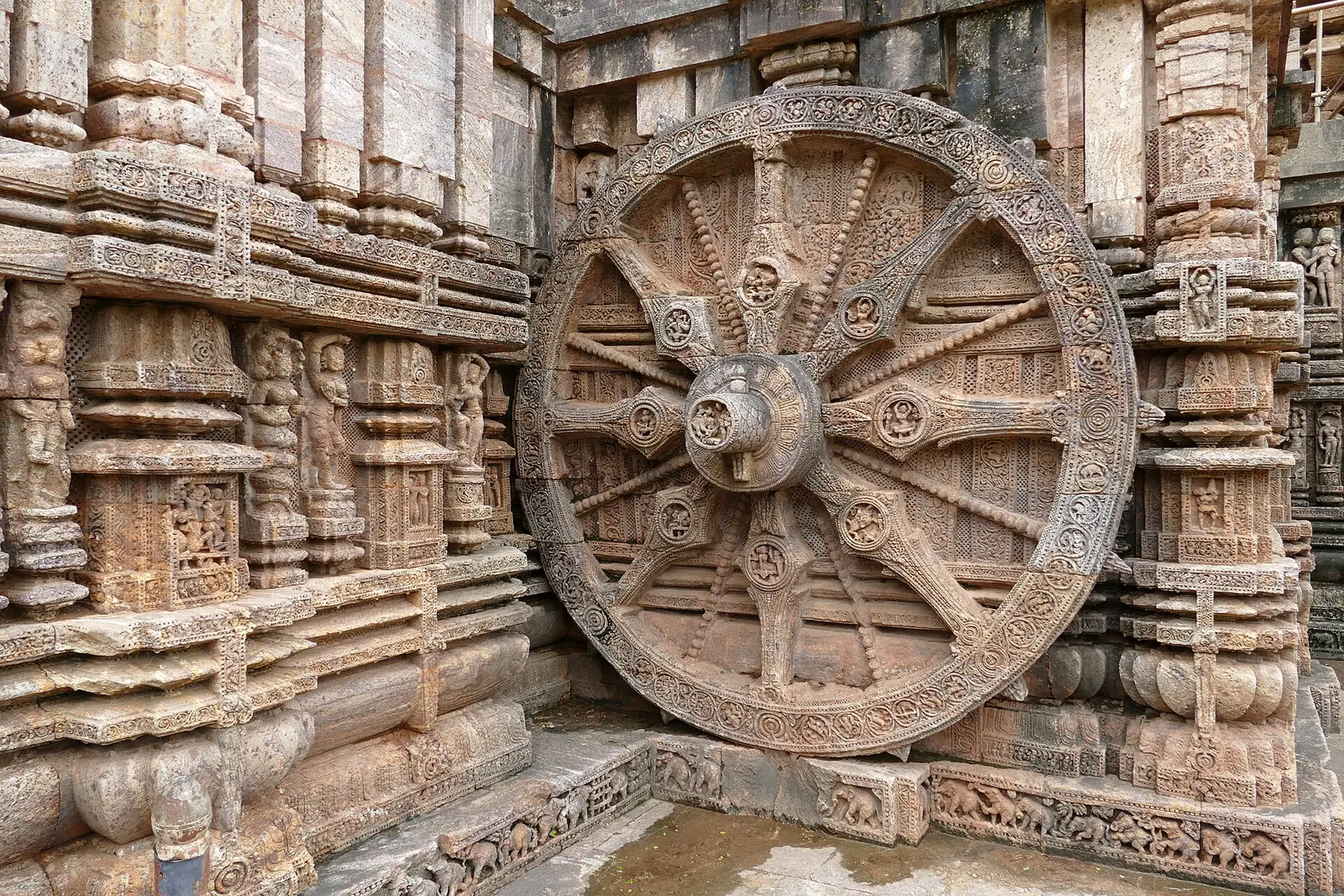
On the shore at Konark the Eastern Ganga king builds Surya’s temple as a stone chariot with twenty-four carved wheels drawn by seven horses. The wheels work as sundials to this day.
- c. 1262 CE
Rudrama Devi rules the Kakatiya kingdomPolity
Ganapati Deva’s daughter Rudrama Devi takes up the Kakatiya throne at Warangal and rules in her own name. She beats back the Seuna Yadavas and holds the kingdom together for about a quarter century.
- 1268 CE
Chennakeshava temple at Somanathapura consecratedCulture
Somanatha, a general of the Hoysala king Narasimha III, consecrates the star-shaped Keshava temple at Somanathapura near the Kaveri. It is the most complete Hoysala temple standing.
- 1270 CE (traditional)
Sant Namdev born at NarsiFaith
Namdev, the tailor-saint of the Varkari path, is born at Narsi in Marathwada. His abhangas to Vitthal of Pandharpur are sung in Maharashtra, and sixty-one of his hymns sit in the Guru Granth Sahib.
- 1289 CE
Rudrama Devi falls; Prataparudra succeedsPolity
The Chandupatla inscription records Rudrama Devi’s death in 1289, apparently in battle against the rebel chief Ambadeva. Her grandson Prataparudra becomes the last great Kakatiya king.
- 1290 CE
Dnyaneshwari completed at NevasaFaith
At Nevasa on the Pravara, the young Jnaneshwar completes his Marathi commentary on the Bhagavad Gita in Shaka 1212. The Dnyaneshwari opened the Gita to every Marathi household.
- 1296 CE
Jnaneshwar takes sanjeevan samadhi at AlandiFaith
At twenty-one, Sant Jnaneshwar enters sanjeevan samadhi at Alandi on the Indrayani. Every year the Varkari palkhi to Pandharpur sets out from his samadhi.
- 1296 CE
Alauddin Khalji raids DevagiriWar
Alauddin, then governor of Kara, makes a surprise raid on Devagiri, capital of the Seuna Yadava king Ramachandra, and forces a heavy ransom. The gold pays for his seizure of the Delhi throne the same year.
- 1299 CE
Somnath sacked by Alauddin’s generalsWar
Ulugh Khan and Nusrat Khan overrun Gujarat; the Vaghela king Karna flees, and the temple of Somnath is sacked and its linga carried to Delhi. Amir Khusrau describes the raid in his Khazain-ul-Futuh.
- 1301 CE
Ranthambore falls; Hammir Dev dies fightingResistance
After a long siege, Ranthambore falls to Alauddin Khalji. Hammir Dev Chauhan, who had refused to hand over Mongol refugees he had sheltered, dies sword in hand and the women of the fort perform jauhar. Nayachandra Suri’s Hammira Mahakavya tells his story.
- 26 August 1303
Chittorgarh falls to Alauddin KhaljiResistance
After about eight months of siege Chittor falls. Amir Khusrau, in the Sultan’s camp, gives the date and says some 30,000 people were then killed; Rawal Ratan Singh falls, and Jayasi’s Padmavat (1540) keeps the memory of Rani Padmini’s jauhar.
- 1310 CE
Malik Kafur besieges WarangalWar
Alauddin’s general Malik Kafur lays siege to the Kakatiya capital. Prataparudra saves his kingdom by paying a huge tribute in elephants, horses and treasure and agreeing to send yearly payment to Delhi.
- 1311 CE
Malik Kafur raids Dwarasamudra and MaduraiWar
Kafur forces the Hoysala king Ballala III to submit at Dwarasamudra and pushes into the Pandya country as far as Madurai. Amir Khusrau describes the plunder of a golden temple at ‘Bramastpuri’, usually identified with Chidambaram.
- 1311 CE
Jalore falls; Kanhadadeva dies fightingResistance
The Chauhan king Kanhadadeva of Jalore, who had harried the army returning from Somnath, is besieged and killed with his son Viramade. Padmanabha’s Kanhadade Prabandha (1455) tells of their stand.
- 1318 CE
Devagiri annexed; last Seuna Yadava killedWar
Harapaladeva, who had risen against Delhi, is defeated by Mubarak Shah Khalji and put to death. The Seuna Yadava kingdom of Devagiri ends.
- c. 1320 CE
Lal Ded, the Shaiva poet-saint of KashmirFaith
Lalleshwari, Lal Ded, is born near Srinagar. Her vakhs on Shiva, sung in Kashmiri, are still on the lips of Kashmiris of every faith.
- 1323 CE
Warangal falls; the Kakatiya kingdom endsWar
Ulugh Khan, the future Muhammad bin Tughluq, takes Warangal at his second attempt and renames it Sultanpur. Prataparudra is taken captive towards Delhi; Telugu records say he gave up his life on the banks of the Narmada.
- c. 1323 CE
Srirangam’s Namperumal carried away to safetyResistance
As the Delhi army nears Srirangam, Pillai Lokacharya leads the utsava murti of Ranganatha out of the temple and into nearly five decades of wandering. The temple chronicle Koil Olugu says some 12,000 Srivaishnavas died defending the shrine.
- c. 1326 CE
Rana Hammir wins back ChittorResistance
Hammir of the Sisodia branch recovers Chittorgarh from the governors left by Delhi and takes the title of Rana. Every later Maharana of Mewar descends from him.
- 1327 CE
Muhammad bin Tughluq moves his capital to DaulatabadPolity
The Sultan orders Delhi’s people to move to Devagiri, renamed Daulatabad, to rule the south. The march costs many lives, and within a few years the court returns north.
- c. 1336 CE
Musunuri Nayakas free WarangalResistance
Kaapaya Nayaka of the Musunuri family, with a league of Telugu chiefs, drives the Tughluq governor out of Warangal. The Kaluvacheru grant of Anitalli praises the Nayakas for restoring the land.
- 18 April 1336
Vijayanagara founded on the TungabhadraPolity
Harihara and Bukka, sons of Sangama, found Vijayanagara on the south bank of the Tungabhadra with the blessing of Vidyaranya of Sringeri. 18 April 1336 is the date traditionally given; the empire held the south for over two centuries.
- 1339 CE
Kota Rani falls; Shah Mir takes KashmirPolity
Kota Rani, the last Hindu ruler of Kashmir, is overthrown by her minister Shah Mir, who founds a sultanate. Jonaraja’s continuation of the Rajatarangini records her end.
- c. 1340–1425 CE
Madhava of Sangamagrama, founder of the Kerala schoolScience
Madhava of Sangamagrama, near Irinjalakuda, works out infinite series for sine, cosine and pi. His pupils’ pupils carried the Kerala school of mathematics and astronomy for two hundred years.
- 1343 CE
Hoysala Ballala III killed near TiruchirappalliWar
The aged Hoysala king, who had spent his last years fighting the Madurai Sultanate, is captured and killed after a battle near Tiruchirappalli. His lands soon pass to Vijayanagara.
- 1347 CE
Bahmani Sultanate founded at GulbargaPolity
Rebel nobles of the Deccan break from Muhammad bin Tughluq and crown Hasan Gangu as Alauddin Bahman Shah. For 180 years the Bahmanis and Vijayanagara fight over the Raichur doab.
- 1350 CE
Namdev’s samadhi at PandharpurFaith
Sant Namdev passes away at Pandharpur. Tradition places his samadhi at the first step of the Vitthal temple, so that every devotee’s feet may touch it.
- 1360 CE
Firuz Shah Tughluq raids PuriWar
Firuz Shah marches into Odisha and attacks the temple of Jagannath at Puri. The Sirat-i-Firuz Shahi boasts that the images were broken and thrown into the sea; the worship went on and the Gajapatis restored it.
- c. 1371 CE
Kumara Kampana ends the Madurai SultanateResistance
Bukka I’s son Kumara Kampana marches south and defeats the Sultan of Madurai. His queen Gangadevi tells the campaign in her Sanskrit poem Madhura Vijayam, and the Meenakshi temple returns to worship.
- 1371 CE
Namperumal returns to SrirangamRenewal
After nearly fifty years away, the utsava murti of Ranganatha is brought back to Srirangam by Gopanna, a Vijayanagara commander. Sanskrit verses carved on the temple wall record the return.
- 1398 CE (traditional)
Sant Kabir born at KashiFaith
Kabir, the weaver-poet of Kashi, is born; the Kabir Panth gives the year as 1398. His dohas on Ram and the inner path entered the Guru Granth Sahib and every Hindi schoolbook.
- 17 December 1398
Timur defeats the Delhi army; Delhi sackedWar
Timur routs Sultan Nasiruddin Mahmud Tughluq outside Delhi. In the days that follow his army sacks the city; his own memoirs speak of the massacre of tens of thousands of captives.
- January 1399
Timur attacks pilgrims at HaridwarWar
On his way out of Bharat, Timur falls on the Hindus gathered at Kupila, the gorge where the Ganga leaves the hills at Haridwar. Sharafuddin Ali Yazdi’s Zafarnama records the slaughter.
- reign of Sikandar, 1389–1413
Martand Sun Temple destroyed in KashmirWar
Under Sultan Sikandar of Kashmir, called Butshikan, the great Sun temple of Lalitaditya at Martand is pulled down along with many others. Jonaraja’s Rajatarangini records the destruction; the ruins still stand on the plateau above Mattan.
- 1408 CE
Annamacharya born at TallapakaFaith
Annamacharya, the first great composer of Telugu kirtanas, is born at Tallapaka. Tradition credits him with 32,000 songs to Venkateswara of Tirumala, many preserved on copper plates.
- c. 1414 CE
Narsinh Mehta born at TalajaFaith
Narsinh Mehta, the first poet of Gujarati, is born. His bhajan Vaishnav jan to tene kahiye became Gandhiji’s favourite hymn.
- 1420s
Zain-ul-Abidin recalls the Pandits to KashmirRenewal
Sultan Zain-ul-Abidin, called Budshah, ends the persecution of his father’s time, invites the Pandits back and lets temples be repaired. Jonaraja and Shrivara record his reign.
- 1434 CE
Kapilendra Deva founds the Gajapati linePolity
Kapilendra Deva takes the throne of Odisha and founds the Suryavamsi Gajapati dynasty, which at its height held land from the Ganga to the Kaveri. The Gajapatis ruled as servants of Jagannath.
- 1437 CE
Rana Kumbha defeats Mahmud Khalji at SarangpurResistance
Maharana Kumbha of Mewar defeats the Sultan of Malwa at Sarangpur and, by Mewar’s account, holds him captive at Chittor before releasing him.
- 1443 CE
Abdur Razzaq describes VijayanagaraCulture
The Persian envoy Abdur Razzaq visits the court of Devaraya II and writes that the eye had never seen a city like Vijayanagara, with seven rings of walls.
- 1443–58 CE
Kumbhalgarh fort raised by Rana KumbhaCulture
Work begins on Kumbhalgarh in the Aravallis, designed by the architect Mandan. Its wall runs some 36 km over the ridges, and Maharana Pratap was born inside it.
- 14 June 1444
Nilakantha Somayaji born in KeralaScience
The astronomer of the Kerala school is born; he himself gives his birth as Kali-day 16,60,181. His Tantrasangraha of 1500 revises the model of the planets’ motion handed down from Aryabhata.
- 1448 CE
Vijay Stambh completed at ChittorgarhCulture
Rana Kumbha completes the nine-storey Vijay Stambh at Chittor to mark his victories over Malwa and Gujarat. Its walls carry images of Vishnu, Shiva and the Devi from base to crown.
- 1449 CE
Srimanta Sankardev born in AssamFaith
Sankardev is born at Alipukhuri near Bordowa in Nagaon. His Ek Sharan Naam Dharma, his namghars and his Ankiya Naat plays shaped Assamese life.
- 15 April 1469
Guru Nanak born at TalwandiFaith
Guru Nanak Dev is born at Rai Bhoi di Talwandi, now Nankana Sahib. The date 15 April 1469 comes from the early janamsakhis; the Sikh panth celebrates his Prakash Purab on Kartik Purnima.
- 1473 CE
Mahmud Begada sacks DwarkaWar
Sultan Mahmud Begada of Gujarat, having taken Girnar from Ra Mandalika, raids Dwarka and destroys its temples. The Mirat-i-Sikandari records the raid; worship returned and the Dwarkadhish temple stands rebuilt.
- c. 1478 CE
Surdas, the blind poet of BrajFaith
Surdas is born near Delhi; most accounts give 1478. As a disciple of Vallabhacharya he sang the Sursagar, the child Krishna’s leela in Braj bhasha.
- 1479 CE
Vallabhacharya born at ChamparanFaith
Vallabhacharya, teacher of Shuddhadvaita and the Pushti Marg, is born at Champaran near Raipur to a Telugu family on pilgrimage. Shrinathji’s seva follows his rules.
- 1484 CE
Purandara Dasa bornFaith
Srinivasa Nayaka, a rich merchant who would become Purandara Dasa, is born near Tirthahalli. He set the graded lessons every Carnatic music student still begins with.
- 18 February 1486
Chaitanya Mahaprabhu born at NabadwipFaith
Vishvambhar Mishra, later Chaitanya Mahaprabhu, is born at Nabadwip on Phalguna Purnima during a lunar eclipse. His sankirtan of Hari’s names spread from Bengal to Odisha and Vrindavan.
- c. 1498 CE
Meerabai born at Kudki, MarwarFaith
Meera, daughter of the Rathore house of Merta, is born at Kudki. Her padas to Giridhar Gopal are sung across Bharat.
- 20 May 1498
Vasco da Gama lands near CalicutPolity
The Portuguese fleet of Vasco da Gama anchors off Kappad near Calicut, the port of the Zamorin. European sea power in the Indian Ocean begins here.
- c. 1500 (reign 1489–1517)
Sikandar Lodi destroys temples at MathuraWar
Sultan Sikandar Lodi orders temples at Mathura pulled down and forbids Hindus to bathe at its ghats or shave their heads there, as Abdullah’s Tarikh-i-Daudi records.
- 1500–01 CE
Nilakantha Somayaji completes the TantrasangrahaScience
Nilakantha Somayaji of Trikkantiyur finishes the Tantrasangraha, a work of astronomy that revises planetary models of the Kerala school of Madhava.
- 1509 CE
Krishnadevaraya crowned at VijayanagaraPolity
Krishnadevaraya of the Tuluva line takes the throne. Over twenty years he wins back Raichur, humbles the Gajapatis and writes the Telugu poem Amuktamalyada about Andal.
- 1509 CE
Kanakadasa born at BadaFaith
Kanakadasa, a Kuruba chieftain who became a Haridasa poet, is born at Bada in Haveri. At Udupi the window through which Krishna is said to have turned to give him darshan is still called the Kanakana Kindi.
- 1510 CE
Chaitanya takes sannyasa and settles at PuriFaith
Having taken sannyasa at Katwa, Chaitanya goes to Puri, where he spends most of his remaining years before Jagannath. Gajapati Prataparudra becomes his devotee.
- 25 November 1510
Portuguese seize Goa from BijapurPolity
Afonso de Albuquerque takes Goa at the second attempt. It becomes the capital of Portuguese Asia and stays under Lisbon for 451 years.
- 1516 CE
Krishnadevaraya’s victory pillar at SimhachalamWar
Pressing his Kalinga campaign against the Gajapatis, Krishnadevaraya reaches Simhachalam and records his victories there. Peace is sealed by his marriage to the Gajapati princess.
- 1517–18 CE
Rana Sanga defeats Ibrahim Lodi at KhatoliResistance
Maharana Sangram Singh of Mewar routs the Delhi Sultan’s army at Khatoli near Kota; he loses an arm in the fight. Mewar now stands as the strongest power of the north.
- 1520 CE
Battle of Raichur won by KrishnadevarayaWar
Krishnadevaraya defeats Ismail Adil Shah of Bijapur and takes Raichur fort. The Portuguese chronicler Fernão Nunes gives a long account of the battle.
- 21 April 1526
First Battle of Panipat; Babur takes DelhiWar
Babur’s guns and cavalry crush Ibrahim Lodi at Panipat; the Sultan dies on the field. The Delhi Sultanate ends and Mughal rule begins.
11 · The Mughal era and the resistance1526–1707 CE
- 16 March 1527
Battle of Khanwa: Rana Sanga against BaburResistance
Rana Sanga leads a great Rajput confederacy against Babur at Khanwa near Fatehpur Sikri. Babur’s guns and a late flank attack break the Rajput lines; the wounded Rana is carried from the field.
- January 1528
Chanderi falls; Medini Rai’s last standResistance
Babur storms Chanderi, held by Medini Rai, Rana Sanga’s ally. The garrison fights to the end and the women perform jauhar, as Babur himself records in the Baburnama.
- 1528 CE
Mosque raised at Ram Janmabhoomi, AyodhyaWar
Mir Baqi, a commander of Babur, builds a mosque at the Ram Janmabhoomi in Ayodhya; its inscriptions named Babur. The ASI excavation of 2003, accepted by the Supreme Court in 2019, found a large structure beneath it that was not Islamic.
- 30 January 1528
Rana Sanga dies at KalpiResistance
Preparing to fight Babur again, Rana Sanga dies in camp at Kalpi; Mewar tradition holds that nobles who wanted no new war poisoned him. He bore eighty wounds and had lost an eye and an arm in battle.
- 26 December 1530
Babur dies; Humayun succeedsPolity
Babur dies at Agra, four years after Panipat. His son Humayun will lose the empire to Sher Shah Suri within a decade.
- 1532 CE (common reckoning)
Goswami Tulsidas born at RajapurFaith
Tulsidas is born at Rajapur on the Yamuna, in the year most accounts give. He grew up in poverty and became the poet of the Ramcharitmanas.
- 1535 CE
Second saka of Chittor; Rani Karnavati’s jauharResistance
Bahadur Shah of Gujarat storms Chittor. Rani Karnavati, widow of Rana Sanga, sends her infant son Udai Singh to safety and leads the jauhar while the men ride out to die.
- 8 March 1535
Chittor falls; Rani Karnavati leads the second jauharWar
Bahadur Shah of Gujarat takes Chittor after a long siege. Rani Karnavati, widow of Rana Sanga and regent for her young son, leads the women of the fort into the fire while the men ride out to fight to the last.
- 1540 CE
Jayasi completes the PadmavatCulture
Malik Muhammad Jayasi of Jais writes the Awadhi poem Padmavat, telling of Rani Padmini of Chittor and Alauddin Khalji’s siege.
- 9 May 1540
Maharana Pratap born at KumbhalgarhResistance
Pratap Singh, eldest son of Udai Singh II, is born in Kumbhalgarh fort. Mewar celebrates Pratap Jayanti by the Hindu calendar on Jyeshtha Shukla Tritiya.
- c. 1555 CE
Rani Abbakka beats back the Portuguese at UllalResistance
Abbakka Chowta, the Jain queen of Ullal near Mangaluru, refuses tribute to the Portuguese and drives off their fleet. For years she fought them with Bunt and Mappila allies, and the Zamorin’s help.
- 27 January 1556
Humayun dies after a fall in DelhiPolity
Humayun slips on the stairs of his library and dies three days later, leaving the thirteen-year-old Akbar. The confusion opens the way for Hemu’s march on Delhi that year.
- 7 October 1556
Hemu crowned Vikramaditya at DelhiResistance
Hemu, the Sur general who had won twenty-two battles, takes Delhi after defeating the Mughal governor Tardi Beg Khan and is crowned with the title Vikramaditya at Purana Qila.
- 5 November 1556
Second Battle of Panipat; Hemu fallsWar
Hemu is winning at Panipat when an arrow strikes his eye; his army breaks and he is captured and beheaded. The thirteen-year-old Akbar’s rule is saved.
- 1560 CE
Inquisition set up in GoaFaith
The Portuguese Inquisition begins work in Goa. Over the next two centuries it bans Hindu rites in Portuguese territory and tries thousands; many families carried their kuldevatas across the border to Ponda.
- 24 June 1564
Rani Durgavati dies fighting at NarraiResistance
The Gond queen of Garha-Katanga, wounded by arrows in battle against Akbar’s general Asaf Khan near Jabalpur, takes her own life rather than be captured. The day is kept as her Balidan Diwas.
- January 1565
Talikota: Vijayanagara falls, Hampi sackedWar
The four Deccan sultanates combine to defeat Vijayanagara near Talikota; Aliya Rama Raya is captured and beheaded. For about five months the city is plundered and its temples broken; the ruins of Hampi still show the damage.
- 1565 CE
Koch king Naranarayan rebuilds KamakhyaRenewal
Naranarayan of Cooch Behar and his brother Chilarai rebuild the Kamakhya temple on Nilachal hill after its destruction. A stone inscription in the temple records the work in Shaka 1487.
- 1568 CE
Srimanta Sankardev passes away at Cooch BeharFaith
Sankardev, about 119 years old by the traditional count, passes away at Bheladonga in Cooch Behar. His disciple Madhavdev carries on the Ek Sharan movement.
- 23 February 1568
Third saka of Chittor; Jaimal and Patta fallResistance
After a four-month siege Akbar takes Chittor. Jaimal Rathore and Patta Chundawat die leading the defence, the women perform jauhar, and Akbar orders a massacre of some 30,000 people of the fort.
- 1572 CE
Pratap becomes Maharana at GogundaResistance
On Udai Singh’s death the nobles of Mewar set aside his chosen heir and raise Pratap to the gaddi at Gogunda. He vows never to bow to Akbar.
- 1574 CE
Tulsidas begins the RamcharitmanasFaith
At Ayodhya on Ram Navami of Samvat 1631, Tulsidas begins the Ramcharitmanas in Awadhi, as he says in the Balkand. He completed it at Kashi.
- 18 June 1576
Battle of HaldighatiResistance
Maharana Pratap meets the Mughal army under Raja Man Singh in the pass of Haldighati. Hakim Khan Sur and the Bhil archers of Rana Punja fight beside him; the wounded Chetak carries the Maharana to safety, and Mewar fights on from the hills.
- 1577 CE
Guru Ram Das founds Ramdaspur, later AmritsarFaith
The fourth Sikh Guru begins digging the sarovar around which the town of Ramdaspur grows. The town is today’s Amritsar.
- 1582 CE
Pratap wins at Dewair and frees most of MewarResistance
Maharana Pratap and his son Amar Singh overwhelm the Mughal post at Dewair. Over the following years he wins back most of Mewar except Chittor and Mandalgarh.
- 1590 CE
Govind Dev temple raised at VrindavanRenewal
Raja Man Singh of Amber builds the red sandstone temple of Govind Dev at Vrindavan, then one of the tallest temples of the north. Its upper storeys were later pulled down under Aurangzeb, and the murti was taken to Jaipur.
- 19 January 1597
Maharana Pratap dies at ChavandResistance
Maharana Pratap dies at his hill capital of Chavand, never having submitted to Akbar. His cenotaph stands at Bandoli nearby.
- 1599 CE
Sant Eknath takes jal samadhi at PaithanFaith
Eknath, who wrote the Eknathi Bhagavat and restored the text of the Dnyaneshwari, takes samadhi in the Godavari at Paithan.
- 31 December 1600
East India Company chartered in LondonPolity
Queen Elizabeth I grants a charter to the Governor and Company of Merchants of London trading into the East Indies. The trading company will rule Bharat within two centuries.
- 1604 CE
Adi Granth installed in the Harmandir SahibFaith
Guru Arjan Dev compiles the Adi Granth, with the hymns of the Gurus and of Kabir, Namdev, Ravidas and other bhagats, and installs it in the Harmandir Sahib at Amritsar.
- 30 May 1606
Guru Arjan Dev martyred at LahoreFaith
On Jahangir’s orders, recorded in his own memoir, the fifth Sikh Guru is tortured and put to death at Lahore. His martyrdom set the Sikh panth on the path of the sword.
- 1610 CE
Raja Wodeyar takes Srirangapatna; Mysore Dasara beginsPolity
Raja Wodeyar I takes Srirangapatna from the Vijayanagara viceroy and carries on the Navaratri festival of the Vijayanagara kings. The Mysore Dasara has been held ever since.
- 1615 CE
Mewar makes peace with JahangirPolity
Worn down by years of war, Maharana Amar Singh I makes terms with Prince Khurram. Mewar keeps its land, and the Maharana is excused from attending the Mughal court in person.
- 1 April 1621
Guru Tegh Bahadur born at AmritsarFaith
Tyag Mal, youngest son of Guru Hargobind, is born at Amritsar. Named Tegh Bahadur for his courage in battle at Kartarpur, he became the ninth Guru.
- 19 February 1630
Shivaji born at ShivneriResistance
Shivaji, son of Shahaji Bhonsle and Jijabai, is born in Shivneri fort near Junnar. The Maharashtra government keeps 19 February 1630 as his birth date; many still mark his jayanti by the tithi, Phalguna Vadya Tritiya.
- 1632 CE
Shah Jahan orders new temples demolishedWar
Shah Jahan orders that temples begun in his father’s reign be pulled down. Abdul Hamid Lahori’s Badshahnama records that 76 temples were demolished in the district of Benares alone.
- 22 August 1639
Company gets the Madras stripPolity
Francis Day of the East India Company obtains a strip of coast from the Nayaka of the area, under the Vijayanagara king. Fort St George rises there, and Chennai keeps the date as Madras Day.
- 1646 CE
Shivaji takes Torna, the first fort of SwarajyaResistance
At sixteen, Shivaji takes Torna fort from Bijapur. Treasure found there pays for the building of Rajgad, his first capital.
- 1650 CE
Sant Tukaram’s vaikunthagaman at DehuFaith
Sant Tukaram, whose abhangas the Varkaris sing on the road to Pandharpur, departs from Dehu on Phalguna Vadya Dwitiya. Devotees keep the day as Tukaram Beej.
- 10 November 1659
Shivaji kills Afzal Khan at PratapgadResistance
Bijapur sends Afzal Khan, who had defiled the temples of Tuljapur and Pandharpur on his way, to crush Shivaji. At their meeting below Pratapgad, Afzal Khan strikes first; Shivaji kills him with the wagh-nakh and his army is routed.
- 13 July 1660
Baji Prabhu holds Ghod KhindResistance
As Shivaji escapes from the siege of Panhala to Vishalgad, Baji Prabhu Deshpande holds the narrow pass with a few hundred Bandal men until the guns at Vishalgad announce his king’s safe arrival. The pass has been called Pavan Khind ever since.
- 5 April 1663
Shivaji’s night raid on Shaista KhanResistance
Shivaji slips into Lal Mahal in Pune, where the Mughal general Shaista Khan has camped for three years, and attacks him at night. Shaista Khan escapes with the loss of his fingers and is soon recalled.
- 11 June 1665
Treaty of PurandarPolity
Hard-pressed by Mirza Raja Jai Singh, Shivaji cedes 23 forts to the Mughals and agrees to visit Aurangzeb’s court.
- 17 August 1666
Shivaji escapes from AgraResistance
Held under house arrest after being insulted at Aurangzeb’s court, Shivaji and his son Sambhaji escape, by the common account hidden in baskets of sweets. He is back in the Deccan within weeks.
- 22 December 1666
Guru Gobind Singh born at PatnaFaith
Gobind Rai, son of Guru Tegh Bahadur and Mata Gujri, is born at Patna. Takht Sri Patna Sahib stands at his birthplace.
- 9 April 1669
Aurangzeb orders temples and schools demolishedWar
Saqi Mustaid Khan’s Maasir-i-Alamgiri records that the emperor ordered governors in all provinces to demolish the schools and temples of the infidels and put down their teaching and worship.
- 2 September 1669
Kashi Vishwanath temple demolishedWar
The Maasir-i-Alamgiri records the report that, on the emperor’s order, the temple of Vishwanath at Kashi had been demolished. The Gyanvapi mosque was raised on its plinth, and the old temple wall still stands in its rear.
- January–February 1670
Keshav Dev temple at Mathura demolishedWar
In the month of Ramzan, the Maasir-i-Alamgiri records, the great Keshav Dev temple built by Bir Singh Deo Bundela at Mathura was destroyed and a mosque built on its site; its images were buried under the steps of the Jahanara mosque at Agra.
- 4 February 1670
Tanaji Malusare takes Kondhana and fallsResistance
Tanaji Malusare scales the cliffs of Kondhana by night and wins the fort but dies in single combat with Udaybhan. Shivaji is said to have mourned, ‘Gad ala pan simha gela’, the fort is won but the lion is gone; it has been Sinhagad since.
- 3 October 1670
Shivaji strikes Surat a second timeWar
Some fifteen thousand Maratha horse enter the Mughal port and take its treasure over three days, sparing the European factories.
- March 1671
Battle of Saraighat on the BrahmaputraResistance
Lachit Borphukan, gravely ill, leads the Ahom boats against Raja Ram Singh’s Mughal fleet at Saraighat near Guwahati and wins. The Mughals never conquered Assam.
- 1671 CE
Chhatrasal raises Bundelkhand against the MughalsResistance
Chhatrasal Bundela, after meeting Shivaji, begins his war for Bundelkhand with a few horsemen. He went on to rule from Panna for half a century.
- 1672 CE
Shrinathji installed at NathdwaraFaith
Carried out of Govardhan to save the murti from destruction, Shrinathji’s chariot wheels sink at Sinhad in Mewar; Maharana Raj Singh gives shelter, and the haveli of Nathdwara is built there.
- 25 April 1672
Lachit Borphukan dies at KaliaborResistance
The victor of Saraighat dies about a year after the battle. His maidam stands at Hoolungapara near Jorhat, and Assam keeps 24 November as Lachit Divas.
- 6 June 1674
Shivaji crowned Chhatrapati at RaigadPolity
Gaga Bhatt of Kashi performs the coronation of Shivaji at Raigad. He takes the title Chhatrapati, starts the Rajyabhisheka Shaka era and has the Rajavyavahara Kosha prepared to replace Persian terms of state.
- 17 June 1674
Rajmata Jijabai passes away at PachadPolity
Eleven days after seeing her son crowned Chhatrapati at Raigad, Jijabai dies at Pachad below the fort.
- 11 November 1675
Guru Tegh Bahadur martyred at DelhiFaith
The ninth Guru, who had taken up the cause of Kashmiri Pandits facing forced conversion, is beheaded at Chandni Chowk on Aurangzeb’s order. Gurdwara Sis Ganj marks the spot; he is remembered as Hind di Chadar.
- 1676 CE
Maratha rule begins at ThanjavurPolity
Ekoji (Venkoji), Shivaji’s half-brother, takes Thanjavur and founds the Maratha line there. His successors made Thanjavur a seat of music and learning; the Saraswati Mahal library holds their collection.
- 1679 CE
Durgadas Rathore rescues the infant Ajit SinghResistance
When Aurangzeb tries to take Marwar after Maharaja Jaswant Singh’s death, Durgadas Rathore smuggles the infant heir Ajit Singh out of Delhi. The Rathores fight on for nearly thirty years until Ajit Singh takes Jodhpur in 1707.
- 2 April 1679
Aurangzeb reimposes the jizyaPolity
The Maasir-i-Alamgiri records the emperor’s order reimposing the jizya, a poll tax on non-Muslims that Akbar had abolished a century earlier.
- 3 April 1680
Chhatrapati Shivaji dies at RaigadPolity
Shivaji Maharaj dies at Raigad after a short illness, aged about fifty. He leaves a kingdom of some 300 forts and a navy on the western coast.
- 16 January 1681
Sambhaji crowned at RaigadPolity
Sambhaji is crowned Chhatrapati. For nine years he fights the Mughals, Siddis and Portuguese at once, while Aurangzeb moves his whole court to the Deccan.
- 1682 CE
Ahoms drive the Mughals out of GuwahatiResistance
Under Gadadhar Singha the Ahoms defeat the Mughals at Itakhuli and take back Guwahati for good. The Manas river becomes the frontier.
- 1682 CE
Samarth Ramdas passes away at SajjangadFaith
Samarth Ramdas, author of the Dasbodh and the Manache Shlok, who founded Hanuman maths across Maharashtra, passes away at Sajjangad near Satara.
- 3 November 1688
Sawai Jai Singh II born at AmberPolity
The Kachwaha king who founds Jaipur and builds the Jantar Mantar observatories at Delhi, Jaipur, Ujjain, Varanasi and Mathura is born.
- 1689 CE
Rajaram escapes to Jinji; Keladi Chennamma shelters himResistance
With Raigad besieged, Sambhaji’s brother Rajaram slips south. Rani Chennamma of Keladi gives him passage in defiance of Aurangzeb, and from Jinji fort he keeps the Maratha state alive for eight years.
- 11 March 1689
Sambhaji executed at TulapurResistance
Captured at Sangameshwar, Chhatrapati Sambhaji is tortured for weeks and put to death at Tulapur on the Bhima after refusing to give up his forts or his faith. His samadhi stands at Vadhu Budruk.
- 24 August 1690
Job Charnock settles at SutanutiPolity
The Company agent Job Charnock returns to Sutanuti on the Hooghly; with Kalikata and Gobindapur it grew into Calcutta, capital of British India until 1911.
- Vaisakhi 1699
Guru Gobind Singh creates the KhalsaFaith
At Anandpur on Vaisakhi, Guru Gobind Singh calls for heads; five men offer themselves and become the Panj Pyare, the first of the Khalsa, initiated with khande di pahul.
- 1700 CE
Tarabai leads the Marathas after RajaramResistance
When Chhatrapati Rajaram dies at Sinhagad, his widow Tarabai rules in her young son’s name and carries the war into Mughal territory. Khafi Khan, a Mughal historian, credits her with keeping the Marathas fighting.
- December 1704
The four Sahibzade fall at Chamkaur and SirhindFaith
The elder sons of Guru Gobind Singh, Ajit Singh and Jujhar Singh, die fighting at Chamkaur. The younger, Zorawar Singh and Fateh Singh, aged nine and six, are bricked in and executed at Sirhind for refusing to convert; Bharat marks Veer Bal Diwas on 26 December.
- 3 March 1707
Aurangzeb dies at AhmednagarPolity
After twenty-six years trying to crush the Marathas in the Deccan, Aurangzeb dies at Ahmednagar aged eighty-eight. The empire begins to come apart within a decade.
12 · Maratha ascendancy and the Sikh empire1707–1818 CE
- 12 January 1708
Shahu crowned Chhatrapati at SataraPolity
Released by the Mughals after Aurangzeb’s death, Sambhaji’s son Shahu wins over most Maratha chiefs and is crowned at Satara. Tarabai’s line later rules from Kolhapur.
- 7 October 1708
Guru Gobind Singh passes; the Granth becomes GuruFaith
Wounded by an assassin at Nanded, Guru Gobind Singh passes away after declaring the Granth Sahib the everlasting Guru of the Sikhs. Takht Sachkhand Hazur Sahib stands at the place.
- 12 May 1710
Banda Singh Bahadur wins at Chappar ChiriResistance
Banda Singh Bahadur, sent to Punjab by Guru Gobind Singh, defeats Wazir Khan of Sirhind, the man who had the young Sahibzade killed. Two days later Sirhind falls, and Banda strikes coins in the Gurus’ name at Lohgarh.
- 17 November 1713
Balaji Vishwanath becomes PeshwaPolity
Shahu appoints Balaji Vishwanath Bhat his Peshwa. In 1719 Balaji marches to Delhi and brings back Mughal grants recognising Maratha rights to chauth and sardeshmukhi across the Deccan.
- 9 June 1716
Banda Singh Bahadur executed at DelhiResistance
Captured after the siege of Gurdas Nangal, Banda Singh is paraded through Delhi with hundreds of Sikhs, who are beheaded day after day. Refusing to convert, he is tortured to death near the Qutb Minar.
- 17 April 1720
Bajirao I becomes PeshwaPolity
At twenty, Bajirao succeeds his father as Peshwa. In twenty years of campaigning he never lost a battle and carried Maratha power from the Deccan to the gates of Delhi.
- 1721 CE
Kanhoji Angre beats off an Anglo-Portuguese attackResistance
The Maratha admiral Kanhoji Angre repels a combined British and Portuguese attack on his base at Colaba (Alibag). His fleet controlled the Konkan coast until his death in 1729.
- 1724 CE
Sawai Jai Singh builds the Jantar Mantar at DelhiScience
Maharaja Sawai Jai Singh II of Amber raises his first great masonry observatory at Delhi; others follow at Jaipur, Ujjain, Varanasi and Mathura. The Jaipur instrument, the Samrat Yantra, reads time to two seconds.
- 18 November 1727
Jaipur founded by Sawai Jai Singh IICulture
The foundation of Jaipur is laid on a grid plan drawn up with the architect Vidyadhar Bhattacharya, following the Shilpa Shastra. The city is a UNESCO World Heritage Site.
- 28 February 1728
Bajirao traps the Nizam at PalkhedWar
Bajirao draws Nizam-ul-Mulk away from his base by swift marches and corners him in waterless country at Palkhed. The Nizam signs the Treaty of Mungi Shevgaon, accepting Shahu’s rights.
- 1729 CE
Bajirao rescues Chhatrasal in BundelkhandResistance
The aged Chhatrasal, besieged at Jaitpur by Muhammad Khan Bangash, sends Bajirao a call for help; the Peshwa comes and breaks the siege. Chhatrasal gives him a third of his kingdom.
- March–April 1737
Bajirao’s cavalry strikes at DelhiWar
After a forced march round the Mughal armies in the Doab, Peshwa Bajirao I appears outside Delhi, beats the force sent out against him and withdraws. The Mughal court learns the Marathas can reach its gates at will.
- March 1737
Bajirao rides to the gates of DelhiWar
In a lightning raid Bajirao appears outside Delhi, defeats a Mughal force and withdraws. Months later he beats the Nizam at Bhopal, and Malwa passes to the Marathas.
- 7 January 1738
Nizam signs the convention of DorahaWar
Trapped by Bajirao I near Bhopal, the Nizam signs terms at Doraha, promising Malwa to the Marathas and an indemnity from the Mughal court.
- May 1739
Chimaji Appa takes Vasai from the PortugueseWar
After a two-year campaign Bajirao’s brother Chimaji Appa storms Vasai, the Portuguese stronghold north of Bombay, ending their rule over the northern Konkan.
- 22 March 1739
Nadir Shah’s massacre in DelhiWar
After crushing the Mughal army at Karnal, the Persian conqueror Nadir Shah orders a massacre in Delhi in which tens of thousands die. He leaves with the Peacock Throne and the Koh-i-Noor.
- 28 April 1740
Bajirao I dies at RaverkhediPolity
The Peshwa dies of fever in camp at Raverkhedi on the Narmada, aged thirty-nine. His samadhi stands on the river bank.
- 10 August 1741
Marthanda Varma defeats the Dutch at ColachelWar
The Travancore army defeats the Dutch East India Company at Colachel and captures its commander Eustachius De Lannoy, who then serves Travancore for decades. It was the first defeat of a European power by an Indian kingdom.
- January 1750
Thrippadidanam: Travancore given to PadmanabhaFaith
Marthanda Varma lays his sword before Sree Padmanabhaswamy at Thiruvananthapuram and dedicates the kingdom to the deity. From then on the kings ruled as Padmanabha Dasa, servants of the Lord.
- February 1756
Vijaydurg falls; the Angre navy is brokenWar
A British fleet under Watson and Clive, with Peshwa support, takes Vijaydurg (Gheria) from Tulaji Angre and burns his ships. The Maratha navy never recovered.
- March 1757
Ahmad Shah Abdali sacks Mathura and VrindavanWar
Abdali’s army falls on Mathura during the Holi season and on Vrindavan and Gokul, killing pilgrims and sadhus. Naga sadhus fought back at Gokul; contemporary letters describe the Yamuna running red.
- 1758 CE
Maratha flag flies at Attock and PeshawarWar
Raghunathrao and Malhar Rao Holkar drive Abdali’s governors out of Punjab and take Attock and Peshawar. Maratha power reaches the Indus frontier.
- 14 January 1761
Third Battle of PanipatWar
Sadashivrao Bhau’s starving Maratha army attacks Ahmad Shah Abdali at Panipat on Makar Sankranti and is destroyed; Vishwasrao and Bhau fall, and tens of thousands of camp followers are killed or enslaved. Abdali never ruled in Delhi, and the Marathas were back within a decade.
- 5 February 1762
Vadda Ghallughara: the great Sikh massacreResistance
Abdali surprises a Sikh column with its families near Kup, by Malerkotla, and many thousands are killed in a single day. In April he blows up the Harmandir Sahib; the Sikhs rebuild it and within two years take Sirhind and Lahore.
- 25 December 1763
Maharaja Suraj Mal killed near DelhiPolity
The Jat king of Bharatpur, who had sheltered the Maratha survivors of Panipat, is killed in an ambush on the Hindan near Delhi. His forts of Bharatpur and Deeg were never taken by storm in his lifetime.
- 1767 CE
Ahilyabai Holkar takes up the rule of MalwaPolity
After losing her husband, son and father-in-law Malhar Rao, Ahilyabai rules the Holkar state from Maheshwar on the Narmada for twenty-eight years. Her reign is remembered for justice and for temples and ghats from Kedarnath to Rameswaram.
- 4 May 1767
Tyagaraja born at TiruvarurCulture
Tyagaraja, the saint-composer of Carnatic music, is born at Tiruvarur. His kritis to Shri Rama, including the Pancharatna, are sung at his samadhi at Thiruvaiyaru every January.
- 1769 CE
Moamoria rising shakes the Ahom kingdomPolity
The Moamoria Vaishnava followers rise against the Ahom court; the civil war lasts on and off for thirty years and leaves Assam open to Burmese invasion.
- 1771–72
Mahadji Scindia restores Shah Alam to DelhiPolity
Ten years after Panipat, Maratha armies under Mahadji Scindia retake Delhi and escort the emperor Shah Alam II back to his capital. The Marathas now hold the Mughal throne in their hand.
- 22 May 1772
Raja Ram Mohan Roy born at RadhanagarRenewal
The reformer is born in Hooghly district of Bengal. He translates the Upanishads into Bengali and English and campaigns for the abolition of sati.
- 18 November 1772
Peshwa Madhavrao I dies at TheurPolity
Madhavrao I, who rebuilt Maratha power after Panipat, dies of tuberculosis at twenty-seven before the Chintamani Ganesh at Theur. Grant Duff wrote that the plains of Panipat were not more fatal to the Maratha empire than his early end.
- 30 August 1773
Peshwa Narayanrao killed in Shaniwar WadaPolity
On Ganesh Chaturthi the young Peshwa is cut down by Gardi guards inside his palace. His uncle Raghunathrao is held responsible, and the Barbhai council of Nana Phadnavis takes over.
- 24 March 1775
Muthuswami Dikshitar born at TiruvarurCulture
Muthuswami Dikshitar, one of the Trinity of Carnatic music, is born at Tiruvarur. His Sanskrit kritis map the temples of the Tamil country deity by deity.
- 1 March 1776
Treaty of Purandar signedPolity
Nana Phadnavis’ regency at Pune and the Company’s government at Calcutta sign a treaty that drops the Company’s backing of Raghunathrao. Bombay refuses to honour it, and the war goes on.
- January 1779
Marathas force the British to surrender at WadgaonWar
A Bombay army marching on Pune is surrounded by Mahadji Scindia and Nana Phadnavis’s forces near Talegaon and signs the humiliating Convention of Wadgaon.
- c. 1779
Bhagyachandra installs Shri Govindaji in ManipurFaith
Rajarshi Bhagyachandra of Manipur installs the murti of Shri Govindaji at Imphal and gives form to the Manipuri Ras Lila, first performed at his court.
- 1780 CE
Ahilyabai rebuilds Kashi VishwanathRenewal
Ahilyabai Holkar builds the present Kashi Vishwanath temple beside the Gyanvapi site. In 1835 Maharaja Ranjit Singh gilds its spires with about a tonne of gold.
- 1780 CE
Velu Nachiyar wins back SivagangaResistance
Rani Velu Nachiyar, widowed when the Company and the Nawab of Arcot took Sivaganga, returns with Hyder Ali’s help and her own army and retakes her kingdom.
- 13 November 1780
Ranjit Singh born at GujranwalaPolity
Ranjit Singh, son of Maha Singh of the Sukerchakia misl, is born at Gujranwala. Smallpox cost him an eye as a child.
- 17 May 1782
Treaty of Salbai ends the first Anglo-Maratha warPolity
Negotiated through Mahadji Scindia, the treaty restores most territory on both sides and brings twenty years of peace between the Marathas and the Company.
- 1783 CE
Baghel Singh raises the gurdwaras of DelhiFaith
The Sikh misls under Baghel Singh enter Delhi. By agreement with Shah Alam II he stays to mark and build the gurdwaras of the Gurus’ sites, among them Sis Ganj, Rakab Ganj and Bangla Sahib.
- 1783 CE
Ahilyabai builds a new Somnath templeRenewal
Beside the ruined old shrine, Ahilyabai Holkar builds a new temple of Somnath where worship continued until the great temple rose again in 1951. It is still in worship as the Ahilyabai temple.
- March 1795
Last united Maratha victory at KhardaWar
The armies of the Peshwa, Scindia, Holkar, Bhonsle and Gaekwad, under Nana Phadnavis’s direction, defeat the Nizam at Kharda. It was the last time the confederacy fought as one.
- 13 August 1795
Ahilyabai Holkar passes away at MaheshwarFaith
Punyashlok Ahilyabai dies at Maheshwar. Her charities, the ghats, dharmashalas and temples at Kashi, Gaya, Somnath, Dwarka and many more, are still in use.
- 7 July 1799
Ranjit Singh takes LahorePolity
Invited by the city’s people, nineteen-year-old Ranjit Singh enters Lahore. It becomes the capital of the Sikh empire.
- 13 March 1800
Nana Phadnavis dies at PunePolity
The minister who held the Maratha state together for a quarter century dies. Wellesley’s Resident wrote that with him departed all the wisdom and moderation of the Maratha government.
- 12 April 1801
Ranjit Singh proclaimed Maharaja of PunjabPolity
On Vaisakhi at Lahore, Ranjit Singh is proclaimed Maharaja. He strikes coins in the name of the Gurus and rules as head of the Sarkar Khalsa.
- 31 December 1802
Peshwa signs the Treaty of BasseinPolity
Bajirao II, driven from Pune by Yashwantrao Holkar, accepts a subsidiary alliance with the Company at Vasai. Scindia and Bhonsle take up arms against it.
- 23 September 1803
Battle of AssayeWar
Arthur Wellesley’s army defeats the Scindia and Bhonsle forces at Assaye; the Maratha gunners serve their cannon until they are cut down. Wellesley, later the Duke of Wellington, called it the bloodiest thing he ever saw.
- 29 November 1803
Battle of ArgaonWar
Arthur Wellesley defeats the army of Raghuji Bhonsle of Nagpur in Berar. Within weeks the Bhonsle signs the Treaty of Deogaon.
- January–April 1805
Bharatpur holds out against Lord LakeResistance
Four British assaults on the mud walls of Bharatpur fail with heavy loss. The Jat fort earned the name Lohagarh, the iron fort, and stood until 1826.
- 25 April 1809
Treaty of Amritsar fixes the Sutlej frontierPolity
Ranjit Singh and the Company agree that the Sutlej will divide their spheres. He turns his armies west and north.
- 2 December 1815
Treaty of Sugauli signedPolity
After the Anglo-Nepal war, Nepal agrees to give up Kumaon, Garhwal and the Terai lands to the Company. It is ratified in March 1816.
- 13 June 1817
Treaty of Poona humbles Bajirao IIPolity
Under pressure from Mountstuart Elphinstone, the Peshwa gives up his claim to lead the Maratha confederacy and cedes forts and territory. He takes up arms against the Company in November.
- 21 December 1817
Battle of Mahidpur breaks the HolkarsWar
The Company’s army under Thomas Hislop defeats the young Malhar Rao Holkar II on the Kshipra. The Treaty of Mandsaur follows in January.
- 3 June 1818
Bajirao II surrenders; the Peshwai endsPolity
After the third Anglo-Maratha war the last Peshwa surrenders to John Malcolm and is pensioned off to Bithoor near Kanpur. The Company is now paramount in Bharat.
- July 1819
Ranjit Singh takes KashmirPolity
The Sikh army defeats the Afghan governor at Shopian and ends nearly five centuries of rule by sultans and Afghans in the valley.
- 1834
Zorawar Singh conquers LadakhPolity
General Zorawar Singh Kahluria of the Dogra ruler Gulab Singh marches into Ladakh over the high passes and brings it under Jammu.
- 30 April 1837
Hari Singh Nalwa falls at JamrudWar
The Sikh empire’s great general, who had held the Khyber frontier against the Afghans, is mortally wounded defending Jamrud. The Afghans failed to take the fort.
- 27 June 1839
Maharaja Ranjit Singh dies at LahorePolity
The Lion of Punjab dies after forty years of rule. Within a decade of quarrels among his heirs, the Sikh empire falls to the British.
- 12 December 1841
Zorawar Singh falls at Toyo in TibetWar
Having led his army to Lake Mansarovar and Kailash, Zorawar Singh is killed in battle with Tibetan forces at Toyo in the winter snows. His samadhi there is still honoured.
13 · Company rule and the war of 18571757–1858 CE
- 23 June 1757
Battle of PlasseyWar
Robert Clive defeats Nawab Siraj-ud-Daulah at Palashi after Mir Jafar and other commanders hold their troops back. The East India Company becomes master of Bengal.
- 23 October 1764
Battle of BuxarWar
The Company’s army under Hector Munro defeats the combined forces of Mir Qasim, Shuja-ud-Daula of Awadh and the Mughal emperor Shah Alam II. British power in the Gangetic plain is now unchallenged.
- 12 August 1765
Company gets the Diwani of BengalPolity
By the Treaty of Allahabad, Shah Alam II grants the Company the right to collect the revenue of Bengal, Bihar and Odisha. The drain of Bengal’s wealth to Britain begins.
- 1769–70
Great Bengal faminePolity
Drought and the Company’s harsh revenue collection bring famine to Bengal and Bihar. Warren Hastings later estimated that a third of the people of Bengal died.
- 1770s
Sannyasi and Fakir risings in BengalResistance
Bands of Dashanami sannyasis and fakirs, cut off from their pilgrim routes and land grants, fight the Company in north Bengal through the 1770s. Bankim Chandra’s Anandamath drew on their memory.
- 29 January 1780
Hicky’s Bengal Gazette, Bharat’s first newspaperCulture
James Augustus Hicky prints the first issue of his weekly at Calcutta. Its attacks on Warren Hastings get the press seized within two years.
- 15 January 1784
Asiatic Society founded at CalcuttaCulture
Sir William Jones founds the Asiatic Society of Bengal. Its journal and collections opened Sanskrit learning to Europe, and its scholars later deciphered the Brahmi script.
- 1785 CE
Bhagavad Gita translated into EnglishCulture
Charles Wilkins publishes the first English translation of the Bhagavad Gita, with a preface by Warren Hastings. It reached Goethe, Emerson and Thoreau.
- 22 March 1793
Permanent Settlement of BengalPolity
Lord Cornwallis fixes the land revenue of Bengal for ever with the zamindars. Peasants lose old rights, and estates are auctioned when payments fall short.
- 4 May 1799
Srirangapatna falls; Tipu Sultan killedWar
The Company storms Srirangapatna and Tipu dies at the breach. The British restore the five-year-old Krishnaraja Wodeyar III to a reduced Mysore under their protection.
- 16 October 1799
Veerapandiya Kattabomman hanged at KayatharResistance
The palayakkarar of Panchalankurichi, who refused to pay tribute to the Company, is betrayed, captured and hanged from a tamarind tree at Kayathar.
- 24 October 1801
Marudhu brothers hanged at TiruppathurResistance
Periya Marudhu and Chinna Marudhu of Sivaganga, who had issued the Tiruchirappalli proclamation calling all of the south to rise against the Company, are hanged with their kin at Tiruppathur fort.
- 31 July 1805
Dheeran Chinnamalai hanged at SankagiriResistance
The Kongu chieftain who fought the Company in three battles is captured by betrayal and hanged with his brothers at Sankagiri fort.
- 10 July 1806
Vellore sepoys riseResistance
Ordered to remove caste marks and wear a new turban, sepoys at Vellore fort rise at night and kill over a hundred British soldiers before the revolt is crushed the same day.
- January 1809
Velu Thampi’s Kundara ProclamationResistance
Velu Thampi Dalawa, prime minister of Travancore, calls the people to rise against the Company. Hunted down, he takes his own life at Mannadi rather than surrender.
- March 1817
Paika rising in OdishaResistance
Bakshi Jagabandhu leads the Paikas, the old militia of the Khurda kings, against the Company’s land policies. The rising holds Khurda and Puri for months.
- 20 January 1817
Hindu College founded at CalcuttaCulture
Calcutta’s Hindu citizens found the Hindu College for modern education. It became Presidency College, now Presidency University.
- 26 September 1820
Ishwar Chandra Vidyasagar bornCulture
Ishwar Chandra Bandyopadhyay is born at Birsingha in Midnapore. The Sanskrit College gave him the title Vidyasagar, ocean of learning; his Bengali primer Barnaparichay is still in use.
- 5 October 1823
Ramalinga Swamigal (Vallalar) born at MarudurFaith
The Tamil saint is born near Chidambaram. He sets up a free kitchen at Vadalur whose fire, lit in 1867, still burns, and builds the Sathya Gnana Sabai.
- 12 February 1824
Swami Dayananda Saraswati born at TankaraFaith
Mool Shankar, later Swami Dayananda Saraswati, is born at Tankara in Kathiawar. He called Hindus back to the Vedas.
- 23 October 1824
Kittur Chennamma defeats the CompanyResistance
When the Company refuses to recognise her adopted son and moves to seize Kittur, Rani Chennamma’s forces defeat its troops; the Collector Thackeray is killed. A second force takes the fort in December, and she dies a prisoner at Bailhongal in 1829.
- 4 September 1825
Dadabhai Naoroji born in BombayPolity
The Grand Old Man of India is born in Bombay. His drain theory shows how wealth flows out of Bharat to Britain, and in 1892 he becomes the first Indian in the British Parliament.
- 24 February 1826
Treaty of Yandabo: Assam passes to the CompanyPolity
Burma, which had overrun Assam and Manipur, cedes them to the Company after the first Anglo-Burmese war. Six centuries of Ahom rule end.
- 11 April 1827
Jyotirao Phule born at PuneRenewal
The reformer is born in a family of gardeners. With his wife Savitribai he opens a school for girls at Bhide Wada in 1848.
- 20 August 1828
Raja Ram Mohan Roy founds the Brahmo SabhaFaith
Ram Mohan Roy opens the Brahmo Sabha in Calcutta for worship of the one Brahman of the Upanishads. It became the Brahmo Samaj.
- 19 November 1828
Rani Lakshmibai born at KashiResistance
Manikarnika, called Manu, is born at Varanasi by the date most often cited. Married to the king of Jhansi, she dies fighting at Gwalior in 1858.
- 4 December 1829
Regulation XVII bans satiPolity
Lord William Bentinck’s regulation makes sati punishable in the Bengal Presidency, after years of campaigning by Raja Ram Mohan Roy.
- c. 1830
Jhalkari Bai born near JhansiResistance
The Kori woman soldier of Rani Lakshmibai’s women’s wing is born at Bhojla near Jhansi. In 1858 she dresses as the Rani to draw the British away while Lakshmibai escapes.
- 1 June 1830
Bhagwan Swaminarayan leaves the body at GadhadaFaith
Sahajanand Swami passes away at Gadhada in Saurashtra. By then he had built the first Swaminarayan mandirs at Ahmedabad, Bhuj, Vadtal and other towns.
- 2 February 1835
Macaulay’s Minute on EducationPolity
Thomas Babington Macaulay argues that Company money should fund English education instead of Sanskrit and Arabic learning, claiming that a single shelf of a good European library was worth the whole native literature of India and Arabia.
- 17 July 1835
Tirot Sing dies a prisoner at DhakaResistance
The Khasi chief of Nongkhlaw, who led four years of war against the Company’s road through the hills, dies in captivity at Dhaka. Meghalaya keeps the day as Tirot Sing Day.
- 18 February 1836
Sri Ramakrishna born at KamarpukurFaith
Gadadhar Chattopadhyay, later Sri Ramakrishna Paramahamsa, is born at Kamarpukur in Hooghly district.
- 27 June 1838
Bankim Chandra Chattopadhyay bornCulture
The novelist who wrote Vande Mataram is born at Kanthalpara near Naihati in Bengal.
- 18 January 1842
Mahadev Govind Ranade born at NiphadRenewal
Ranade, judge, economist and reformer, is born in Nashik district. He helps found the Prarthana Samaj and the Poona Sarvajanik Sabha, and is Gokhale’s guru.
- 10 February 1846
Battle of Sobraon ends the first Anglo-Sikh warWar
The Khalsa army fights with its back to the Sutlej; Sham Singh Attariwala falls leading the last stand. The defeat opens Lahore to the Company.
- 9 March 1846
Treaty of Lahore signedPolity
The Sikh state gives up the Jalandhar Doab and is charged an indemnity it cannot pay; Kashmir is taken in its place. A British resident settles at Lahore.
- 16 March 1846
Treaty of Amritsar creates Jammu and Kashmir statePolity
After the first Anglo-Sikh war, the British sell Kashmir to Gulab Singh of Jammu for 75 lakh rupees. The Dogra state of Jammu and Kashmir lasts until 1947.
- 6 January 1847
Tyagaraja attains samadhi at ThiruvaiyaruFaith
Tyagaraja passes on Pushya Bahula Panchami on the bank of the Kaveri. The Tyagaraja Aradhana is held on that tithi each year.
- 29 April 1848
Raja Ravi Varma born at KilimanoorCulture
The painter is born at Kilimanoor palace in Travancore. His oleographs of Shri Rama, Lakshmi and Saraswati put the Devi-Devatas in homes across Bharat.
- 22 November 1848
Khalsa stands firm at RamnagarResistance
On the Chenab at Ramnagar, Gough’s cavalry charges the Sikh army of Sher Singh Attariwala and is thrown back; Brigadier Cureton falls. The first battle of the second Anglo-Sikh war ends with the Khalsa holding the river.
- 21 February 1849
Battle of Gujrat ends the Sikh kingdom’s armyWar
Near the Chenab, the Company’s heavy guns break the Sikh army under Sher Singh Attariwala. Within weeks the Punjab is annexed.
- 29 March 1849
Punjab annexedPolity
After the second Anglo-Sikh war Lord Dalhousie annexes Punjab. The boy Maharaja Duleep Singh is sent away and the Koh-i-Noor goes to Queen Victoria.
- 9 September 1850
Bharatendu Harishchandra born at VaranasiCulture
The father of modern Hindi literature is born at Kashi. His plays, among them Andher Nagari and Bharat Durdasha, shape Hindi prose and theatre.
- 16 April 1853
First passenger train runs from Bombay to ThaneScience
A train of fourteen carriages hauled by three engines covers the 34 km from Bori Bunder to Thane. Bharat’s railways begin.
- 31 May 1855
Dakshineswar Kali temple consecratedFaith
Rani Rashmoni consecrates the temple of Bhavatarini Kali at Dakshineswar on the Ganga. Ramakrishna becomes its priest soon after.
- 30 June 1855
Santhal Hul beginsResistance
At Bhognadih, the brothers Sidhu and Kanhu Murmu call thousands of Santhals to rise against moneylenders, zamindars and the Company. The rising is crushed after months of fighting; 30 June is kept as Hul Diwas.
- 23 July 1856
Bal Gangadhar Tilak born at RatnagiriResistance
Keshav Gangadhar Tilak is born at Ratnagiri. He gave Bharat the cry ‘Swaraj is my birthright, and I shall have it’.
- 26 July 1856
Hindu Widows’ Remarriage Act passedPolity
After Vidyasagar’s petition drive, the law permits the remarriage of Hindu widows. He paid for many of the first marriages himself.
- June 1857
Nana Saheb takes KanpurResistance
After a three-week siege, General Wheeler’s garrison surrenders to Nana Saheb, adopted son of the last Peshwa. Kanpur saw terrible killings on both sides in the weeks that followed.
- 24 January 1857
University of Calcutta foundedCulture
The University of Calcutta is founded; the universities of Bombay and Madras follow the same year.
- 29 March 1857
Mangal Pandey attacks his officers at BarrackporeResistance
Sepoy Mangal Pandey of the 34th Bengal Native Infantry, angered by the greased cartridges, attacks his British officers on the parade ground. He is hanged on 8 April.
- 10 May 1857
The sepoys rise at MeerutResistance
On a Sunday evening the sepoys at Meerut free their jailed comrades, kill their officers and march through the night for Delhi. The war of 1857 begins.
- 11 May 1857
Delhi taken; Bahadur Shah Zafar proclaimedResistance
The Meerut sepoys reach Delhi, the garrison joins them, and the aged Bahadur Shah Zafar is proclaimed emperor of Hindustan, the rising’s figurehead.
- 14 September 1857
British storm DelhiWar
British columns blow in the Kashmiri Gate and fight street by street for six days. Bahadur Shah surrenders at Humayun’s Tomb and is exiled to Rangoon; his sons are shot.
- 18 September 1857
Raja Shankar Shah and Raghunath Shah blown from cannonResistance
The Gond king of Garha-Mandla and his son, arrested for poems calling for revolt, are tied to cannon mouths and killed at Jabalpur.
- 21 September 1857
Bahadur Shah Zafar taken at Humayun’s TombWar
A week after Delhi falls, William Hodson takes the surrender of the last Mughal emperor. Next day Hodson shoots three of the princes at the Khooni Darwaza.
- 10 December 1857
Veer Narayan Singh hanged at RaipurResistance
The zamindar of Sonakhan, who had broken open a merchant’s grain store to feed the starving in famine and later rose in 1857, is hanged in public at Raipur.
- March–April 1858
Siege of JhansiResistance
Hugh Rose besieges Jhansi. Rani Lakshmibai leads the defence and, as the city falls, rides out at night with her adopted son tied to her back to reach Kalpi.
- 26 April 1858
Kunwar Singh dies at JagdishpurResistance
The eighty-year-old zamindar of Jagdishpur who led the rising in Bihar wins his last fight and dies at home days later. Wounded in the arm while crossing the Ganga, he is said to have cut it off and offered it to the river.
- 18 June 1858
Rani Lakshmibai falls at GwaliorResistance
Fighting in cavalry dress near Kotah-ki-Serai outside Gwalior, the Rani of Jhansi is killed. Her opponent Hugh Rose called her the bravest and best military leader of the rebels.
14 · Renaissance and the struggle for Swaraj1858–1947 CE
- 1 November 1858
Crown takes over from the CompanyPolity
Queen Victoria’s proclamation is read at Allahabad: the Company’s rule ends and the British Crown governs Bharat through a Viceroy.
- 30 November 1858
Jagadish Chandra Bose bornScience
The physicist and plant physiologist who pioneered radio waves and the crescograph is born at Mymensingh in Bengal.
- 18 April 1859
Tatya Tope hanged at ShivpuriResistance
After nearly a year of guerrilla war across central India, Tatya Tope is betrayed while asleep, tried and hanged at Shivpuri.
- 15 September 1860
M. Visvesvaraya born at MuddenahalliScience
The engineer who builds the Krishna Raja Sagara dam and serves as Diwan of Mysore is born in Kolar district. Bharat keeps his birthday as Engineers’ Day.
- 1861
Archaeological Survey of India set upScience
Alexander Cunningham is appointed the first Archaeological Surveyor. Using Xuanzang’s travels as his guide, he identified Sarnath, Sankisa, Shravasti and Takshashila.
- 6 May 1861
Motilal Nehru born at AgraPolity
The lawyer and Congress leader is born at Agra. He founds the Swaraj Party with C. R. Das and drafts the Nehru Report of 1928.
- 7 May 1861
Rabindranath Tagore born at JorasankoCulture
Rabindranath, youngest son of Maharshi Debendranath Tagore, is born at Jorasanko in Calcutta. He wrote the national anthems of Bharat and Bangladesh.
- 2 August 1861
Prafulla Chandra Ray born at RaruliScience
The chemist is born in Khulna district. He founds Bengal Chemicals and writes A History of Hindu Chemistry from the Rasashastra texts.
- 25 December 1861
Madan Mohan Malaviya born at PrayagResistance
Madan Mohan Malaviya is born at Allahabad. He founded the Banaras Hindu University and was four times president of the Congress.
- 12 January 1863
Swami Vivekananda born at CalcuttaFaith
Narendranath Datta is born at Simla Pally in north Calcutta. Bharat keeps his birthday as National Youth Day.
- 28 January 1865
Lala Lajpat Rai bornResistance
The Punjab Kesari is born at Dhudike in Ferozepur district. He was the ‘Lal’ of Lal-Bal-Pal.
- 11 April 1869
Kasturba Gandhi born at PorbandarResistance
Kasturba Kapadia is born at Porbandar. Married to Mohandas at thirteen, she goes to jail in South Africa and Bharat for the satyagrahas.
- 2 October 1869
Mohandas Karamchand Gandhi born at PorbandarResistance
Gandhi is born at Porbandar in Kathiawar, son of the state’s diwan. His birthday is a national holiday, Gandhi Jayanti.
- 17 January 1872
Namdhari Kukas blown from guns at MalerkotlaResistance
After a Kuka raid on Malerkotla, the Deputy Commissioner has forty-nine Namdhari Sikhs blown from cannon without trial, and sixteen more the next day. Their leader Satguru Ram Singh, who had urged boycott of British goods, is exiled to Burma.
- 8 February 1872
Viceroy Lord Mayo killed at Port BlairResistance
Inspecting the penal settlement in the Andamans, the Viceroy is stabbed to death by Sher Ali Afridi, a convict. Sher Ali is hanged on 11 March.
- 15 August 1872
Sri Aurobindo born at CalcuttaFaith
Aurobindo Ghose is born at Calcutta. Revolutionary, then yogi of Pondicherry, his birthday falls on the day Bharat would become free seventy-five years later.
- 24 September 1873
Jyotirao Phule founds the Satyashodhak SamajPolity
At Pune Jyotirao Phule founds the Satyashodhak Samaj to spread education among women and the depressed classes. He and Savitribai had opened a girls’ school in 1848.
- 6 February 1874
Bhaktisiddhanta Sarasvati born at PuriFaith
The son of Bhaktivinoda Thakur is born at Puri. He founds the Gaudiya Math, and his disciple A. C. Bhaktivedanta takes Gaudiya Vaishnavism to the West.
- 26 June 1874
Shahu Maharaj of Kolhapur bornRenewal
The ruler of Kolhapur, a descendant of Shivaji, is born. In 1902 he reserves half the posts in his state service for the backward classes.
- 10 April 1875
Arya Samaj founded at BombayFaith
Swami Dayananda Saraswati founds the Arya Samaj. His Satyarth Prakash, published the same year, called Hindus back to the Vedas and opened Vedic study to all.
- 31 October 1875
Vallabhbhai Patel born at NadiadResistance
The Iron Man of India is born at Nadiad in Gujarat. His birthday is kept as Rashtriya Ekta Diwas, National Unity Day.
- 15 November 1875
Birsa Munda born at UlihatuResistance
Birsa Munda is born at Ulihatu near Ranchi. The day is Janjatiya Gaurav Divas, and Jharkhand was formed on his birthday in 2000.
- 9 October 1877
Utkalmani Gopabandhu Das born at SuandoRenewal
The Odia reformer, poet and freedom fighter is born near Puri. He opens the open-air school at Satyabadi and founds the newspaper Samaja.
- 1879
Vasudev Balwant Phadke’s armed risingResistance
A clerk in the Pune military accounts office, Phadke raises bands of Ramoshis and others for armed revolt against British rule. Captured in July, he dies in Aden prison in 1883.
- 13 February 1879
Sarojini Naidu born at HyderabadResistance
The poet called the Nightingale of India is born at Hyderabad. She becomes the first Indian woman president of the Congress in 1925.
- 30 December 1879
Ramana Maharshi born at TiruchuliFaith
Venkataraman Iyer is born at Tiruchuli on the night of Arudra Darshanam. At sixteen he left for Arunachala and never left it.
- 4 January 1881
Tilak’s Kesari first publishedCulture
The Marathi weekly Kesari appears at Pune, started by Bal Gangadhar Tilak and Gopal Ganesh Agarkar. For four decades it is the loudest Swaraj voice in western Bharat.
- 1882
Anandamath published with Vande MataramCulture
Bankim Chandra’s novel of the sannyasi rising appears as a book, carrying the hymn Vande Mataram to the Motherland as Durga. It became the song of the freedom movement.
- 11 December 1882
Subramania Bharati born at EttayapuramCulture
The Tamil poet of freedom and of Shakti is born in Tirunelveli district. His songs to Bharata Mata and Kali are still sung in Tamil Nadu.
- 17 February 1883
Vasudev Balwant Phadke dies in Aden prisonResistance
Transported for life after his armed rising of 1879, Phadke escapes once, is recaptured and dies after a hunger strike in the jail at Aden.
- 28 May 1883
Vinayak Damodar Savarkar born at BhagurResistance
Savarkar is born at Bhagur near Nashik. He wrote The Indian War of Independence of 1857 and spent ten years in the Cellular Jail.
- 30 October 1883
Swami Dayananda passes away at AjmerFaith
Swami Dayananda Saraswati dies at Ajmer on Deepavali, weeks after falling ill at Jodhpur; Arya Samaj accounts say he was poisoned.
- 4 June 1884
Krishnaraja Wodeyar IV born at MysorePolity
The Maharaja whose reign builds the Krishna Raja Sagara dam and the University of Mysore is born at Mysore.
- 28 December 1885
Indian National Congress founded at BombayResistance
Seventy-two delegates meet at Gokuldas Tejpal Sanskrit College in Bombay under W. C. Bonnerjee. The Congress began as a forum for petitions and became the main body of the freedom struggle.
- 25 May 1886
Rash Behari Bose born in BardhamanResistance
The revolutionary is born in Bengal. He plans the bomb on Hardinge in 1912 and the Ghadar rising of 1915, then escapes to Japan, where he builds the Indian Independence League.
- 3 August 1886
Maithili Sharan Gupt born at ChirgaonCulture
The Rashtrakavi is born near Jhansi. His Bharat-Bharati wakes Hindi readers to Bharat’s past, and his Saket retells the Ramayana through Urmila.
- 16 August 1886
Sri Ramakrishna’s mahasamadhi at CossiporeFaith
Sri Ramakrishna Paramahamsa leaves the body at the Cossipore garden house. His young disciples, led by Narendranath, take sannyasa and form the first monastery at Baranagar.
- 17 March 1887
D. V. Gundappa born at MulbagalCulture
DVG, journalist and poet, is born in Kolar district. His Mankuthimmana Kagga, verses on life drawn from the Gita and Upanishads, is quoted across Karnataka.
- 8 September 1887
Swami Sivananda born at PattamadaiFaith
Kuppuswami is born in Tirunelveli district. A doctor in Malaya before taking sannyasa at Rishikesh, he writes hundreds of books on yoga and Vedanta.
- 22 December 1887
Srinivasa Ramanujan born at ErodeScience
The mathematician is born at Erode and grows up in Kumbakonam. His birthday is National Mathematics Day.
- 1888
Sree Narayana Guru consecrates the Shiva at AruvippuramFaith
On Shivaratri, Sree Narayana Guru takes a stone from the Neyyar river and consecrates it as Shiva at Aruvippuram, opening temple worship to those long kept out. He answered critics that he had installed an Ezhava Shiva.
- 7 November 1888
C. V. Raman born at TiruchirappalliScience
Chandrasekhara Venkata Raman is born at Thiruvanaikoil near Tiruchirappalli. He became Asia’s first Nobel laureate in science.
- 1 April 1889
K. B. Hedgewar born at NagpurPolity
Keshav Baliram Hedgewar is born at Nagpur on Gudi Padwa. A doctor trained in Calcutta among revolutionaries, he founded the Rashtriya Swayamsevak Sangh.
- 14 November 1889
Jawaharlal Nehru born at AllahabadPolity
Bharat’s first Prime Minister is born at Allahabad. His birthday is kept as Children’s Day.
- 28 November 1890
Jyotirao Phule dies at PuneRenewal
The founder of the Satyashodhak Samaj, who had opened schools for girls and for the lowest castes, dies at Pune.
- 14 April 1891
B. R. Ambedkar born at MhowPolity
Bhimrao Ambedkar is born at the military cantonment of Mhow. He chaired the drafting committee of Bharat’s Constitution.
- 1893
Tilak makes Ganeshotsav a public festivalFaith
In Pune, Lokmanya Tilak turns the household Ganesh festival into a ten-day public celebration. The pandals became meeting places for people of every class.
- 5 January 1893
Paramahansa Yogananda born at GorakhpurFaith
Mukunda Lal Ghosh is born at Gorakhpur. As Paramahansa Yogananda he will carry Kriya Yoga to America, and his Autobiography of a Yogi is still read across the world.
- 29 June 1893
P. C. Mahalanobis born in CalcuttaScience
The statistician who founds the Indian Statistical Institute and plans the Second Five Year Plan is born in Calcutta.
- 11 September 1893
Vivekananda speaks at the Parliament of ReligionsFaith
At Chicago, Swami Vivekananda opens with ‘Sisters and Brothers of America’ and the hall rises to applaud. He spoke for the Hindu dharma as the mother of religions.
- 6 October 1893
Meghnad Saha born near DhakaScience
The astrophysicist is born at Shaoratali. His ionisation equation lets astronomers read the temperature of stars, and he later leads the reform of the national calendar.
- 21 February 1894
Shanti Swarup Bhatnagar born at BheraScience
The chemist is born at Bhera in the Punjab. He becomes the first Director-General of the CSIR and builds its chain of national laboratories.
- 25 February 1894
Meher Baba born at PuneFaith
Merwan Sheriar Irani is born at Pune. As Meher Baba he keeps silence from 1925 until his death in 1969, and his followers gather at Meherabad near Ahmednagar.
- 20 May 1894
Kanchi Paramacharya born at VillupuramFaith
Swaminathan, who became the 68th Shankaracharya of Kanchi, Chandrasekharendra Saraswati, is born at Villupuram. He headed the matha for 87 years.
- 31 January 1896
Kannada poet D. R. Bendre born at DharwadCulture
Bendre, who wrote as Ambikatanayadatta, is born at Dharwad. His Naku Tanti wins the Jnanpith in 1973.
- 29 February 1896
Morarji Desai born at BhadeliPolity
The future Prime Minister is born in Valsad district of Gujarat. In 1977 he heads the first government in Delhi not led by the Congress.
- 28 August 1896
Firaq Gorakhpuri born at GorakhpurCulture
Raghupati Sahay, the Urdu poet known as Firaq, is born at Gorakhpur. His Gul-e-Naghma wins the Jnanpith.
- 1 September 1896
A. C. Bhaktivedanta Swami Prabhupada bornFaith
Abhay Charan De is born in Calcutta, the day after Janmashtami. At seventy he would carry the Hare Krishna maha-mantra to the West.
- 23 January 1897
Subhas Chandra Bose born at CuttackResistance
Netaji is born at Cuttack in Odisha. His birthday is Parakram Diwas.
- 10 March 1897
Savitribai Phule dies nursing plague victimsRenewal
Bharat’s first woman teacher of a girls’ school in Pune catches plague while carrying a sick child to her clinic and dies.
- 1 May 1897
Ramakrishna Mission foundedFaith
Back from the West, Vivekananda founds the Ramakrishna Mission at Calcutta to join monastic life with service. Belur Math is consecrated the following year.
- 22 June 1897
Chapekar brothers shoot W. C. Rand at PuneResistance
On the night of Queen Victoria’s Diamond Jubilee, Damodar and Balkrishna Chapekar shoot the plague commissioner Rand, whose soldiers had searched homes and shrines. All three brothers were hanged.
- 12 September 1897
Twenty-one Sikhs hold SaragarhiWar
Havildar Ishar Singh and twenty men of the 36th Sikhs defend the signal post against thousands of Afridi and Orakzai tribesmen and fight to the last man.
- 9 December 1898
Belur Math consecratedFaith
Vivekananda carries the urn of Sri Ramakrishna’s relics on his shoulder to the new monastery on the Ganga at Belur. It is the headquarters of the Ramakrishna Order.
- 9 June 1900
Birsa Munda dies in Ranchi jailResistance
Dharti Aba Birsa Munda, who led the Ulgulan, the great tumult, against British rule and the landlords, dies in custody at twenty-five. The Chotanagpur Tenancy Act of 1908 followed his rising.
- 8 December 1900
Uday Shankar born at UdaipurCulture
The dancer who brings Indian dance to Western stages, partnering Anna Pavlova, is born at Udaipur. He later opens a culture centre at Almora.
- 6 July 1901
Syama Prasad Mookerjee bornPolity
Syama Prasad, son of Sir Ashutosh Mookerjee, is born in Calcutta. He became the youngest vice-chancellor of Calcutta University and later founded the Bharatiya Jana Sangh.
- 22 December 1901
Tagore opens his school at SantiniketanCulture
Rabindranath starts the Brahmacharya Ashram, a school under the trees, at Santiniketan with five pupils. It grew into Visva-Bharati.
- 4 July 1902
Swami Vivekananda’s mahasamadhi at BelurFaith
Vivekananda leaves the body at Belur Math at thirty-nine, after an evening of meditation.
- 29 February 1904
Rukmini Devi Arundale born at MaduraiCulture
The dancer who brought Bharatanatyam back to the public stage is born at Madurai. In 1936 she founds Kalakshetra at Adyar.
- 29 July 1904
J. R. D. Tata born in ParisScience
The industrialist is born in Paris. In 1932 he flies the first airmail from Karachi to Bombay, the start of Tata Airlines, later Air India.
- 29 December 1904
Kuvempu born at HirekodigeCulture
K. V. Puttappa, the Kannada poet Kuvempu, is born. His epic Sri Ramayana Darshanam wins the Jnanpith in 1967, the first for Kannada.
- 7 August 1905
Swadeshi movement launched in CalcuttaResistance
A meeting at Calcutta Town Hall resolves to boycott British goods against the planned partition of Bengal. The day is National Handloom Day.
- 16 October 1905
Bengal partitioned; Rakhi Bandhan in protestResistance
Lord Curzon’s partition of Bengal comes into force. Tagore leads crowds to the Ganga to tie rakhis on one another’s wrists, and Vande Mataram rings through Calcutta.
- 25 August 1906
Kirupananda Variyar bornFaith
Thirumuruga Kirupananda Variyar is born in the Vellore country of Tamil Nadu. His discourses on Bhagwan Murugan, the Kanda Puranam and Arunagirinathar’s Tiruppugazh filled temple courtyards across the Tamil land for six decades.
- 17 October 1906
Swami Rama Tirtha takes jal samadhiFaith
The mathematics teacher turned Vedantin, who had lectured on Vedanta in Japan and America, is taken by the Bhilangana river near Tehri on Diwali day.
- 26 March 1907
Mahadevi Varma born at FarrukhabadCulture
The Chhayavad poet is born at Farrukhabad. Her collection Yama wins the Jnanpith in 1982.
- 15 May 1907
Sukhdev Thapar born at LudhianaResistance
The revolutionary of the Hindustan Socialist Republican Association is born at Ludhiana. He is hanged with Bhagat Singh and Rajguru in 1931.
- 28 September 1907
Bhagat Singh born at BangaResistance
Bhagat Singh is born at Banga in Lyallpur district to a family of patriots; his father and uncles were in jail for the national cause on the day of his birth.
- July 1908
Tilak sentenced to six years in MandalayResistance
Convicted of sedition for Kesari articles, Tilak is sent to Mandalay jail in Burma. There he writes the Gita Rahasya, his commentary on the karma yoga of the Gita.
- 2 May 1908
Aurobindo Ghose arrested in the Alipore bomb caseResistance
Police raid the Maniktala garden and arrest Aurobindo at dawn. In Alipore jail he has the experience of Vasudeva everywhere, and he is acquitted in 1909.
- 11 August 1908
Khudiram Bose hanged at MuzaffarpurResistance
Eighteen-year-old Khudiram Bose, who with Prafulla Chaki threw a bomb at a carriage they believed carried Magistrate Kingsford, goes to the gallows smiling. Bengal sang of him for years.
- 1 July 1909
Madan Lal Dhingra shoots Curzon Wyllie in LondonResistance
At the Imperial Institute, Madan Lal Dhingra shoots Sir William Curzon Wyllie, political aide at the India Office. He is hanged at Pentonville on 17 August.
- 16 July 1909
Aruna Asaf Ali born at KalkaResistance
Aruna Ganguly is born at Kalka. On 9 August 1942 she hoists the tricolour at Gowalia Tank and then leads the Quit India movement from hiding.
- 21 December 1909
Collector Jackson shot at NashikResistance
Anant Kanhere shoots A. M. T. Jackson in the Vijayanand theatre, in revenge for the transportation of Babarao Savarkar. Kanhere is hanged in 1910.
- 4 April 1910
Sri Aurobindo reaches PondicherryFaith
Acquitted in the Alipore bomb case, Aurobindo leaves British India for French Pondicherry and turns from politics to yoga. He stayed there for forty years.
- 8 July 1910
Savarkar’s leap at MarseilleResistance
Being shipped from London to Bombay for trial, Savarkar squeezes through a porthole of the SS Morea at Marseille and swims ashore, but is seized on the quay. He is sentenced to two life terms in the Andamans.
- 21 July 1911
Umashankar Joshi born at BamnaCulture
The Gujarati poet is born in Sabarkantha. His Nishith shares the Jnanpith in 1967.
- 13 October 1911
Sister Nivedita passes away at DarjeelingFaith
Swami Vivekananda’s Irish disciple, who ran a girls’ school in Bagbazar and nursed Calcutta through plague, dies at 44. Her memorial stone reads that she gave her all to India.
- 12 December 1911
Delhi Durbar: capital to move to DelhiPolity
At the Delhi Durbar King George V announces that the capital will move from Calcutta to Delhi and that the partition of Bengal is reversed.
- 27 December 1911
Jana Gana Mana first sungCulture
Tagore’s Bharoto Bhagyo Bidhata is sung on the second day of the Congress session at Calcutta. Its first stanza became Bharat’s national anthem.
- 23 December 1912
Bomb thrown at Viceroy Hardinge in DelhiResistance
As Lord Hardinge rides on an elephant into the new capital at Chandni Chowk, revolutionaries organised by Rash Behari Bose throw a bomb into his howdah. He is wounded and his attendant killed.
- 3 May 1913
Raja Harishchandra released at BombayCulture
Dadasaheb Phalke’s film of the truthful king opens at the Coronation Cinema. It is Bharat’s first full-length feature film.
- 13 November 1913
Tagore wins the Nobel Prize for LiteratureCulture
The Swedish Academy awards Rabindranath Tagore the Nobel Prize for Gitanjali. He is the first Asian Nobel laureate.
- 22 September 1914
German cruiser Emden shells MadrasWar
At night the Emden fires on the Burmah Oil tanks in Madras harbour and sets them ablaze. Tamil still calls a daredevil an “Emden”.
- 29 September 1914
Komagata Maru passengers fired on at Budge BudgeResistance
Turned away from Canada, the ship’s Punjabi passengers land at Budge Budge near Calcutta; police open fire and about twenty are killed.
- 9 January 1915
Gandhi returns from South AfricaResistance
Gandhi lands at Apollo Bunder, Bombay, after twenty-one years in South Africa. The day is Pravasi Bharatiya Divas.
- 16 November 1915
Kartar Singh Sarabha hanged at LahoreResistance
After the Ghadar Party’s planned rising of February 1915 is betrayed, nineteen-year-old Kartar Singh Sarabha is hanged with six comrades. Bhagat Singh carried his photograph.
- 4 February 1916
Banaras Hindu University foundedCulture
Lord Hardinge lays the foundation stone of Madan Mohan Malaviya’s Banaras Hindu University on Vasant Panchami. It grew into one of the largest residential universities in Asia.
- 28 April 1916
Tilak founds the Home Rule LeagueResistance
At Belgaum Tilak launches his Indian Home Rule League; Annie Besant starts hers in September. Swaraj becomes a demand of the street.
- 8 May 1916
Swami Chinmayananda born at ErnakulamFaith
Balakrishna Menon is born in Kerala. As Swami Chinmayananda he gives Gita jnana yajnas in English across Bharat and the world, and his followers found the Chinmaya Mission.
- 16 September 1916
M. S. Subbulakshmi born at MaduraiCulture
The Carnatic singer whose Venkatesa Suprabhatam wakes Tirumala every morning is born at Madurai. In 1998 she becomes the first musician to receive the Bharat Ratna.
- April 1917
Champaran SatyagrahaResistance
Called by Rajkumar Shukla, Gandhi goes to Champaran in Bihar to hear the indigo farmers. He refuses an order to leave; the inquiry that follows ends the tinkathia system.
- 19 November 1917
Indira Gandhi born at AllahabadPolity
Bharat’s first woman Prime Minister is born to Jawaharlal and Kamala Nehru.
- May 1918
Kunwar Pratap Singh Barhath dies in Bareilly jailResistance
The young revolutionary from Shahpura in Rajasthan, son of Kesari Singh Barhath and a comrade of Rash Behari Bose, dies in Bareilly jail in his mid-twenties. Jailed in the Banaras conspiracy case, he refused under torture to name his comrades.
- 30 July 1918
Swami Premananda, disciple of Sri Ramakrishna, attains mahasamadhiFaith
Baburam Maharaj, one of the young monastic disciples of Sri Ramakrishna, passes away in Calcutta. For years he ran the daily life of Belur Math and its worship.
- 13 April 1919
Jallianwala Bagh massacreResistance
On Vaisakhi, Brigadier-General Dyer’s troops fire without warning on a peaceful crowd in the walled Jallianwala Bagh at Amritsar. Official figures gave 379 dead; Indian estimates were far higher.
- 31 August 1919
Amrita Pritam born at GujranwalaCulture
The Punjabi poet is born at Gujranwala. Her lament for the women of Partition, Ajj Aakhaan Waris Shah Nu, is sung on both sides of the border.
- 7 April 1920
Pandit Ravi Shankar born at VaranasiCulture
The sitar master is born at Kashi. A disciple of Baba Allauddin Khan, he takes Hindustani music to concert halls across the world.
- 24 April 1920
The Mother settles at PondicherryFaith
Mirra Alfassa returns from Japan to Pondicherry to stay with Sri Aurobindo. She later builds the Ashram and founds Auroville.
- 26 April 1920
Ramanujan dies at KumbakonamScience
Srinivasa Ramanujan dies at thirty-two, a year after returning from Cambridge, where he had been elected a Fellow of the Royal Society. His notebooks are still yielding results.
- 20 July 1920
Sri Sarada Devi leaves the body in CalcuttaFaith
The Holy Mother, consort and first disciple of Sri Ramakrishna, passes away at Udbodhan House. Her samadhi temple stands at Belur Math.
- 1 August 1920
Tilak dies; Non-Cooperation beginsResistance
Lokmanya Tilak dies in Bombay; the same day Gandhi launches the Non-Cooperation movement. Lakhs gather for Tilak’s last journey to Chowpatty.
- 18 October 1920
Gandhi founds Gujarat VidyapithCulture
A national university opens at Ahmedabad for students leaving British-run colleges, teaching in Gujarati with spinning as part of the course.
- 19 October 1920
Pandurang Shastri Athavale born at RohaFaith
Dadaji, founder of the Swadhyaya Parivar, is born in Raigad district. His Gita-based movement reaches lakhs of fisherfolk and farmers, and he receives the Templeton Prize in 1997.
- 10 February 1921
Kashi Vidyapith opened at VaranasiCulture
Gandhi opens the national university at Kashi, founded by Shiv Prasad Gupta with Bhagwan Das as its first head, for students leaving government colleges in the Non-Cooperation movement.
- 2 May 1921
Satyajit Ray born in CalcuttaCulture
The film-maker is born into the Ray family of writers and printers. His Pather Panchali (1955) is the first Indian film to win wide notice abroad.
- 11 September 1921
Subramania Bharati dies at MadrasCulture
Mahakavi Bharati, whose Tamil songs of freedom and devotion to Shakti stirred the south, dies at thirty-eight after being struck by the Parthasarathy temple elephant months earlier.
- 7 December 1921
Pramukh Swami Maharaj born at ChansadFaith
Shantilal Patel is born near Vadodara. As head of BAPS from 1971 he builds the Akshardham temples at Gandhinagar and Delhi and mandirs across the world.
- 4 February 1922
Chauri Chaura; Non-Cooperation called offResistance
After police fire on a procession at Chauri Chaura near Gorakhpur, a crowd burns the police station and twenty-two policemen die. Gandhi calls off the movement days later.
- 18 March 1922
Gandhi sentenced to six years at AhmedabadResistance
In the Great Trial, Gandhi pleads guilty to sedition for his articles in Young India and asks for the heaviest penalty. Judge Broomfield gives him six years, the same as Tilak.
- 30 March 1924
Vaikom Satyagraha beginsFaith
Satyagrahis in Travancore defy the ban on the depressed classes using the roads around the Vaikom Mahadeva temple. After twenty months the roads on three sides are opened.
- 7 May 1924
Alluri Sitarama Raju killed at KoyyuruResistance
The leader of the Rampa rebellion, who had led the hill tribes of the Godavari agency against the forest laws since 1922, is captured and shot by the Assam Rifles.
- 14 December 1924
Raj Kapoor born at PeshawarCulture
The actor and director is born at Peshawar. Films like Awaara make Hindi cinema loved from Moscow to Cairo.
- 6 August 1925
Surendranath Banerjee, ‘Rashtraguru’, diesPolity
Surendranath Banerjee dies at Barrackpore. He founded the Indian Association in 1876, twice presided over the Congress, and led Bengal’s fight against the partition of 1905.
- 9 August 1925
Kakori train actionResistance
Revolutionaries of the Hindustan Republican Association, led by Ram Prasad Bismil, stop a train at Kakori near Lucknow and take the government treasury it carries.
- 27 September 1925
Rashtriya Swayamsevak Sangh founded at NagpurPolity
On Vijayadashami, Dr K. B. Hedgewar founds the RSS with a handful of young men in Nagpur, built on the daily shakha.
- 23 November 1926
Sathya Sai Baba born at PuttaparthiFaith
Sathyanarayana Raju is born in Anantapur district. His ashram Prasanthi Nilayam draws devotees from many lands, and his trusts bring drinking water to hundreds of villages.
- 24 November 1926
Sri Aurobindo’s Siddhi DayFaith
Sri Aurobindo withdraws into seclusion after an experience he called the descent of the Overmind, leaving the Mother to guide the ashram that formed around him.
- 20 March 1927
Mahad satyagraha at the Chavdar tankRenewal
Dr Ambedkar leads thousands to drink from the public Chavdar tank at Mahad, which untouchables had been barred from using.
- 8 November 1927
Lal Krishna Advani born at KarachiPolity
The leader of the 1990 Ram Rath Yatra is born in Sindh. He later serves as Deputy Prime Minister.
- 19 December 1927
Bismil, Ashfaqulla and Roshan Singh hangedResistance
For the Kakori action, Ram Prasad Bismil is hanged at Gorakhpur, Ashfaqulla Khan at Faizabad and Thakur Roshan Singh at Allahabad. Rajendra Lahiri had been hanged two days earlier at Gonda.
- 28 February 1928
C. V. Raman discovers the Raman effectScience
At the Indian Association for the Cultivation of Science in Calcutta, Raman and K. S. Krishnan confirm the scattering of light that bears his name. Bharat keeps the day as National Science Day.
- 26 May 1928
First Olympic hockey gold at AmsterdamCulture
Bharat beats the Netherlands 3–0 in the final without conceding a goal in the whole tournament. Dhyan Chand is the top scorer.
- 20 September 1928
Sree Narayana Guru’s samadhi at SivagiriFaith
The saint who consecrated temples open to all, under the call of one caste, one religion, one God for humankind, leaves the body at Sivagiri near Varkala.
- 17 November 1928
Lala Lajpat Rai dies after police lathi blowsResistance
Leading a silent march against the Simon Commission at Lahore on 30 October, Lajpat Rai is struck by police lathis and dies weeks later. He had said that the blows struck at him would be nails in the coffin of British rule.
- 8 April 1929
Bhagat Singh’s bombs in the Central AssemblyResistance
Bhagat Singh and Batukeshwar Dutt throw two harmless bombs into the Central Legislative Assembly in Delhi, shower leaflets, shout ‘Inquilab Zindabad’ and wait to be arrested.
- 13 September 1929
Jatindra Nath Das dies on hunger strikeResistance
Jatin Das dies in Lahore jail on the 63rd day of a hunger strike for the rights of political prisoners. Lakhs line the route as his body is carried to Calcutta.
- 31 December 1929
Purna Swaraj resolution at LahoreResistance
At midnight on the Ravi bank, the Lahore Congress adopts complete independence as its goal and hoists the tricolour. 26 January 1930 is declared Purna Swaraj Day, the date later chosen for the Republic.
- 1930
Raman wins the Nobel Prize in PhysicsScience
C. V. Raman becomes the first Asian to win a Nobel Prize in science, for his work on the scattering of light.
- 2 March 1930
Kalaram temple entry satyagraha at NashikRenewal
Dr Ambedkar leads thousands to the Kalaram temple to claim the right of all Hindus to enter it. The temple doors stay shut, and the satyagraha goes on for five years.
- 12 March 1930
Dandi March beginsResistance
Gandhi sets out from Sabarmati Ashram with 78 followers to walk 385 km to Dandi. On 6 April he picks up a handful of salt on the shore, breaking the salt law.
- 6 April 1930
Gandhi breaks the salt law at DandiResistance
After the 24-day march from Sabarmati, Gandhi picks up a lump of natural salt on the shore at Dandi. Lakhs follow him in making salt across Bharat.
- 18 April 1930
Chittagong armoury raidResistance
Surya Sen, Masterda, leads young revolutionaries in seizing the police and auxiliary armouries at Chittagong. Days later they fight British troops on Jalalabad hill.
- 23 April 1930
Firing at Qissa Khwani; Garhwal Rifles refuse to shootResistance
Troops fire on unarmed Khudai Khidmatgars in Peshawar. Platoons of the Royal Garhwal Rifles under Chandra Singh Garhwali refuse to fire and are court-martialled.
- 21 May 1930
Satyagrahis beaten at the Dharasana salt worksResistance
Column after column of unarmed volunteers walks up to the salt works and is clubbed down by police. Webb Miller’s report carries the scene to the world.
- 8 December 1930
Benoy, Badal and Dinesh storm the Writers’ BuildingResistance
Three young revolutionaries enter the seat of the Bengal government and shoot Inspector-General Simpson, then fight a gun battle in the corridors. The square outside is now B. B. D. Bagh.
- 13 February 1931
New Delhi inaugurated as the capitalPolity
Viceroy Irwin inaugurates the new imperial city on Raisina hill, designed by Edwin Lutyens and Herbert Baker, twenty years after the Durbar decision to move the capital.
- 27 February 1931
Chandrashekhar Azad falls at Alfred ParkResistance
Surrounded by police at Alfred Park in Allahabad, Azad fights alone and, keeping his vow never to be taken alive, uses his last bullet on himself. The park is now Chandrashekhar Azad Park.
- 5 March 1931
Gandhi–Irwin Pact signedPolity
Civil disobedience is called off; prisoners not charged with violence are freed and salt may be made for home use. Gandhi agrees to attend the Round Table Conference in London.
- 14 March 1931
Alam Ara, the first Indian talkie, releasedCulture
Ardeshir Irani’s film opens at the Majestic Cinema in Bombay. Its song De De Khuda Ke Naam Par is the first recorded for an Indian film.
- 23 March 1931
Bhagat Singh, Rajguru and Sukhdev hangedResistance
The three are hanged in Lahore jail a day ahead of schedule, and their bodies are secretly burned at Hussainiwala on the Sutlej. The day is Shaheed Diwas.
- 25 March 1931
Ganesh Shankar Vidyarthi killed in the Kanpur riotsResistance
The editor of Pratap goes into the rioting streets of Kanpur to rescue people of both communities and is killed by a mob.
- 15 October 1931
A. P. J. Abdul Kalam born at RameswaramScience
The boatman’s son from the island of the Ramanathaswamy temple is born. He leads the SLV-3 and Agni projects and becomes the eleventh President of Bharat.
- 1 November 1931
Guruvayur Satyagraha beginsFaith
K. Kelappan leads a satyagraha for the entry of all Hindus into the Guruvayur temple; A. K. Gopalan is among the volunteers. Kelappan’s fast is ended at Gandhi’s request.
- October 1932
Rani Gaidinliu captured in the Naga hillsResistance
The seventeen-year-old Zeliangrong leader, who led the Heraka movement and armed resistance against the British, is captured and given a life sentence. She was freed only in 1947.
- 24 September 1932
Poona Pact signedPolity
After Gandhi’s fast in Yerawada jail against separate electorates for the depressed classes, he and Dr Ambedkar agree on reserved seats within a joint electorate.
- 15 October 1932
J. R. D. Tata flies the first airmail to BombayScience
In a single-engine Puss Moth, J. R. D. Tata flies mail from Karachi to Bombay via Ahmedabad, the first flight of Tata Air Lines, later Air India.
- 12 January 1934
Surya Sen hanged at ChittagongResistance
Masterda Surya Sen, leader of the Chittagong rising, is tortured and hanged with Tarakeswar Dastidar in Chittagong jail.
- 15 January 1934
Great Bihar–Nepal earthquakePolity
An earthquake of magnitude about 8 strikes north Bihar and Nepal, killing over ten thousand people and levelling Munger and much of Kathmandu.
- 8 June 1936
All India Radio gets its nameCulture
The Indian State Broadcasting Service is renamed All India Radio. Later it takes the name Akashvani.
- 12 November 1936
Travancore Temple Entry ProclamationFaith
On his birthday, Maharaja Chithira Thirunal of Travancore opens all state temples to every Hindu regardless of birth.
- 13 March 1940
Udham Singh shoots Michael O’DwyerResistance
At Caxton Hall in London, Udham Singh shoots Sir Michael O’Dwyer, governor of Punjab at the time of Jallianwala Bagh. He is hanged at Pentonville on 31 July.
- 21 June 1940
Dr Hedgewar dies at NagpurPolity
The founder of the RSS dies; M. S. Golwalkar, Guruji, succeeds him as sarsanghchalak.
- 17 October 1940
Vinoba Bhave starts the individual satyagrahaResistance
Chosen by Gandhi as the first individual satyagrahi, Vinoba speaks against the war at Pavnar and is arrested four days later.
- 17 January 1941
Subhas Bose escapes from CalcuttaResistance
Under house arrest at his Elgin Road home, Subhas Chandra Bose slips out at night disguised as a Pathan insurance agent and reaches Kabul and then Berlin.
- 7 August 1941
Rabindranath Tagore dies at JorasankoCulture
Gurudev Tagore dies in the house where he was born. Bengal marks the day by the calendar, on Baishe Srabon.
- 8 August 1942
Quit India resolution at Gowalia TankResistance
The Congress passes the Quit India resolution in Bombay and Gandhi gives the call ‘Do or die’. By the next morning the leaders are in jail and the country rises; 9 August is August Kranti Din.
- 14 August 1942
Usha Mehta’s secret Congress Radio goes on airResistance
With the leaders in jail, a 22-year-old student begins broadcasting from hidden transmitters in Bombay. It runs until police seize it in November.
- 19 August 1942
Ballia declares itself freeResistance
Crowds force the officials at Ballia to free the jailed leaders, and Chittu Pandey heads a national government there for some days before troops retake the district.
- 20 September 1942
Kanaklata Barua shot at GohpurResistance
The seventeen-year-old leads a procession to raise the tricolour on the Gohpur police station in Assam and is shot dead holding the flag.
- 29 September 1942
Matangini Hazra shot at TamlukResistance
Seventy-three-year-old Matangini Hazra leads a Quit India march on the Tamluk police station holding the tricolour and is shot; she falls still holding the flag.
- 1943
Bengal faminePolity
War, the loss of Burmese rice, hoarding and the government’s refusal to stop exports or bring in grain bring famine to Bengal; between 20 and 30 lakh people die.
- 21 January 1943
Hemu Kalani hanged at SukkurResistance
The nineteen-year-old Sindhi revolutionary, caught trying to derail a train carrying troops during Quit India, is hanged at Sukkur jail.
- 21 October 1943
Netaji proclaims Azad Hind governmentResistance
At Singapore Subhas Chandra Bose proclaims the Provisional Government of Free India and leads the Azad Hind Fauj, with its women’s Rani of Jhansi Regiment.
- 16 February 1944
Dadasaheb Phalke passes away at NashikCulture
The maker of Raja Harishchandra and Lanka Dahan, father of Indian cinema, dies at Nashik. The national award for lifetime work in film bears his name.
- 22 February 1944
Kasturba Gandhi dies in detention at PuneResistance
Arrested in the Quit India movement, Kasturba dies at the Aga Khan Palace with Gandhi beside her. Her samadhi stands in its grounds.
- 14 April 1944
INA tricolour raised at MoirangResistance
Colonel Shaukat Malik of the INA raises the national flag at Moirang in Manipur, the first Indian soil taken by the Azad Hind Fauj.
- November 1945
INA trials at the Red FortResistance
Shah Nawaz Khan, Prem Sahgal and Gurbaksh Singh Dhillon are tried for treason at the Red Fort. The country rises in their support, and their sentences are remitted.
- 18 August 1945
Netaji reported killed in Taipei air crashResistance
Japanese sources report that Subhas Chandra Bose died of burns after an air crash at Taihoku (Taipei). Doubts persisted for decades, and several inquiries were held.
- 18 February 1946
Royal Indian Navy ratings rise in BombayResistance
Ratings of HMIS Talwar begin a strike that spreads to some seventy-eight ships and twenty shore establishments. British leaders saw they could no longer count on Indian forces.
- 16 August 1946
Direct Action Day killings in CalcuttaPolity
The Muslim League’s call for Direct Action to press for Pakistan sets off four days of killing in Calcutta in which thousands of Hindus and Muslims die. Violence spreads to Noakhali in October and then to Bihar.
- 10 October 1946
Noakhali killings beginPolity
On Kojagari Lakshmi Puja, mobs attack Hindus across Noakhali and Tippera in east Bengal; thousands are killed or forcibly converted. Gandhi walks through the villages for four months.
- 9 December 1946
Constituent Assembly meets for the first timePolity
The Constituent Assembly meets in the Central Hall of Parliament in New Delhi; Dr Rajendra Prasad is elected its permanent president two days later.
- 20 April 1947
Historian Gaurishankar Hirachand Ojha passes awayCulture
The historian of Rajputana dies at Rohida in Sirohi. His Bharatiya Prachin Lipimala first taught Hindi readers to read Brahmi and the old scripts.
- 3 June 1947
Mountbatten announces the partition planPolity
The Viceroy announces that British India will be divided into two dominions, Bharat and Pakistan, and the date of transfer is brought forward to August.
- 18 July 1947
Indian Independence Act receives royal assentPolity
The British Parliament’s act ends British rule from 15 August 1947 and lets the princely states choose accession.
- 22 July 1947
Constituent Assembly adopts the national flagPolity
The saffron, white and green tricolour with the Ashoka Chakra in navy blue is adopted as the flag of free Bharat.
- 14 August 1947
“Tryst with destiny” at midnightPolity
In the Constituent Assembly, Nehru speaks as the clock nears midnight and power passes to Bharat. The same day Pakistan comes into being.
15 · Independent Bharat1947 CE–today
- 28 June 1921
P. V. Narasimha Rao born at LaknepalliPolity
The scholar-politician who spoke many languages is born in Warangal district. As Prime Minister in 1991 he opens Bharat’s economy.
- 8 September 1926
Bhupen Hazarika born at SadiyaCulture
The singer and composer of Assam is born at Sadiya. His songs of the Brahmaputra carry Assamese music across Bharat.
- 15 August 1947
Bharat becomes independentPolity
At midnight the Constituent Assembly takes power, and in the morning the tricolour is raised in Delhi. Partition comes with it: Punjab and Bengal are divided, well over a crore of people are uprooted, and lakhs are killed.
- 26 October 1947
Maharaja Hari Singh accedes to BharatPolity
With tribal raiders from Pakistan sacking Baramulla and nearing Srinagar, the ruler of Jammu and Kashmir signs the Instrument of Accession. Indian troops land at Srinagar airfield the next morning.
- 27 October 1947
Indian troops land at SrinagarWar
The day after the accession, 1 Sikh is flown into Srinagar airfield and stops the raiders short of the city. The Army keeps the day as Infantry Day.
- 13 November 1947
Sardar Patel vows to rebuild SomnathRenewal
Standing among the ruins at Prabhas Patan, Sardar Patel announces that the temple of Somnath will be rebuilt. K. M. Munshi takes charge of the work.
- 30 January 1948
Mahatma Gandhi assassinatedPolity
Gandhi is shot by Nathuram Godse on his way to the evening prayer at Birla House in Delhi. Bharat keeps the day as Martyrs’ Day.
- 24 May 1948
A Dakota lands at LehWar
With raiders from Gilgit and Skardu moving up the Indus, Air Commodore Mehar Singh lands a Dakota on a rough strip at Leh, higher than any transport aircraft had landed before. Troops and arms follow by air, and Ladakh is held.
- 13 September 1948
Operation Polo: Hyderabad joins BharatPolity
The Indian Army moves into Hyderabad, where the Nizam’s Razakar militia had terrorised the countryside. In four days the Nizam surrenders and the state joins Bharat.
- 4 November 1948
Ambedkar moves the Draft ConstitutionPolity
As chairman of the Drafting Committee, Dr Ambedkar presents the draft to the Constituent Assembly, opening a year of clause-by-clause debate.
- 2 March 1949
Sarojini Naidu dies at LucknowPolity
Bharat’s first woman governor dies in office at Government House, Lucknow, as Governor of the United Provinces.
- 26 November 1949
Constitution of Bharat adoptedPolity
The Constituent Assembly adopts the Constitution after nearly three years of debate. Its hand-lettered original carries paintings by Nandalal Bose of Shri Rama, Shri Krishna and scenes of Bharat’s history.
- 7 December 1949
First Armed Forces Flag DayWar
Bharat sets aside the day to collect funds for soldiers, veterans and their families by selling small flags.
- 23 December 1949
Ram Lalla murtis appear in the Ayodhya structureFaith
On the night of 22–23 December, murtis of Ram Lalla are placed under the central dome of the Babri structure. The gates are locked by the administration, and worship continues through a grille.
- 26 January 1950
Bharat becomes a RepublicPolity
The Constitution comes into force, Dr Rajendra Prasad takes office as the first President, and the first Republic Day parade is held.
- 6 March 1950
Sachchidananda Sinha dies in PatnaPolity
Sachchidananda Sinha, who presided over the first sitting of the Constituent Assembly on 9 December 1946 and worked for Bihar’s separation from Bengal, dies in Patna, six weeks after the Constitution came into force.
- 14 April 1950
Ramana Maharshi’s mahasamadhiFaith
Bhagavan Ramana Maharshi leaves the body at Tiruvannamalai. Many present reported a bright star cross the sky towards Arunachala at that moment.
- 5 December 1950
Sri Aurobindo leaves the bodyFaith
Sri Aurobindo passes away at Pondicherry. His body lay without decay for over four days, the ashram records, before he was laid in the samadhi in the courtyard.
- 15 December 1950
Sardar Patel dies in BombayPolity
The Iron Man, who brought more than 560 princely states into the Union, dies of a heart attack.
- 4 March 1951
First Asian Games open in New DelhiCulture
Eleven nations send athletes to the National Stadium in Delhi. Bharat finishes second on the medal table behind Japan.
- 11 May 1951
Somnath consecrated againRenewal
President Rajendra Prasad performs the pran pratishtha of the jyotirlinga in the rebuilt temple at Prabhas Patan. He said that the power of rebuilding is always greater than the power of destruction.
- 25 October 1951
First general election beginsPolity
Voting begins in Himachal Pradesh for the first general election under universal adult franchise. About 17 crore people were eligible, and the polls ran into February 1952.
- 13 May 1952
First Parliament meets after the general electionPolity
The first elected Lok Sabha and the Rajya Sabha hold their first sittings. G. V. Mavalankar becomes Speaker two days later.
- 19 October 1952
Potti Sriramulu begins his fast for AndhraPolity
Sriramulu starts a fast unto death in Madras for a Telugu state. He dies on the 58th day, and Andhra State is announced days later.
- 29 May 1953
Tenzing Norgay and Hillary reach the summit of EverestCulture
Tenzing of Darjeeling and Edmund Hillary stand on Sagarmatha, the first climbers known to have reached it. Tenzing leaves an offering of sweets in the snow.
- 23 June 1953
Syama Prasad Mookerjee dies in detention in KashmirPolity
Arrested for entering Jammu and Kashmir without a permit while campaigning against its separate status, Mookerjee dies in custody in Srinagar.
- 1 October 1953
Andhra State formedPolity
The Telugu districts of Madras State become Andhra State with Kurnool as capital, the first state carved on the basis of language.
- 2 January 1954
Bharat Ratna institutedPolity
The President creates the Bharat Ratna, the nation’s highest civilian honour, along with the Padma awards. C. Rajagopalachari, S. Radhakrishnan and C. V. Raman are its first recipients that year.
- 3 February 1954
Stampede at the Prayag KumbhFaith
On Mauni Amavasya at the first Kumbh of free Bharat, a crush at the Sangam kills several hundred pilgrims.
- 2 August 1954
Dadra and Nagar Haveli freed from PortugalPolity
Volunteers take Silvassa and end Portuguese rule over the enclave. It joins the Indian Union in 1961.
- 18 May 1955
Hindu Marriage Act passedPolity
The first of the Hindu Code laws comes into force, followed by acts on succession, adoption and guardianship in 1956.
- 14 October 1956
Dr Ambedkar takes the Buddhist diksha at NagpurFaith
On Vijayadashami at Deekshabhoomi, Ambedkar takes the Buddhist refuge with lakhs of followers. He died seven weeks later, on 6 December.
- 1 November 1956
States reorganised on linguistic linesPolity
The States Reorganisation Act redraws the map of Bharat into fourteen states and six union territories.
- 20 December 1956
Sant Gadge Baba passes awayRenewal
The wandering kirtankar of Maharashtra, who swept village streets before singing and built dharamshalas at pilgrim towns, dies near Amravati.
- 10 June 1957
Bhai Vir Singh passes away at AmritsarCulture
The poet and scholar who renewed Punjabi literature, author of Rana Surat Singh, dies at Amritsar.
- 31 March 1959
The Dalai Lama reaches BharatFaith
Fleeing the Chinese army, the fourteenth Dalai Lama crosses into Arunachal at Khenzimane and is given refuge. The Tibetan government in exile settles at Dharamshala.
- 15 September 1959
Doordarshan begins in DelhiCulture
An experimental television service starts from a small studio at Akashvani Bhavan, Delhi. Twenty-eight years later its Ramayan empties the streets.
- 27 April 1960
Rajshekhar Basu, who retold the Itihasas in Bengali, diesCulture
Rajshekhar Basu, chemist, lexicographer and the humorist ‘Parashuram’, dies in Calcutta. His Bengali prose renderings of Valmiki’s Ramayana (1946) and the Mahabharata (1949) are still read in Bengali homes.
- 4 March 1961
INS Vikrant, Bharat’s first aircraft carrier, commissionedWar
The carrier is commissioned into the Indian Navy at Belfast. In 1971 her aircraft blockade the ports of East Pakistan.
- 19 December 1961
Goa liberatedPolity
Operation Vijay ends 451 years of Portuguese rule in Goa, Daman and Diu in about two days. Goa Liberation Day is kept on this date.
- 20 October 1962
China attacks across the HimalayaWar
Chinese forces attack in Ladakh and the North-East Frontier. At Rezang La on 18 November, Major Shaitan Singh’s company fights almost to the last man. China declares a ceasefire on 21 November.
- 14 July 1963
Swami Sivananda’s mahasamadhi at RishikeshFaith
The doctor turned sannyasi, founder of the Divine Life Society, leaves the body at his ashram on the Ganga.
- 21 November 1963
First rocket rises from ThumbaScience
A Nike-Apache sounding rocket is launched from Thumba near Thiruvananthapuram, where a church gave its building for the first workshop. Bharat’s space programme begins here.
- 1 December 1963
Nagaland becomes a statePolity
President Radhakrishnan inaugurates Nagaland at Kohima as the 16th state of the Union.
- 27 May 1964
Jawaharlal Nehru dies in DelhiPolity
Bharat’s first Prime Minister dies of a heart attack after seventeen years in office.
- 29 August 1964
Vishva Hindu Parishad foundedFaith
On Janmashtami at Sandipani Ashram in Bombay, saints and leaders including Swami Chinmayananda and M. S. Golwalkar found the Vishva Hindu Parishad.
- 6 September 1965
Bharat strikes towards LahoreWar
After Pakistan’s Operation Gibraltar and its armoured thrust at Akhnoor, the Indian Army crosses the international border in Punjab. At Asal Uttar, Havildar Abdul Hamid destroys several Patton tanks before he falls. The UN ceasefire comes on 23 September.
- 10 January 1966
Tashkent Declaration signedPolity
Lal Bahadur Shastri and Ayub Khan sign the declaration ending the 1965 war; both armies are to go back to their positions before August 1965. Shastri dies in Tashkent that night.
- 11 January 1966
Lal Bahadur Shastri dies at TashkentPolity
Hours after signing the Tashkent Declaration with Pakistan, the Prime Minister who gave the call ‘Jai Jawan, Jai Kisan’ dies in Tashkent.
- 7 November 1966
Cow protection march fired on in DelhiFaith
A vast gathering of sadhus and citizens marches to Parliament demanding a national ban on cow slaughter. Police open fire and several protesters are killed.
- 12 October 1967
Ram Manohar Lohia dies in DelhiPolity
The socialist leader, who wrote on Rama, Krishna and Shiva as the ideals of the Indian people, dies after surgery.
- 11 February 1968
Deendayal Upadhyaya found dead at MughalsaraiPolity
The president of the Bharatiya Jana Sangh, thinker of Integral Humanism, is found dead near the railway tracks at Mughalsarai junction. The station now bears his name.
- 19 July 1969
Fourteen banks nationalisedPolity
By ordinance, the government takes over the fourteen largest commercial banks, which together hold most of the nation’s deposits.
- 15 August 1969
ISRO foundedScience
The Indian Space Research Organisation is formed under Vikram Sarabhai, taking over from the national committee for space research set up in 1962.
- 2 September 1970
Vivekananda Rock Memorial openedFaith
On the rock off Kanyakumari where Vivekananda meditated in December 1892, the memorial built through Eknath Ranade’s nationwide collection is opened by President V. V. Giri.
- 16 December 1971
Pakistan surrenders at Dhaka; Bangladesh is bornWar
Thirteen days after the war began, Lt Gen A. A. K. Niazi signs the surrender before Lt Gen Jagjit Singh Aurora and about 93,000 Pakistani soldiers lay down arms. Bharat keeps the day as Vijay Diwas.
- 21 January 1972
Manipur, Meghalaya and Tripura become statesPolity
Under the North-Eastern Areas (Reorganisation) Act, the old princely kingdoms of Manipur and Tripura and the Khasi–Jaintia–Garo hills of Meghalaya become full states.
- 2 July 1972
Simla Agreement signedPolity
Indira Gandhi and Zulfikar Ali Bhutto agree that Bharat and Pakistan will settle their differences bilaterally; the ceasefire line in Kashmir becomes the Line of Control.
- 24 April 1973
Kesavananda Bharati judgment: the basic structurePolity
Hearing the plea of the head of the Edneer Math in Kerala, a 13-judge bench of the Supreme Court rules that Parliament cannot alter the basic structure of the Constitution.
- 26 March 1974
Gaura Devi’s women save the Reni forestRenewal
At Reni in Chamoli, Gaura Devi and the village women hold the trees and stop the contractors’ axemen. The Chipko andolan spreads across the Himalaya.
- 18 May 1974
Smiling Buddha: Pokhran-IScience
Bharat carries out its first nuclear test underground at Pokhran in the Thar desert, on Buddha Purnima.
- 19 April 1975
Aryabhata, Bharat’s first satellite, launchedScience
Named after the mathematician of Kusumapura, the ISRO-built satellite is launched on a Soviet rocket from Kapustin Yar. Its image was printed on the two-rupee note.
- 16 May 1975
Sikkim becomes a state of BharatPolity
After a referendum in which Sikkim’s people voted to end the Chogyal’s rule, Sikkim becomes the twenty-second state of the Union.
- 12 June 1975
Allahabad High Court voids Indira Gandhi’s electionPolity
Justice Jagmohanlal Sinha finds the Prime Minister guilty of electoral malpractice on Raj Narain’s petition. Thirteen days later the Emergency is declared.
- 25 June 1975
The Emergency is declaredPolity
Two weeks after the Allahabad High Court set aside her election, Prime Minister Indira Gandhi has an Emergency declared. Opposition leaders are jailed, the press is censored and civil rights are suspended for twenty-one months.
- 21 March 1977
Emergency liftedPolity
The Emergency is withdrawn as the election results come in. The Janata Party wins, and Morarji Desai becomes the first non-Congress Prime Minister.
- 14 November 1977
Srila Prabhupada leaves the body at VrindavanFaith
The founder of ISKCON passes away at the Krishna-Balaram Mandir, having opened over a hundred temples abroad in eleven years.
- 6 April 1980
Bharatiya Janata Party foundedPolity
Former Jana Sangh members found the BJP in Delhi with Atal Bihari Vajpayee as its first president.
- 18 July 1980
SLV-3 puts Rohini into orbitScience
From Sriharikota, ISRO’s own rocket SLV-3, led by A. P. J. Abdul Kalam, places the Rohini satellite in orbit.
- 19 June 1981
APPLE, Bharat’s first communication satellite, launchedScience
The experimental satellite flies on an Ariane rocket from Kourou. Engineers famously moved it to the launch site on a bullock cart for antenna tests.
- 20 November 1981
Bhaskara-II launchedScience
Bharat’s second earth-observation satellite, named after Bhaskaracharya, goes up on a Soviet rocket.
- 27 August 1982
Sri Anandamayi Ma leaves the bodyFaith
The saint from Bengal leaves the body at Kishanpur near Dehradun. Her samadhi is at her ashram at Kankhal, Haridwar.
- 30 August 1983
INSAT-1B launched from the Space ShuttleScience
Carried up by Challenger, INSAT-1B becomes the satellite that brings national television and weather pictures to the whole country.
- 3 April 1984
Rakesh Sharma goes to spaceScience
Squadron Leader Rakesh Sharma flies on Soyuz T-11 to the Salyut 7 station. Asked how Bharat looked from space, he answered with Iqbal’s line ‘Saare jahan se achchha’.
- 31 October 1984
Indira Gandhi assassinated; Sikhs massacred in DelhiPolity
Months after Operation Blue Star at the Harmandir Sahib, Prime Minister Indira Gandhi is shot by two of her Sikh bodyguards. In the days that follow, mobs kill thousands of Sikhs in Delhi and other cities.
- 3 December 1984
Bhopal gas disasterPolity
Methyl isocyanate leaks from the Union Carbide pesticide plant in Bhopal on the night of 2–3 December. Thousands die within days, and lakhs are harmed.
- 1 February 1986
Locks opened at Ram JanmabhoomiFaith
The Faizabad district judge orders the locks on the Ram Janmabhoomi gates opened, allowing darshan of Ram Lalla inside.
- 25 January 1987
Ramanand Sagar’s Ramayan begins on DoordarshanCulture
The televised Ramayan begins its Sunday run; streets empty as families gather before the set, many with incense and flowers. B. R. Chopra’s Mahabharat follows from October 1988.
- 20 February 1987
Arunachal Pradesh and Mizoram become statesPolity
Both union territories of the north-east become full states on the same day, Arunachal as the 24th and Mizoram as the 23rd state of the Union.
- 25 February 1988
Prithvi missile first test-firedScience
The first missile of the Integrated Guided Missile Development Programme flies from Sriharikota. Agni, Akash, Trishul and Nag follow from the same programme.
- 17 March 1988
IRS-1A, first Indian remote-sensing satelliteScience
Launched on a Soviet rocket from Baikonur, IRS-1A begins mapping Bharat’s crops, forests and water from orbit.
- 22 May 1989
Agni missile first flies from ChandipurScience
The first Agni technology demonstrator is fired from the test range on the Odisha coast, opening Bharat’s long-range missile line.
- 9 November 1989
Shilanyas for the Ram MandirFaith
After Ram Shila pujans in lakhs of villages, the foundation stone of the Ram temple is laid at Ayodhya by Kameshwar Chaupal.
- 19 January 1990
Exodus of the Kashmiri PanditsFaith
After months of targeted killings and threats from militants, the Pandits of the Kashmir valley flee in large numbers, most of them in the weeks around 19 January. Lakhs live in exile to this day.
- 25 September 1990
Rath Yatra sets out from SomnathFaith
L. K. Advani’s Ram Rath Yatra leaves Somnath for Ayodhya. It is stopped in Bihar on 23 October and Advani is arrested.
- 2 November 1990
Kar sevaks fired on at AyodhyaFaith
Police fire on kar sevaks in Ayodhya on 30 October and again on 2 November; the Kothari brothers of Calcutta are among those killed.
- 21 May 1991
Rajiv Gandhi assassinated at SriperumbudurPolity
The former Prime Minister is killed by an LTTE suicide bomber at an election rally in Tamil Nadu.
- 24 July 1991
Economic reforms open Bharat’s economyPolity
With foreign reserves enough for only a few weeks of imports, Finance Minister Manmohan Singh’s budget, under Prime Minister P. V. Narasimha Rao, ends the licence raj.
- 23 April 1992
Satyajit Ray passes away in CalcuttaCulture
The director of the Apu trilogy dies weeks after receiving an honorary Oscar and the Bharat Ratna.
- 6 December 1992
Babri structure demolished at AyodhyaFaith
Kar sevaks gathered in lakhs bring down the Babri structure. A makeshift shrine for Ram Lalla is set up on the spot; riots follow in several cities.
- 8 January 1994
Kanchi Paramacharya attains siddhiFaith
Chandrasekharendra Saraswati, the Paramacharya of Kanchi, leaves the body at the age of 99, after 87 years as Shankaracharya.
- 19 March 1998
Atal Bihari Vajpayee sworn in as Prime MinisterPolity
Vajpayee takes office at the head of the NDA coalition. Within two months his government carries out the Pokhran-II tests.
- 11 May 1998
Pokhran-II nuclear testsScience
Bharat conducts three nuclear tests at Pokhran, and two more on 13 May, declaring itself a nuclear weapon state. 11 May is kept as National Technology Day.
- 26 July 1999
Kargil war wonWar
The Indian Army and Air Force drive Pakistani intruders off the heights of Kargil, Tololing and Tiger Hill. Captain Vikram Batra and over 500 soldiers gave their lives; the day is Kargil Vijay Diwas.
- 24 December 1999
Indian Airlines IC-814 hijackedPolity
The flight from Kathmandu to Delhi is seized and taken to Kandahar. After a week, three jailed terrorists are freed in exchange for the passengers.
- 19 September 2000
Karnam Malleswari wins Olympic bronze at SydneyCulture
Lifting in the 69 kg class, the weightlifter from Andhra becomes the first Indian woman to win an Olympic medal.
- 24 December 2000
Viswanathan Anand becomes world chess championCulture
Beating Alexei Shirov in the final at Tehran, Anand becomes the first Indian world champion in chess, the game born in Bharat as chaturanga.
- 4 January 2001
Tejas fighter makes its first flightScience
The Light Combat Aircraft, later named Tejas, flies for the first time from Bengaluru. It is the first fighter designed and built in Bharat since the HF-24 Marut.
- 13 December 2001
Terrorist attack on ParliamentWar
Five armed terrorists attack Parliament House in New Delhi; security personnel kill them all before they can enter, and eight security personnel and a gardener die.
- 27 February 2002
Sabarmati Express burned at GodhraFaith
Coach S-6 of the Sabarmati Express, carrying kar sevaks back from Ayodhya, is set on fire at Godhra; 59 people, many of them women and children, are burned to death. Communal riots across Gujarat follow.
- March–August 2003
ASI excavates at Ram JanmabhoomiScience
On the Allahabad High Court’s order, the Archaeological Survey of India excavates the disputed site. Its report describes a large pillared structure of the 12th century beneath the mosque.
- 29 October 2005
Serial bombings in Delhi on the eve of DiwaliPolity
Bombs at Paharganj, Sarojini Nagar market and on a bus at Govindpuri kill over sixty people shopping for the festival.
- 6 November 2005
Swaminarayan Akshardham opens in DelhiFaith
The stone mandir on the Yamuna bank, built by BAPS without steel, is inaugurated in the presence of Pramukh Swami Maharaj.
- 11 July 2006
Bombs on Mumbai’s suburban trainsPolity
Seven bombs go off within minutes in first-class coaches of Western Railway trains at evening rush hour, killing nearly two hundred commuters.
- 21 August 2006
Ustad Bismillah Khan passes away at VaranasiCulture
The shehnai master, who learnt playing at the Balaji temple in Kashi and played at the Red Fort on 15 August 1947, dies at 90.
- 9 February 2008
Baba Amte passes away at AnandwanRenewal
Murlidhar Devidas Amte dies at Anandwan near Warora, the settlement he built in 1949 where people with leprosy lived and worked with dignity.
- 22 October 2008
Chandrayaan-1 launched to the MoonScience
ISRO’s first lunar mission lifts off from Sriharikota on PSLV-C11. Its NASA-built instrument M3 found clear signs of water on the Moon’s surface, and the Moon Impact Probe struck the lunar south pole region.
- 26 November 2008
Terror attacks on MumbaiWar
Ten terrorists from Pakistan land by sea and attack CST station, the Taj and Oberoi hotels, Nariman House and other sites over four days; 166 people are killed. Constable Tukaram Omble died capturing Ajmal Kasab alive.
- 30 September 2010
Allahabad High Court rules on AyodhyaFaith
The High Court holds that the spot under the central dome is the birthplace of Shri Rama as Hindus believe, and divides the land three ways. All sides appeal to the Supreme Court.
- 3 October 2010
Commonwealth Games open in DelhiCulture
The opening ceremony at the Jawaharlal Nehru Stadium begins the largest multi-sport event Bharat had then hosted.
- June–July 2011
Padmanabhaswamy temple vaults openedFaith
On the Supreme Court’s order, inspectors open the sealed vaults of Sree Padmanabhaswamy temple in Thiruvananthapuram and list gold and jewels offered over centuries. Vault B was left unopened.
- 16 June 2013
Kedarnath floodFaith
A cloudburst and the bursting of Chorabari lake send a flood through Kedarnath and the Mandakini valley; thousands of pilgrims and residents die. A great boulder, now worshipped as Bhim Shila, stops behind the temple and turns the water aside.
- 26 May 2014
Narendra Modi sworn in as Prime MinisterPolity
After the BJP wins a majority on its own, the first for any party in thirty years, Modi takes the oath at Rashtrapati Bhavan.
- 24 September 2014
Mangalyaan reaches Mars orbitScience
The Mars Orbiter Mission enters orbit around Mars at its first attempt, launched for about ₹450 crore. ISRO becomes the first Asian agency to reach Mars.
- 21 June 2015
First International Day of YogaCulture
After a UN resolution in December 2014 backed by 177 nations, the world marks the first International Day of Yoga; at Rajpath in Delhi some 35,000 people practise together.
- 9 October 2015
Ravindra Jain passes awayCulture
The composer, blind from birth, who set the songs of Ramanand Sagar’s Ramayan, dies in Mumbai.
- 15 February 2017
PSLV puts 104 satellites into orbit at onceScience
PSLV-C37 lifts off from Sriharikota with the Cartosat-2D and 103 small satellites, the most ever launched on one rocket at that time.
- 26 February 2019
Air strike on BalakotWar
Twelve days after a suicide bombing killed forty CRPF personnel at Pulwama, Indian Air Force jets strike a terrorist training camp at Balakot in Pakistan.
- 22 July 2019
Chandrayaan-2 launchedScience
A GSLV Mk III carries the orbiter, the Vikram lander and the Pragyan rover. The orbiter still circles the Moon.
- 5 August 2019
Article 370 endedPolity
A presidential order and acts of Parliament end the special status of Jammu and Kashmir and reorganise it into two union territories, Jammu and Kashmir and Ladakh.
- 5 September 2019
Rakhigarhi genome publishedScience
The first ancient genome from a Harappan site, a woman buried at Rakhigarhi, is published in the journal Cell. It shows no Steppe ancestry and is close to the main ancestral source of people living in South Asia today.
- 7 September 2019
Contact lost with the Vikram landerScience
Chandrayaan-2’s lander falls silent about two kilometres above the lunar surface in the last minutes of its descent. The lesson goes into Chandrayaan-3.
- 9 November 2019
Supreme Court rules on Ram JanmabhoomiFaith
A five-judge bench unanimously awards the whole disputed land at Ayodhya for a Ram temple to be built by a trust, and directs five acres elsewhere in Ayodhya for a mosque.
- 15 June 2020
Clash in the Galwan valleyWar
Twenty Indian soldiers, led by Colonel B. Santosh Babu of 16 Bihar, die in hand-to-hand fighting with Chinese troops in Ladakh’s Galwan valley.
- 5 August 2020
Bhoomi pujan for the Ram MandirRenewal
The bhoomi pujan of the Ram Janmabhoomi temple is performed at Ayodhya with soil and water from tirthas across Bharat.
- 25 July 2021
Ramappa temple declared World HeritageCulture
UNESCO inscribes the Kakatiya Rudreshwara (Ramappa) temple on the World Heritage list; Dholavira follows two days later.
- 27 July 2021
Dholavira declared World HeritageCulture
The Harappan city of Dholavira in Kutch, with its reservoirs and its signboard of ten large signs, becomes Bharat’s 40th World Heritage Site.
- 5 November 2021
Adi Shankaracharya’s statue unveiled at KedarnathFaith
A 12-foot statue of Adi Shankaracharya is unveiled at his rebuilt samadhi behind the Kedarnath temple, which had been washed away in the 2013 flood.
- 13 December 2021
Kashi Vishwanath Dham openedRenewal
The corridor linking the Kashi Vishwanath temple to the Ganga at Lalita Ghat is inaugurated; dozens of old temples found inside houses cleared for it were restored.
- 6 February 2022
Lata Mangeshkar passes awayCulture
The singer whose voice carried Bharat’s film songs and bhajans for seven decades dies in Mumbai at 92. She had received the Bharat Ratna in 2001.
- 18 June 2022
Flag restored atop Pavagadh Kalika templeRenewal
The rebuilt shikhar of the Mahakali temple on Pavagadh hill in Gujarat is crowned with a flag again; the shikhar had stood without one since it was broken under Mahmud Begada about five centuries earlier.
- 11 October 2022
Shri Mahakal Lok opened at UjjainRenewal
The first phase of the Mahakal Lok corridor around the Mahakaleshwar jyotirlinga is opened, with murals and statues telling the kathas of the Shiva Purana.
- 26 December 2022
First Veer Bal DiwasFaith
Bharat observes Veer Bal Diwas for the first time, honouring the younger Sahibzade of Guru Gobind Singh, Zorawar Singh and Fateh Singh.
- 28 May 2023
New Parliament building inaugurated with the SengolPolity
The new Parliament House is inaugurated, and the Sengol, a gold-covered sceptre made after the Chola custom and presented by the Tamil adheenams in 1947, is installed beside the Speaker’s chair.
- 14 July 2023
Chandrayaan-3 launched from SriharikotaScience
The LVM3 rocket sends the Vikram lander and Pragyan rover towards the Moon. They touch down near the south pole on 23 August.
- 23 August 2023
Chandrayaan-3 lands near the Moon’s south poleScience
The Vikram lander touches down at 6.04 p.m. IST, making Bharat the first nation to land near the lunar south pole. The landing point was named Shiv Shakti, and 23 August became National Space Day.
- 2 September 2023
Aditya-L1 launched to study the SunScience
Bharat’s first solar observatory lifts off from Sriharikota; it reached its halo orbit around the L1 point in January 2024.
- 3 September 2023
Vikram lander hops on the MoonScience
On command, the Chandrayaan-3 lander fires its engines, rises about 40 cm and sets down again some 30–40 cm away before going to sleep.
- 22 January 2024
Pran pratishtha of Ram Lalla at AyodhyaRenewal
In the new Ram Janmabhoomi temple, the murti of the five-year-old Ram Lalla carved in black stone by Arun Yogiraj is consecrated. Diyas are lit in homes across Bharat that evening.
- 29 June 2024
Bharat wins the T20 World Cup at BarbadosCulture
Rohit Sharma’s team beats South Africa by seven runs in the final, Bharat’s second T20 world title after 2007.
- 13 January 2025
Maha Kumbh at Prayagraj beginsFaith
The Maha Kumbh opens on Paush Purnima and runs to Mahashivratri on 26 February. The Uttar Pradesh government counted over 66 crore baths at the Sangam, reported as the largest gathering on record; a crush on Mauni Amavasya, 29 January, killed some thirty pilgrims by official count.
- 7 February 2025
Kameshwar Choupal, who laid the first brick, diesFaith
Kameshwar Choupal of Bihar, who laid the first brick of the Ram Mandir at the shilanyas of 9 November 1989, dies. He later served as a trustee of the Shri Ram Janmabhoomi Teerth Kshetra.
- 7 May 2025
Operation SindoorWar
Two weeks after terrorists killed 26 people, most of them Hindu tourists singled out by religion, at Pahalgam, the Indian armed forces strike nine terrorist sites in Pakistan and Pakistan-occupied Kashmir.
- 25 June 2025
Shubhanshu Shukla flies to the space stationScience
Group Captain Shubhanshu Shukla lifts off on the Axiom-4 mission and becomes the first Indian aboard the International Space Station, 41 years after Rakesh Sharma.
- 15 July 2025
Shubhanshu Shukla returns from the space stationScience
The Axiom-4 capsule splashes down off California, bringing home the first Indian to have lived aboard the International Space Station.
- 25 November 2025
Dharma dhwaja raised atop the Ram MandirRenewal
On Vivah Panchami, with the main temple complete, a saffron flag bearing the Sun, Om and the Kovidara tree is hoisted on the shikhar of the Ram Janmabhoomi temple.
Hindu worldWhere Dharma travelled: Southeast Asia, Nepal, Lanka, Afghanistan, the Silk Road, and the diaspora from Fiji to London.
- 543 BCE (Mahavamsa reckoning)
Prince Vijaya lands in LankaPolity
The Mahavamsa says Vijaya, exiled from the kingdom of Sinhapura in Bharat, landed in Lanka with 700 companions on the day of the Buddha’s parinirvana.
- c. 247 BCE
Mahinda brings the Buddha’s teaching to LankaFaith
Ashoka’s son Mahinda met King Devanampiya Tissa on Mihintale hill near Anuradhapura. Lanka’s Buddhist sangha dates itself from that meeting.
- c. 1st century CE
Kaundinya and Soma found FunanPolity
Chinese envoys of the 3rd century recorded the founding katha of Funan: a Brahmin named Kaundinya came by sea and married the Naga princess Soma. Their line ruled the Mekong delta.
- c. early 2nd century CE
Kushan coins carry Shiva and NandiFaith
The gold coins of the Kushan king Vima Kadphises show Shiva holding the trident, with Nandi behind him. The king calls himself a devotee of Maheshvara on them.
- c. 127 CE
Kanishka’s Rabatak inscription names MahasenaFaith
Found in northern Afghanistan in 1993, the Rabatak inscription lists the deities Kanishka honoured, among them Umma, Mahasena and Vishakha.
- c. 3rd century CE
Vo Canh: Sanskrit on the Vietnamese coastCulture
A Sanskrit stele near Nha Trang names a king of the line of Sri Mara. It is the oldest Sanskrit inscription found in Southeast Asia.
- c. late 4th century CE
Bhadravarman installs Bhadreshvara at My SonFaith
The Cham king Bhadravarman set up a Shivalinga named Bhadreshvara in the valley of My Son. For nine centuries the kings of Champa returned there to build.
- c. 400 CE
Mulavarman’s yupa pillars in BorneoFaith
Seven stone yupa posts at Kutai in East Kalimantan record that King Mulavarman performed a great yajna and gave the Brahmins 20,000 cows. They are the oldest inscriptions of Indonesia.
- c. 5th century CE
Purnavarman’s footprints at CiaruteunFaith
On a boulder in a river near Bogor, King Purnavarman of Tarumanagara had his footprints carved and compared to the footprints of Vishnu.
- 464 CE
Manadeva’s pillar at Changu NarayanFaith
The Licchavi king Manadeva set up a pillar before the shrine of Vishnu at Changu Narayan. Its inscription, dated Samvat 386, is the oldest dated record of Nepal.
- c. 616–637 CE
Ishanavarman builds IshanapuraPolity
The Chenla king Ishanavarman I ruled from Ishanapura, today Sambor Prei Kuk in Cambodia, where more than a hundred brick temples stand among the trees.
- 682 CE
Kedukan Bukit: Srivijaya’s first recordPolity
An inscription found near Palembang in Sumatra records the siddhayatra of Dapunta Hyang, who set out with twenty thousand men. Its date is given in the Shaka era.
- 732 CE
Sanjaya installs a linga in JavaFaith
The Canggal inscription, dated Shaka 654, records that King Sanjaya of Mataram consecrated a Shivalinga on a hill in central Java.
- 752 CE
Bodhisena opens the eyes of Nara’s BuddhaCulture
The Indian monk Bodhisena, who reached Japan in 736, performed the eye-opening of the great bronze Buddha at Todai-ji in Nara. He is still remembered there.
- 774 CE
Raiders burn Po Nagar; Satyavarman rebuildsWar
Cham inscriptions say raiders from the sea burned the temple of the goddess at Po Nagar in 774 and carried off her image. King Satyavarman restored her in 784.
- c. 780–830 CE
The Shailendras raise BorobudurCulture
The Shailendra kings built Borobudur in central Java, the largest Buddhist monument in the world. Hindu Mataram kings built Prambanan a few kilometres away within a generation.
- 802 CE
Jayavarman II proclaimed chakravartinPolity
On the Kulen hills a Brahmin performed the devaraja rite for Jayavarman II and declared the Khmer land free of Java. The Sdok Kak Thom inscription of 1052 tells the account.
- 856 CE
Shivagrha inscription and PrambananFaith
The Shivagrha inscription of 856 describes a great house of Shiva with a river diverted beside it. It is read as the consecration record of Prambanan.
- c. 870 CE
Kabul falls; the Shahis hold UdabhandapuraWar
The Saffarid Yaqub ibn al-Layth took Kabul around 870. The Hindu Shahi kings held their line east of it, ruling from Udabhandapura (Hund) on the Sindhu.
- c. 889–900 CE
Yashovarman builds YashodharapuraPolity
Yashovarman I moved the Khmer capital to Angkor and set its centre on the hill of Phnom Bakheng, with a great reservoir, the East Baray, beside it.
- 22 April 967 CE
Banteay Srei consecratedFaith
The Brahmin Yajnavaraha, guru to the Khmer king, consecrated a small temple of pink sandstone to Shiva. Its carvings of the Ramayana are the finest in Cambodia.
- 993 CE
Rajaraja Chola takes AnuradhapuraWar
Chola armies under Rajaraja I took northern Lanka and moved its capital to Polonnaruwa, where Shiva temples of Chola style still stand.
- 1025 CE
Rajendra Chola’s fleet strikes SrivijayaWar
The Tanjore inscription of Rajendra I lists the ports his navy took across the Bay of Bengal, from Kadaram (Kedah) to the Srivijayan cities of Sumatra.
- 1070 CE
Vijayabahu I ends Chola rule in LankaPolity
Vijayabahu I drove the Cholas out of Polonnaruwa and was crowned there. He kept the city as his capital.
- c. 1113–1150 CE
Suryavarman II builds Angkor WatFaith
Suryavarman II raised Angkor Wat to Bhagwan Vishnu. Its galleries carry the churning of the ocean and the war at Kurukshetra, and it faces west.
- 1157 CE
Kakawin Bharatayuddha composed in KediriCulture
At the court of King Jayabhaya, the poets Mpu Sedah and Mpu Panuluh retold the war of the Mahabharata in Old Javanese verse.
- 1177 CE
Cham fleet sacks the Khmer capitalWar
A Cham fleet sailed up the Mekong and the Tonle Sap and sacked Yashodharapura. Jayavarman VII drove them out and was crowned in 1181.
- from 1181 CE
Jayavarman VII and the BayonCulture
Jayavarman VII, a Mahayana Buddhist, built Angkor Thom and the Bayon with its towers of serene faces. Later kings reworked parts of it for Shiva and Vishnu.
- 1222 CE
Ken Arok founds SinghasariPolity
Ken Arok defeated the last king of Kediri at Ganter and founded the kingdom of Singhasari in eastern Java. The Pararaton tells his life.
- 10 November 1293
Raden Wijaya crowned; Majapahit beginsPolity
After turning a Mongol expedition against his rivals and then driving it from Java, Raden Wijaya was crowned as Kertarajasa Jayawardhana, the first king of Majapahit.
- 1336 CE
Gajah Mada’s Palapa oathPolity
The Majapahit minister Gajah Mada swore, the Pararaton records, to taste no palapa until the islands of Nusantara were united under Majapahit.
- 1349 CE
Shamsuddin Ilyas raids the Kathmandu valleyWar
Shamsuddin Ilyas Shah of Bengal raided Nepal; the Gopalaraja Vamshavali records that the linga of Pashupatinath was broken. It was restored soon after.
- 1365 CE
Prapanca writes the NagarakretagamaCulture
The court poet Mpu Prapanca described the Majapahit of Hayam Wuruk: its royal progress, its Shaiva and Buddhist officers, and the lands that sent it tribute.
- 1431 CE
Ayutthaya takes AngkorWar
Armies of Ayutthaya sacked Angkor and the Khmer court moved south towards Phnom Penh. Angkor Wat stayed in worship as a Buddhist temple.
- 1471 CE
Vijaya, capital of Champa, fallsWar
The Dai Viet king Le Thanh Tong captured Vijaya. What remained of Champa survived in the far south as the principality of Panduranga.
- c. 16th century
Majapahit’s priests and nobles cross to BaliRenewal
As Majapahit gave way to the sultanate of Demak, many of its Brahmins, artists and nobles crossed to Bali. The island kept the old dharma.
- 1619 CE
Portuguese annex the Jaffna kingdomWar
The Portuguese captured Cankili II, the last king of Jaffna, and took him to Goa, where he was executed. Temple destruction across the peninsula followed.
- 1622 CE
Portuguese destroy KoneswaramWar
Constantino de Sa de Noronha had the temple on Swami Rock at Trincomalee pulled down and used its stones for Fort Frederick. Its murtis were hidden and found again in 1950.
- 1702 CE
Bhupatindra Malla raises NyatapolaFaith
In Bhaktapur, Bhupatindra Malla built the five-roofed Nyatapola temple to the goddess Siddhi Lakshmi. It stood through the earthquakes of 1934 and 2015.
- 25 September 1768
Prithvi Narayan Shah takes KathmanduPolity
The king of Gorkha entered Kathmandu during the festival of Indra Jatra, while the city was at the chariot procession. The Shah dynasty ruled Nepal until 2008.
- 1784 CE
Bangkok’s Giant Swing for the Brahmins’ riteFaith
King Rama I set up the Sao Ching Cha in Bangkok for the swinging rite of the royal Brahmins, held in honour of Shiva’s descent to earth. The rite ran until 1935.
- 1797 CE
Rama I compiles the RamakienCulture
After Ayutthaya’s books were lost in 1767, King Rama I of Siam had the Ramakien, the Thai Ramayana, written down again. Its scenes cover the gallery walls of Wat Phra Kaew.
- 1827 CE
Sri Mariamman temple founded in SingaporeFaith
Naraina Pillai, who came from Penang with Raffles, built a small shrine to Mariamman on South Bridge Road. It is Singapore’s oldest Hindu temple.
- 1832 CE
Panduranga, last Cham state, annexedPolity
The Vietnamese emperor Minh Mang abolished Panduranga. The Cham Balamon of Ninh Thuan still keep their Brahmin priests and their festival of Kate at the old towers.
- 2 November 1834
The Atlas reaches MauritiusWorld
The first indentured labourers from Bharat landed at Port Louis from the Atlas. Over the next eight decades about 4,50,000 came through what is now the Aapravasi Ghat.
- 5 May 1838
Whitby and Hesperus reach British GuianaWorld
The first two ships of Indian indentured labourers reached British Guiana. 5 May is kept in Guyana as Arrival Day.
- 30 May 1845
Fatel Razack lands in TrinidadWorld
The Fatel Razack brought the first indentured Indians to Trinidad. 30 May is Indian Arrival Day there, a public holiday.
- 1 October 1847
Annie Besant born in LondonFaith
The Theosophist is born in London. In Bharat she founds the Central Hindu College at Varanasi, the seed of BHU, translates the Gita and starts the Home Rule League.
- 16 November 1860
The Truro reaches NatalWorld
The Truro landed the first indentured Indians at Port Natal, now Durban, to work the sugar estates. Durban became the largest Indian city outside Asia.
- 28 October 1867
Margaret Noble, Sister Nivedita, born in IrelandFaith
The Irish teacher is born at Dungannon. She meets Swami Vivekananda in London in 1895 and follows him to Bharat.
- 5 June 1873
Lalla Rookh reaches SurinameWorld
The Lalla Rookh brought the first Indian indentured labourers to Paramaribo in Dutch Suriname. Their descendants, the Hindustanis, are the country’s largest community.
- 14 May 1879
The Leonidas reaches FijiWorld
The Leonidas anchored at Levuka with the first girmitiyas for Fiji’s cane fields. By 1916 about 60,000 had come. The Ramcharitmanas they carried is still sung there.
- 1891 CE
Murugan installed at Batu CavesFaith
K. Thamboosamy Pillai installed a vel of Murugan in the limestone caves north of Kuala Lumpur. Thaipusam has been kept there since 1892.
- 7 June 1893
Gandhi put off the train at PietermaritzburgResistance
A young barrister holding a first-class ticket was thrown off a train for being Indian. In South Africa he worked out satyagraha among Indian workers and traders.
- 11 September 1893
Vivekananda speaks at ChicagoRenewal
At the World’s Parliament of Religions, Swami Vivekananda opened with "Sisters and Brothers of America" and was cheered for minutes. Vedanta societies followed in New York and London.
- 18 September 1900
Seewoosagur Ramgoolam born in MauritiusPolity
The grandson of indentured labourers from Bihar is born at Belle Rive. He leads Mauritius to independence in 1968 and becomes its first Prime Minister.
- 1905 CE
The Old Temple of San FranciscoFaith
The Vedanta Society of Northern California dedicated its temple on Webster Street, the first Hindu temple building in the West.
- 23 May 1914
Komagata Maru reaches VancouverWorld
The ship arrives with 376 passengers from the Punjab, all British subjects. Canada refuses to let almost any of them land and, after two months, forces the ship back to Bharat.
- 1917 CE
Indenture recruitment stoppedResistance
After years of protest in Bharat, led by Gokhale, Gandhi and C. F. Andrews among others, the government stopped recruiting indentured labour for the colonies.
- 1920 CE
Yogananda arrives in AmericaRenewal
Paramahansa Yogananda came to Boston as a delegate to a congress of religions and stayed. His Autobiography of a Yogi (1946) brought kriya yoga to millions.
- 1 January 1920
Remaining indentures cancelledWorld
All indenture contracts still running in Fiji were cancelled from this day. The girmit system was over.
- 7 September 1931
Second Round Table Conference opens in LondonPolity
Gandhi attends as the sole representative of the Congress, staying in the East End at Kingsley Hall. The conference breaks down over separate electorates.
- 2 July 1943
Netaji Subhas Bose reaches SingaporeResistance
After a submarine voyage from Germany and a flight from Tokyo, Bose lands at Singapore to take over the Indian independence movement in East Asia.
- 5 July 1943
Netaji takes the salute of the INA: “Delhi Chalo”Resistance
In uniform on the Padang at Singapore, Bose reviews about twelve thousand soldiers of the Indian National Army as its supreme commander and gives the call to march on Delhi.
- 12 July 1943
Rani of Jhansi Regiment announced at SingaporeResistance
Bose announces a women’s fighting regiment of the INA, named after Rani Lakshmibai, with Dr Lakshmi Swaminathan to lead it.
- 1950 CE
Koneswaram murtis found in a wellRenewal
Workers digging a well in Trincomalee found bronze murtis from the temple destroyed in 1622. The temple on Swami Rock was rebuilt from 1952 and opened again in 1963.
- 7 March 1952
Paramahansa Yogananda’s mahasamadhi in Los AngelesFaith
At a dinner for Bharat’s ambassador Binay Ranjan Sen, Yogananda finishes his speech, reads from his poem My India, and leaves the body.
- 1956 CE
Erawan Shrine to Brahma, BangkokFaith
During the building of the Erawan Hotel, a shrine to Bhagwan Brahma, Phra Phrom to the Thais, was set up at the corner. It is now among the busiest shrines in Bangkok.
- 1959 CE
Parisada Hindu Dharma founded in BaliRenewal
Balinese priests and scholars founded the council that won state recognition for Hinduism in Indonesia and now guides its temples and teaching.
- 15 June 1962
World Court awards Preah Vihear to CambodiaPolity
The International Court of Justice ruled that the Shiva temple of Shikhareshvara on the Dangrek cliff lies in Cambodia. It became a World Heritage Site in 2008.
- 1963 CE
Mount Agung erupts during Eka Dasa RudraFaith
Bali was holding the Eka Dasa Rudra, its greatest purification rite, at Besakih when Gunung Agung erupted, killing more than a thousand people. The rite was held again in full in 1979.
- 17 September 1965
Prabhupada lands at BostonRenewal
A. C. Bhaktivedanta Swami, aged 69, reached Boston on the cargo ship Jaladuta. In July 1966 he founded ISKCON in New York.
- 9 July 1967
First Ratha Yatra in the West, at San FranciscoFaith
Devotees of Swami Prabhupada pull Jagannath, Baladeva and Subhadra on a flatbed truck through Golden Gate Park, the first Ratha Yatra outside Bharat in modern times.
- 12 March 1968
Mauritius becomes independentPolity
Mauritius became independent under Sir Seewoosagur Ramgoolam, son of a girmitiya. It is one of the few countries where Hindus are the largest faith.
- 25 March 1971
Operation Searchlight begins in DhakaWar
The Pakistan Army attacks Dhaka at night. Among its first targets is Jagannath Hall, the Hindu students’ hostel of Dhaka University, where students and teachers are shot.
- 27 March 1971
Ramna Kali Mandir destroyed in DhakaWar
During its crackdown in East Pakistan, the Pakistan Army destroyed the Ramna Kali Mandir and killed the people sheltering there. Hindus were singled out through the 1971 war.
- 1972 CE
Ganga water poured into Grand BassinFaith
Water carried from the Ganga was poured into the crater lake of Grand Bassin, which Mauritian Hindus call Ganga Talao. Lakhs walk there at Maha Shivaratri.
- 4 August 1972
Idi Amin orders Asians out of UgandaWorld
Uganda’s ruler gave its Asian community ninety days to leave. Tens of thousands, many of them Gujarati Hindus, rebuilt their lives in Britain, especially in Leicester.
- 1977 CE
Sri Venkateswara temple consecrated at PittsburghFaith
Built by Tirupati-trained shilpis in the Agama style, the temple at Penn Hills became one of the first traditional Hindu temples in the United States.
- 4 October 1977
Vajpayee addresses the United Nations in HindiPolity
As External Affairs Minister, Atal Bihari Vajpayee gives the first speech in Hindi at the UN General Assembly.
- July 1983
Black July in Sri LankaWar
Mobs attacked Tamils across Colombo and other cities for a week; Tamil homes, shops and temples were burned. Most Lankan Tamils are Hindu, and a large diaspora left for India, Canada and Europe.
- 14 May 1987
Fiji’s first coupPolity
On the 108th anniversary of the Leonidas, Sitiveni Rabuka overthrew a newly elected government backed mainly by Indo-Fijians. Many Fiji Hindus emigrated in the years after.
- August 1995
BAPS Shri Swaminarayan Mandir, NeasdenFaith
Pramukh Swami Maharaj opened the mandir in north-west London, carved in Bulgarian limestone and Italian marble shaped by craftsmen in Bharat and shipped over in pieces.
- 19 May 2000
Fiji’s Prime Minister taken hostagePolity
Gunmen led by George Speight seized parliament and held Mahendra Chaudhry, Fiji’s first Prime Minister of Indian descent, and his ministers for 56 days.
- 1 June 2001
Nepal’s royal family killed at NarayanhitiPolity
King Birendra, Queen Aishwarya and eight other members of the royal family are shot dead in the palace; the official inquiry names Crown Prince Dipendra.
- 28 May 2008
Nepal’s monarchy abolishedPolity
Nepal’s Constituent Assembly ended the 240-year rule of the Shah kings. Until 2006 Nepal had been the world’s only constitutionally Hindu kingdom.
- 25 April 2015
Gorkha earthquake strikes the Kathmandu valleyWorld
A 7.8 magnitude earthquake killed nearly 9,000 people and brought down temples in the Durbar Squares. The main shrine of Pashupatinath came through.
- 2021 CE
Over ten lakh Hindus in England and WalesWorld
The 2021 census counted 10,32,775 Hindus in England and Wales, up from about 8,17,000 in 2011. Leicester, Harrow and Brent have the largest communities.
- 8 October 2023
Akshardham at Robbinsville dedicatedFaith
Mahant Swami Maharaj dedicated BAPS Swaminarayan Akshardham in New Jersey, built of stone carved in Bharat and assembled by volunteers over twelve years.
- 14 February 2024
BAPS Hindu Mandir opens in Abu DhabiFaith
The first traditional stone Hindu mandir in the UAE was inaugurated on land given by the Emirates, in the presence of Prime Minister Narendra Modi.