01The minister made king
The Mahavamsa says the people of Magadha, tired of a line in which sons killed fathers, deposed Nagadasaka and anointed his amatya Shishunaga. His great work was in the west. Avanti, ruled from Ujjain by the Pradyotas, had been Magadha’s rival for a century; Shishunaga ended that house and brought Avanti under Magadha, and with it the routes to the western sea. Vatsa and Kosala had already fallen in. From now on Magadha had no equal in the Ganga plain.
02Kalashoka and the council at Vaishali
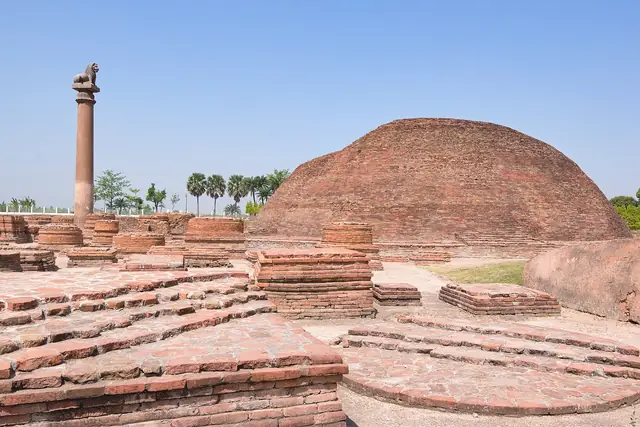
Shishunaga’s son is Kalashoka in the Buddhist chronicles and Kakavarna in the Puranas. In his tenth year, a hundred years after the parinirvana, monks of Vaishali were found accepting gold and silver and keeping nine other relaxed practices, and seven hundred elders met at Vaishali to judge them. That was the second council, and the dispute behind it is the beginning of the split between Sthaviras and Mahasanghikas. Kalashoka moved the royal seat back to Pataliputra. Bana’s Harshacharita remembers his end: Kakavarna was stabbed in the throat near his city.
03Ten sons, then the Nandas
The Mahabodhivamsa says Kalashoka’s ten sons ruled together after him for twenty-two years. The Puranas give a single line instead, ending with Mahanandin, and say that Mahapadma, his son by a shudra mother, took the throne and founded the Nanda house. The two traditions disagree on names and order, and nothing from the Shishunaga kings themselves has been read in stone. What stands certain is the shape of what they did: they finished Magadha’s conquest of the Ganga plain and Malwa, and handed the Nandas a kingdom ready to become an empire.
The rulers
- 1ShishunagaEnded the Pradyotas of Avantic. 413–395 BCE
- 2Kalashoka (Kakavarna)Second Buddhist council at Vaishalic. 395–367 BCE
- 3The ten sons of KalashokaRuled jointly, by the Mahabodhivamsac. 367–345 BCE
- 4MahanandinLast king in the Puranic listto c. 345 BCE
What they left
- Avanti and Malwa joined to Magadha
- The second Buddhist council at Vaishali
- Pataliputra restored as the royal seat