01The faces in the towers
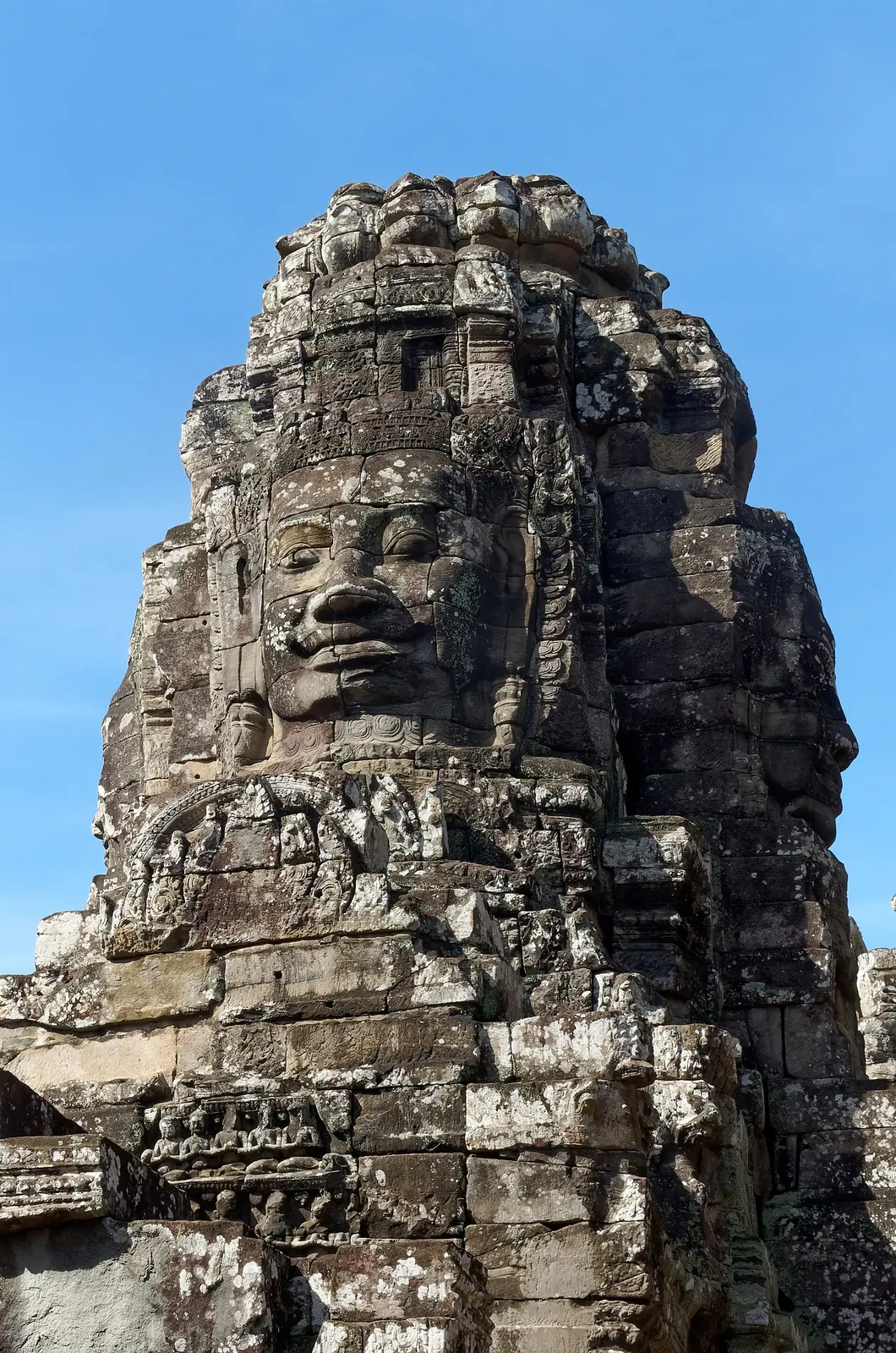
Jayavarman VII drove out the Cham, who had sacked Yashodharapura in 1177, and built a new walled city, Angkor Thom, with the Bayon at its exact centre. Its towers carry more than two hundred huge smiling stone faces looking to the four directions. Most scholars read them as the bodhisattva Lokeshvara, some as the king himself in that form. The outer gallery walls show the naval war against Champa on the Tonle Sap lake, and beside the soldiers ordinary Khmer life: fishermen, a woman in childbirth, men at a cockfight, a market.
02Turned back to Shiva
Jayavarman VIII, who reigned in the second half of the thirteenth century, was a Shaiva. In his time many Buddha images in Angkor were chiselled away or recut, and the great Buddha of the Bayon’s central shrine was broken and thrown into a pit, where French archaeologists found it in 1933. Hindu images and lingas were set up in the temple’s shrines. The record is in the stone itself, and both phases can be seen side by side today. The recovered Buddha has been reassembled and stands in a small pavilion near the Victory Gate road.
The life of this place
- 1177Cham forces sack the Khmer capital Yashodharapura.
- 1181Jayavarman VII is crowned and soon begins Angkor Thom and the Bayon.
- 1933The broken central Buddha image is found in a pit beneath the main shrine.
- 1992Inscribed with Angkor as a UNESCO World Heritage Site.
Inside Angkor Thom, reached through the South Gate with its rows of devas and asuras holding the naga. Early morning light is best on the faces.