01The date he gave himself
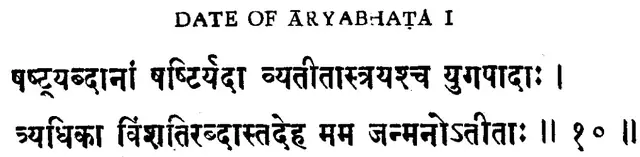
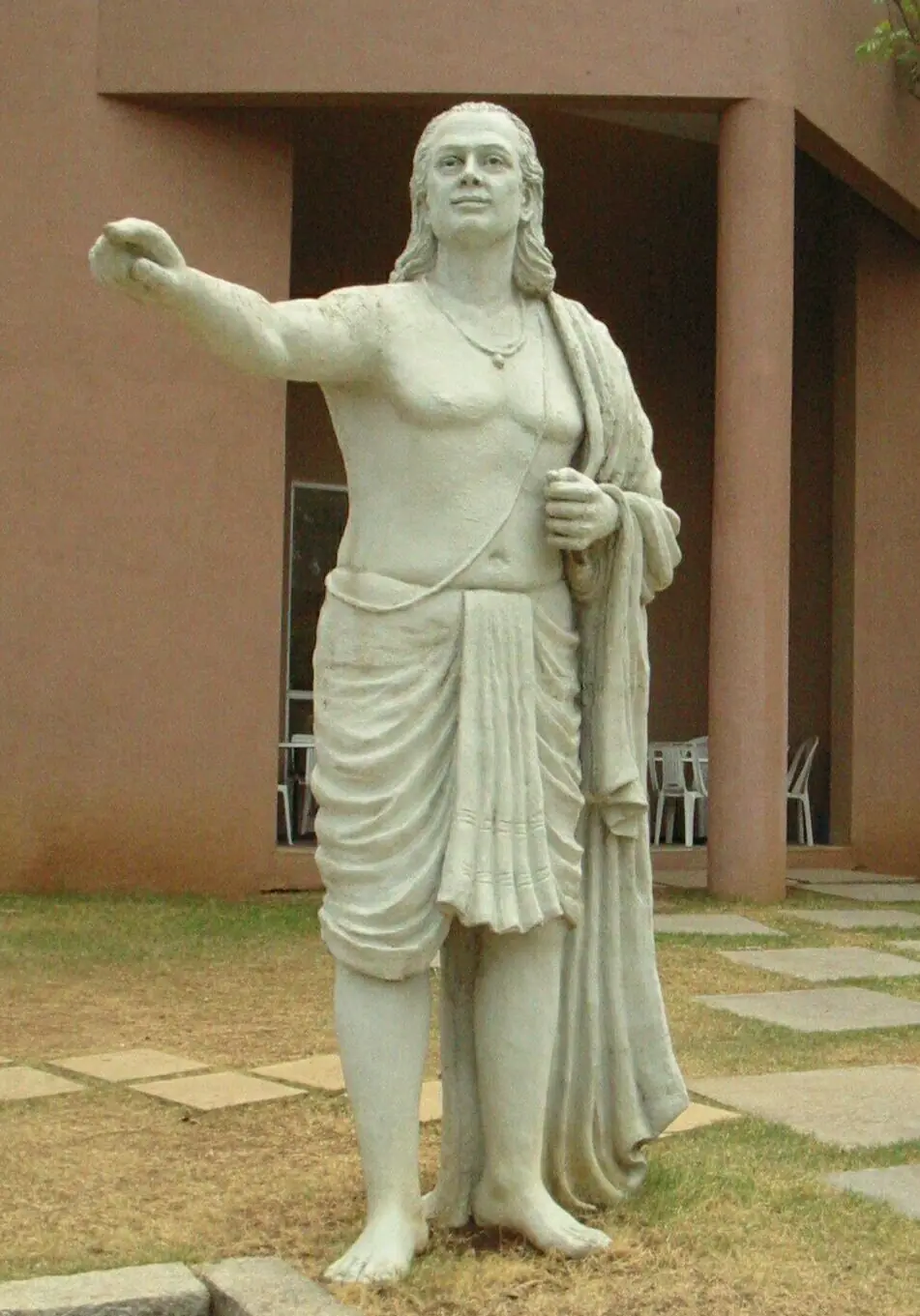
Few ancient authors tell us their age. Aryabhata does. In the Kalakriyapada (verse 10) he says that when sixty times sixty years of the Kali Yuga had passed, he was twenty-three. Kali 3600 falls in 499 CE, so he was born in 476. He names Kusumapura, the Gupta-era Pataliputra, as the place where his knowledge is honoured. The Aryabhatiya is short, 121 verses in four padas: Gitika, Ganita, Kalakriya and Gola. He packed numbers into syllables with his own alphabetic code, so a whole table of sines fits in a single verse.
02π and the turning Earth
Ganitapada verse 10: add four to a hundred, multiply by eight, add sixty-two thousand; that is the approximate circumference of a circle whose diameter is twenty thousand. The result, 62,832 ÷ 20,000, is 3.1416, and he called it asanna, approximate. In the Golapada (verse 9) he wrote that just as a man in a moving boat sees the trees on the bank moving backward, so the fixed stars seem to move west to a person at Lanka (on the equator). The Earth turns; the stars stand still. He also explained that a lunar eclipse is the Moon entering the Earth’s shadow and a solar eclipse the Moon covering the Sun. India named its first satellite after him, launched on 19 April 1975.
“Add four to one hundred, multiply by eight, and add sixty-two thousand: this is the approximate circumference of a circle whose diameter is twenty thousand.”
Aryabhatiya, Ganitapada 10