
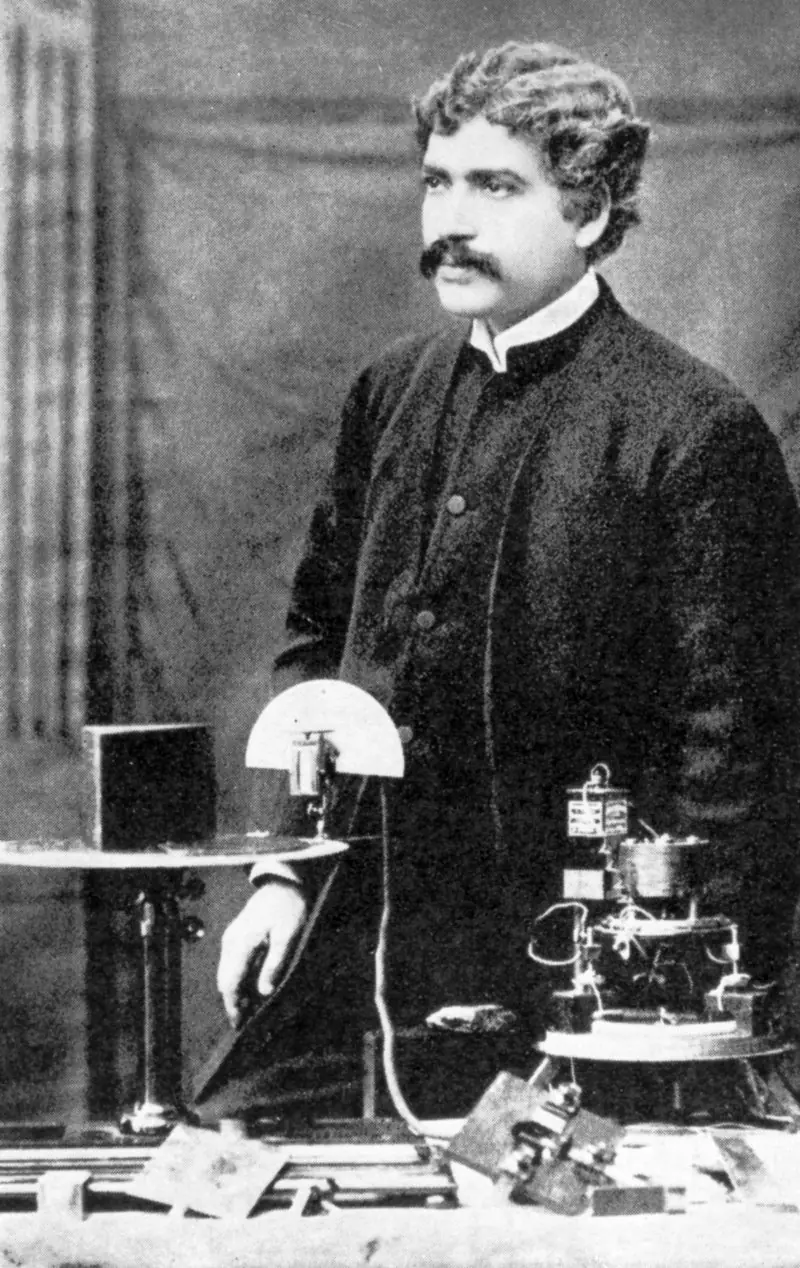
01Waves in a Calcutta laboratory
Born on 30 November 1858 in Mymensingh, now in Bangladesh, he studied at St Xavier’s in Calcutta and at Christ’s College, Cambridge, and in 1885 became professor of physics at Presidency College. He was paid less than his British colleagues and refused his salary for three years in protest until the rule was changed. In a small room there he built apparatus to make radio waves of a few millimetres in wavelength, with horn antennas, polarisers and a galena-crystal detector. In 1895 he sent such waves through walls in Calcutta, and in January 1897 he demonstrated them at the Royal Institution in London. He chose not to seek profit from his work; a US patent on his galena detector was filed by friends and granted in 1904.
02The life of plants
From around 1900 he studied how metals, plants and animal tissue respond to stimulus, and published Response in the Living and Non-Living in 1902. His crescograph magnified a plant’s growth thousands of times, so that the effect of heat, light, poison or a touch could be seen as it happened. On 30 November 1917, his 59th birthday, he opened the Bose Institute in Calcutta, calling it a temple of science. He was knighted in 1917 and elected FRS in 1920. He also wrote in Bengali, including one of the earliest Bengali science-fiction stories. In 2012 the IEEE named his millimetre-wave work of 1894–96 a Milestone in engineering. He died at Giridih on 23 November 1937.