
01Jorasanko to Stockholm
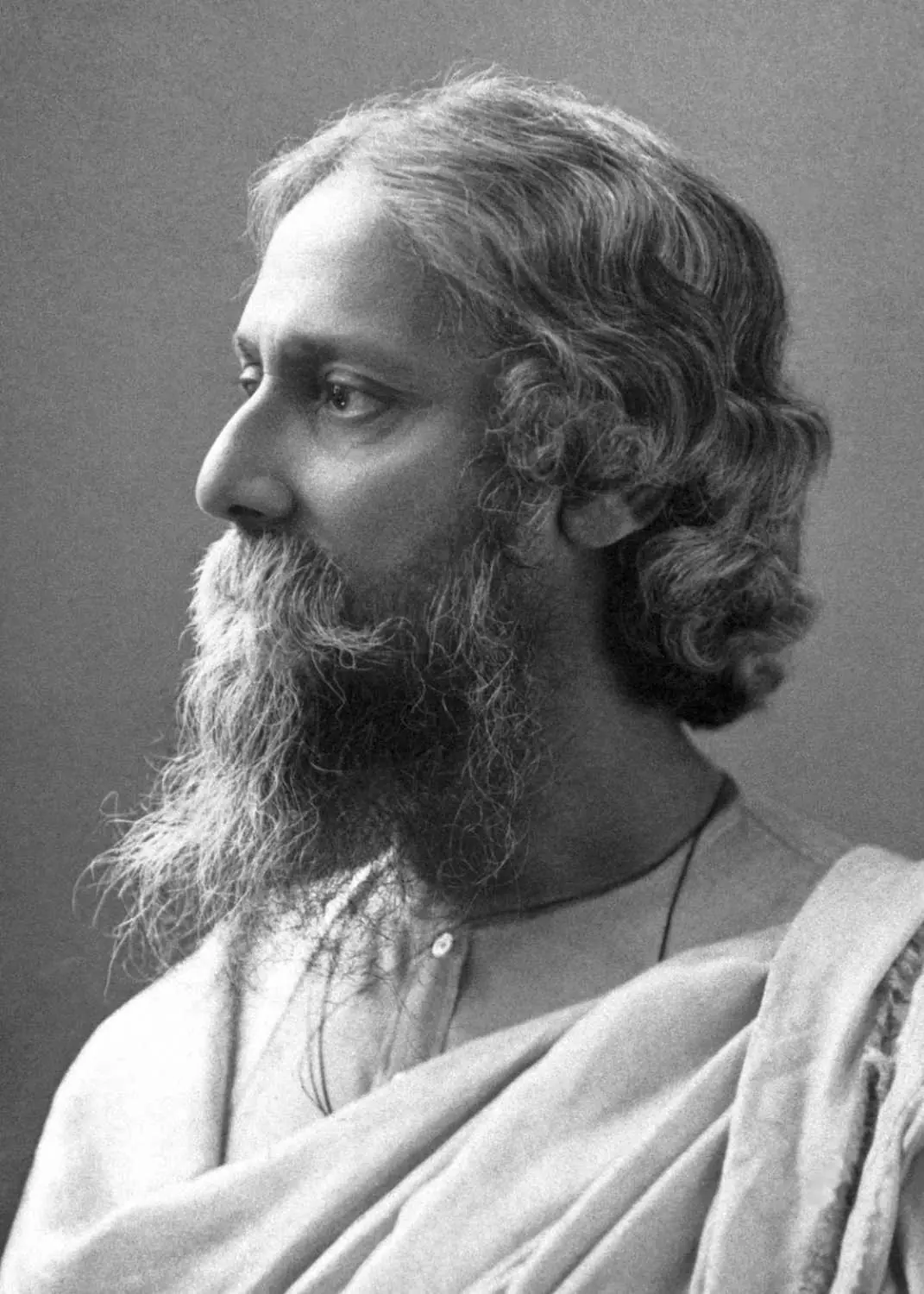
He was born on 7 May 1861 in the Tagore family house at Jorasanko, Kolkata, a home full of music, theatre and the Upanishads that his father read daily. He disliked school and learned at home. He was writing verse by eight and had poems in print at sixteen. For years he managed the family estates at Shilaidaha on the Padma, and the river villages fill his stories. The English Gitanjali, his own prose renderings of his Bengali songs, appeared in London in 1912, and on 13 November 1913 he was named the first Asian to win the Nobel Prize for Literature.
02Santiniketan and the anthem
In 1901 he opened a school in the open air at Santiniketan, where his father had built an ashram, and in 1921 widened it into Visva-Bharati university. When Bengal was partitioned in 1905 he led processions in Kolkata tying rakhis on Hindus and Muslims alike, and wrote Amar Shonar Bangla. Jana Gana Mana was first sung at the Calcutta Congress on 27 December 1911; the Constituent Assembly adopted it as India’s national anthem on 24 January 1950. After the Jallianwala Bagh massacre he gave back his knighthood in a letter to the Viceroy in May 1919. He died at Jorasanko on 7 August 1941.
“Where the mind is without fear and the head is held high; where knowledge is free.”
Rabindranath Tagore, Gitanjali (Song Offerings, 1912), 35