
01From Kumbakonam to Cambridge
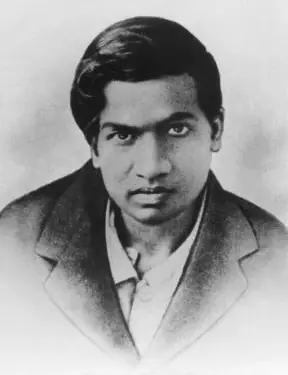
He was born on 22 December 1887 at Erode, in his grandmother’s house, and grew up in Kumbakonam. At fifteen he borrowed G. S. Carr’s Synopsis, a dry list of some five thousand results, and taught himself from it, writing his own discoveries in notebooks. He failed in college because he would study nothing but mathematics. In 1912 he became a clerk at the Madras Port Trust. On 16 January 1913 he wrote to Hardy, enclosing about a hundred and twenty theorems. Hardy later said some of them ‘defeated me completely’ and must be true, because no one would have the imagination to invent them. Ramanujan sailed for England on 17 March 1914.
02Five years in England
With Hardy he found the asymptotic formula for the partition function p(n), the number of ways to write n as a sum, accurate enough to give p(200) exactly. In 1918 he was elected a Fellow of the Royal Society and a Fellow of Trinity College, the first Indian to hold the latter. Cold, war-time diet and illness wore him down. Visiting him in hospital, Hardy remarked that his taxi’s number, 1729, was dull; Ramanujan replied that it is the smallest number expressible as a sum of two cubes in two ways. He came home in 1919 and died on 26 April 1920. He said his family deity, Namagiri of Namakkal, gave him formulas in dreams. India keeps 22 December as National Mathematics Day.