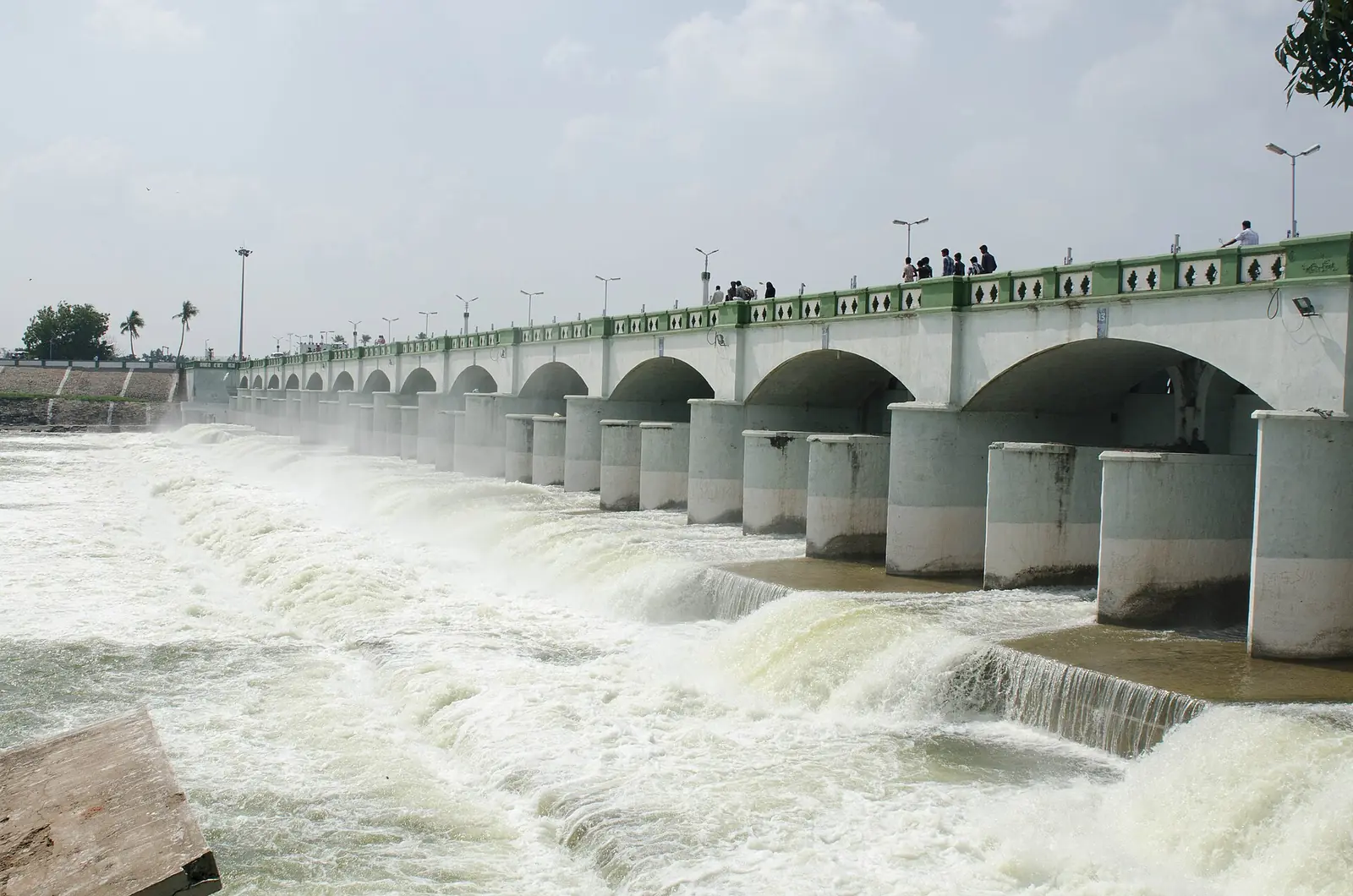
01Karikala’s stone dam
Kallanai means the stone dam. Below Srirangam the Kaveri splits, the northern arm, the Kollidam, running fast and low, the southern keeping the name Kaveri and feeding the delta. The weir, about 329 m long and 20 m wide, was built of unhewn stone laid in the running river and bedded into the sand, to hold the water back and send it into the Kaveri and its channels rather than let it run off down the Kollidam. Tamil tradition gives it to Karikala, the greatest of the early Cholas, whom the Sangam poem Pattinappalai praises, and later Chola copper plates remember him as the king who raised the banks of the Kaveri. It has watered the rice fields of Thanjavur for close to two thousand years by that reckoning.
02Cotton learns from it
By 1800 silt was choking the Kaveri branch and more water was going down the Kollidam. In 1804 the Company’s engineer Captain Caldwell raised the old weir by some 69 cm; Major Sim then cut undersluices to scour the sand. Arthur Cotton, studying how the old stones had held for centuries on a sandy bed, built the Upper Anicut on the Kollidam in 1836 and took the lesson on to his great anicuts on the Godavari and Krishna. He called Kallanai the Grand Anicut, and wrote that the old builders had taught the British how to found a dam on sand. The ancient core still lies under the nineteenth-century masonry, and the irrigated area of the delta grew from some 69,000 acres to about a million.
The life of this place
- c. 2nd century CE (traditional)Karikala Chola builds the stone weir.
- 1804Captain Caldwell raises the weir.
- 1836Arthur Cotton builds the Upper Anicut on the Kollidam, modelled on Kallanai.
About 15 km from Tiruchirappalli; the water runs fullest when the delta gates open in June.