
01Lilavati
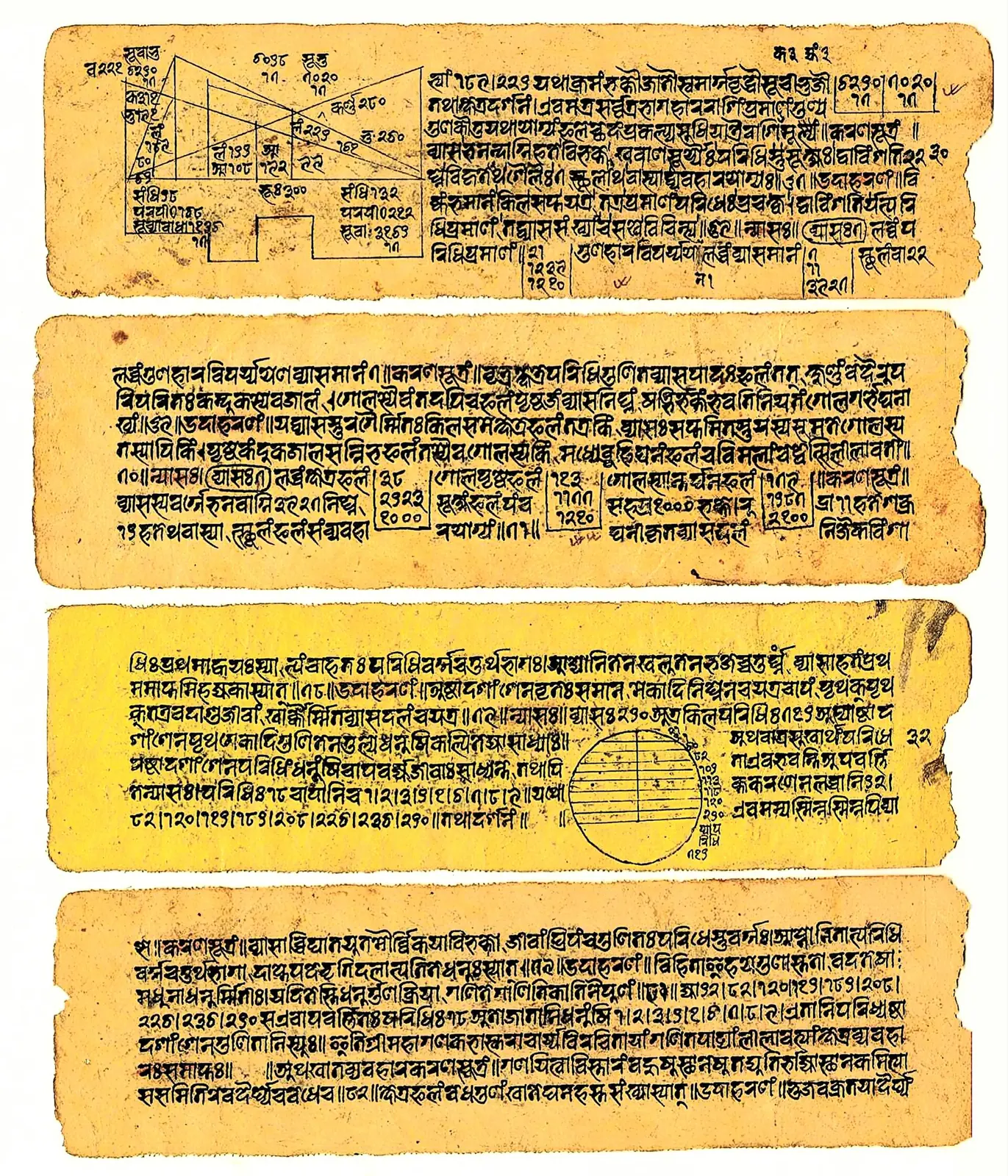
In the Goladhyaya he says he was born in Shaka 1036 (1114 CE) and wrote the Siddhanta Shiromani at 36, in 1150. It has four parts: Lilavati on arithmetic and measurement, Bijaganita on algebra, Grahaganita on the planets and Goladhyaya on the sphere. The Lilavati is written as problems put to a girl: ‘O fawn-eyed Lilavati, tell me…’, about bees among lotuses, a peacock and a snake, a broken bamboo. A katha says Lilavati was his daughter, whose wedding hour was lost when a pearl fell into the water-clock, and he named the book after her to console her. It was taught in pathshalas across India into the 19th century and was translated into Persian for Akbar’s court by Faizi in 1587.
02Chakravala and the Patan school
In the Bijaganita he perfected the chakravala, the cyclic method, for equations of the form Nx² + 1 = y². For N = 61 it yields x = 22,61,53,980 and y = 1,76,63,19,049; Fermat set this very case as a challenge in 1657. In the Grahaganita he works with the instantaneous motion of a planet (tatkalika gati), an idea close to the derivative of calculus. His grandson Changadeva was court astrologer to the Yadava king Singhana, and an inscription of 1207 CE at Patan, near Chalisgaon in Maharashtra, records a matha founded there to teach Bhaskaracharya’s works.