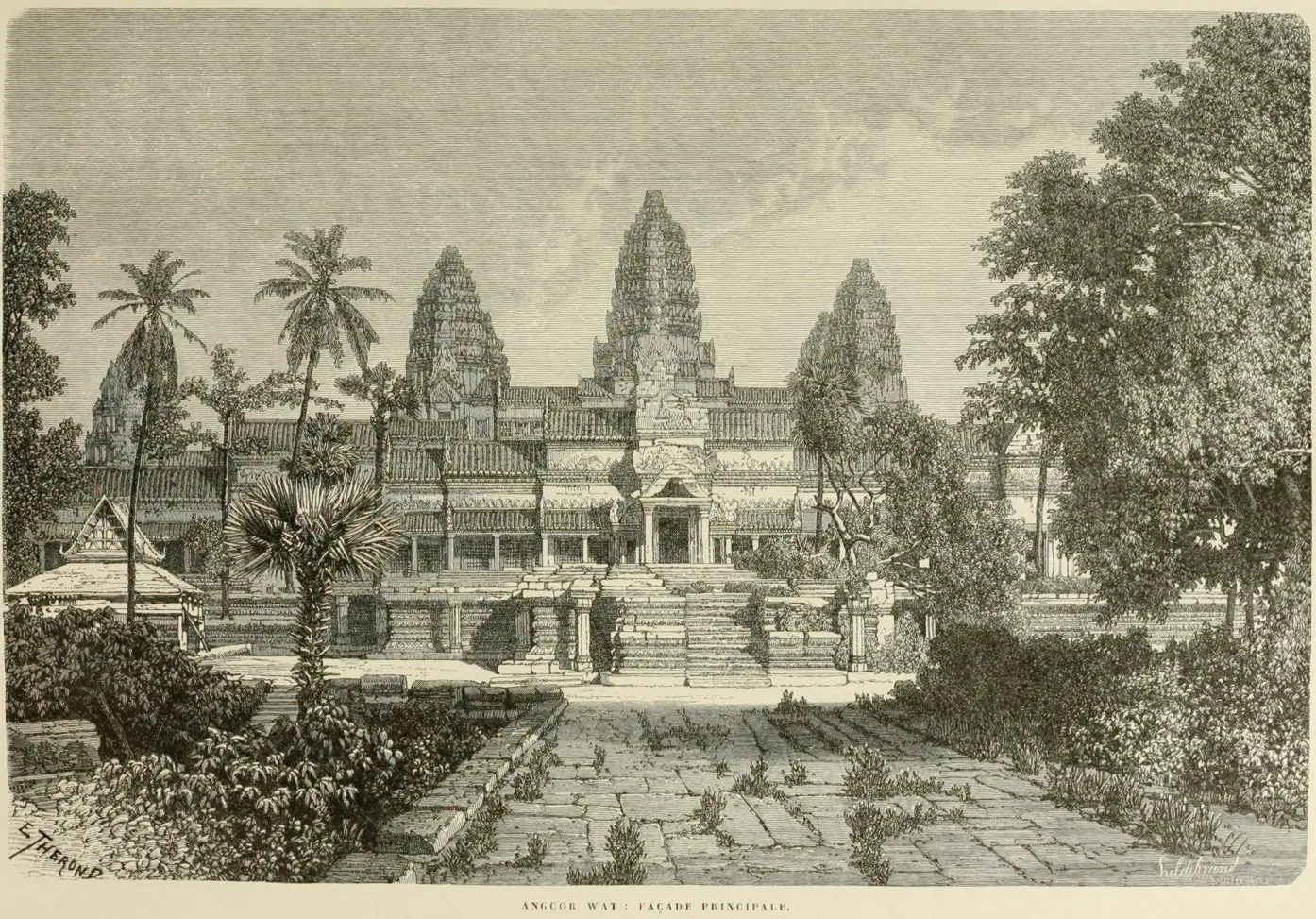
01Meru on the Tonle Sap plain
Suryavarman II came to the throne around 1113 and spent most of his reign building this temple. The plan is a map of the Puranic universe. A moat about 190 metres wide plays the ocean. Three rising galleries play the mountain ranges, and the central tower, some 65 metres above the ground, is Meru, the seat of the devas.
The temple faces west, which is unusual in Khmer building. West is the direction of Vishnu in Khmer practice and also of the dead, and many hold that the king meant it as his own funerary temple. After his death he was known by the posthumous name Paramavishnuloka, the one who has gone to the supreme abode of Vishnu.
02Stone that tells the Itihasa
The lowest gallery carries nearly 800 metres of carved relief, among the longest in the world. On the east wall the devas and asuras pull Vasuki around Mount Mandara in the churning of the ocean, with Vishnu as Kurma below and above. On the west wall the armies of Kurukshetra meet, Bhishma lies on his bed of arrows, and the Pandavas advance. Another panel shows the battle of Lanka, with Shri Rama on Hanuman’s shoulders. The king himself appears too, seated in court and riding at the head of his army, the only Khmer ruler whose portrait survives in a temple relief.
03Never abandoned
Over the following centuries Cambodia turned to Theravada Buddhism and Angkor Wat became a Buddhist shrine, which is why it was never left to the forest like so many Khmer temples. Monks still live in its grounds. The French naturalist Henri Mouhot wrote of it after his visit in 1860, and his account made it famous in Europe. Restoration has run, with breaks for war, through the twentieth century and is still going on, with the Archaeological Survey of India among the teams that worked on it between 1986 and 1993.
The life of this place
- c. 1113Suryavarman II takes the throne and begins the temple for Vishnu.
- 1860Henri Mouhot visits; his published notes bring the temple to European notice.
- 1986–1993The Archaeological Survey of India carries out conservation work at the temple.
- 1992Angkor is inscribed as a UNESCO World Heritage Site.
Siem Reap is the base; an Angkor pass is needed. Go for sunrise over the west causeway, then walk the bas-relief gallery anticlockwise from the west entrance.