01The Vajrasana
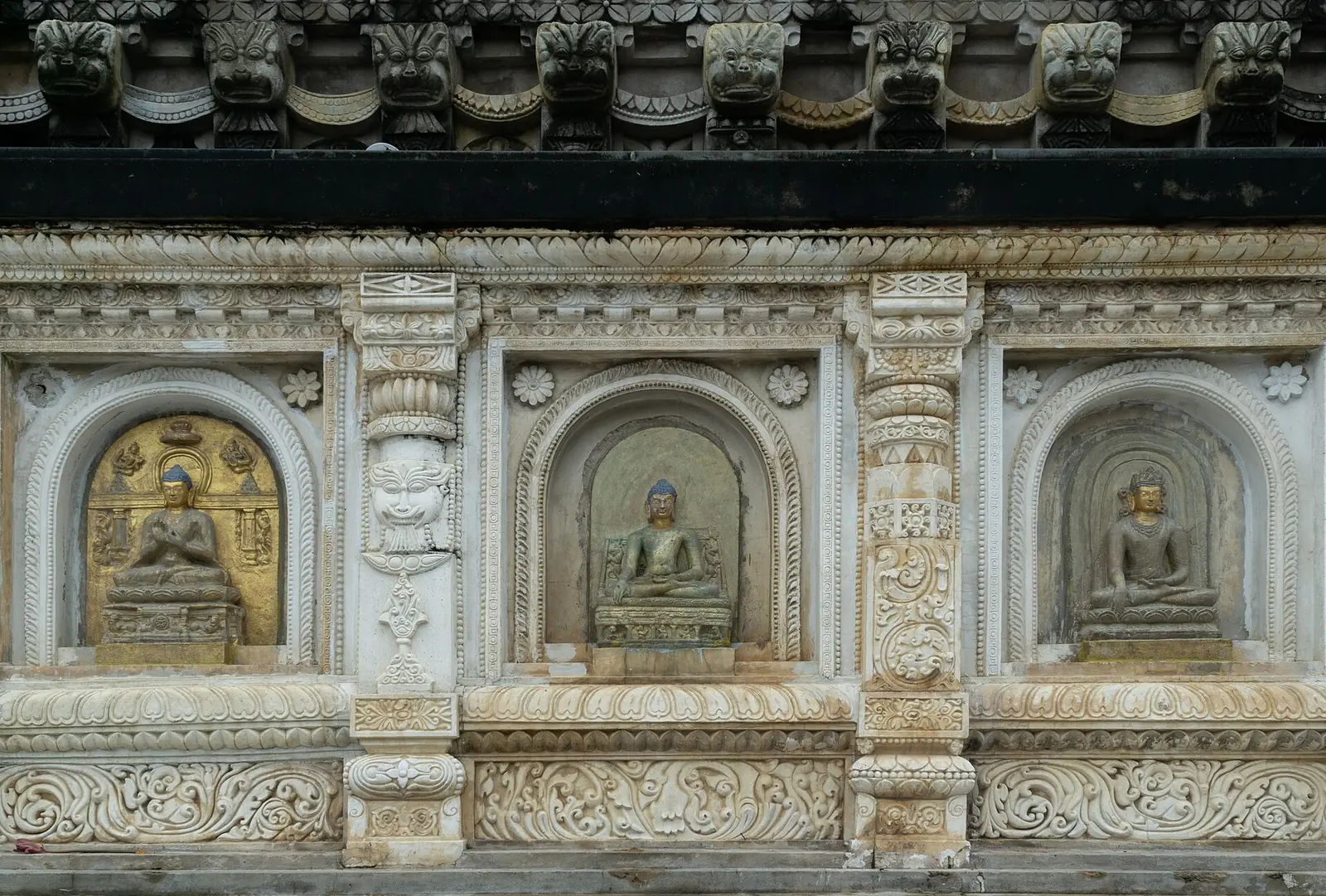
Ashoka came here in the tenth year of his reign, by his own edict, and raised a shrine with the stone seat, the Vajrasana, that still lies under the tree. The present tower, about 55 metres high, is of brick on a square base with four smaller towers at the corners, built in the Gupta period. Xuanzang described it in the 7th century much as we see it. The Bodhi tree today grows from the line of the original, and stone railings from the Shunga period, with Surya on his chariot among their carvings, still surround the walk where the Buddha paced.
02Desertion and return
After the raids on Bihar around 1200 the monks scattered. The Tibetan pilgrim Dharmasvamin, here in 1234, found the temple almost deserted, its image walled up for safety. From the 16th century a Shaiva math of the Giri order, whose mahant still sits next to the temple, held the site and kept it standing. Burmese kings repaired it more than once, and in 1880–84 Alexander Cunningham and J. D. Beglar restored the tower. Since the Bodh Gaya Temple Act of 1949 a committee of Buddhist and Hindu members manages it. UNESCO listed it in 2002.
The life of this place
- 3rd century BCEAshoka visits and raises the first shrine with the Vajrasana.
- 5th–6th centuryThe present brick temple is built.
- 1234Dharmasvamin finds the temple nearly deserted after the raids.
- 1880–84Cunningham and Beglar restore the tower.
- 1949The Bodh Gaya Temple Act sets up a joint management committee.
- 2002Inscribed as a UNESCO World Heritage Site.
Open from early morning to evening; phones are kept at the gate. Gaya airport and station are about 12 km away.