
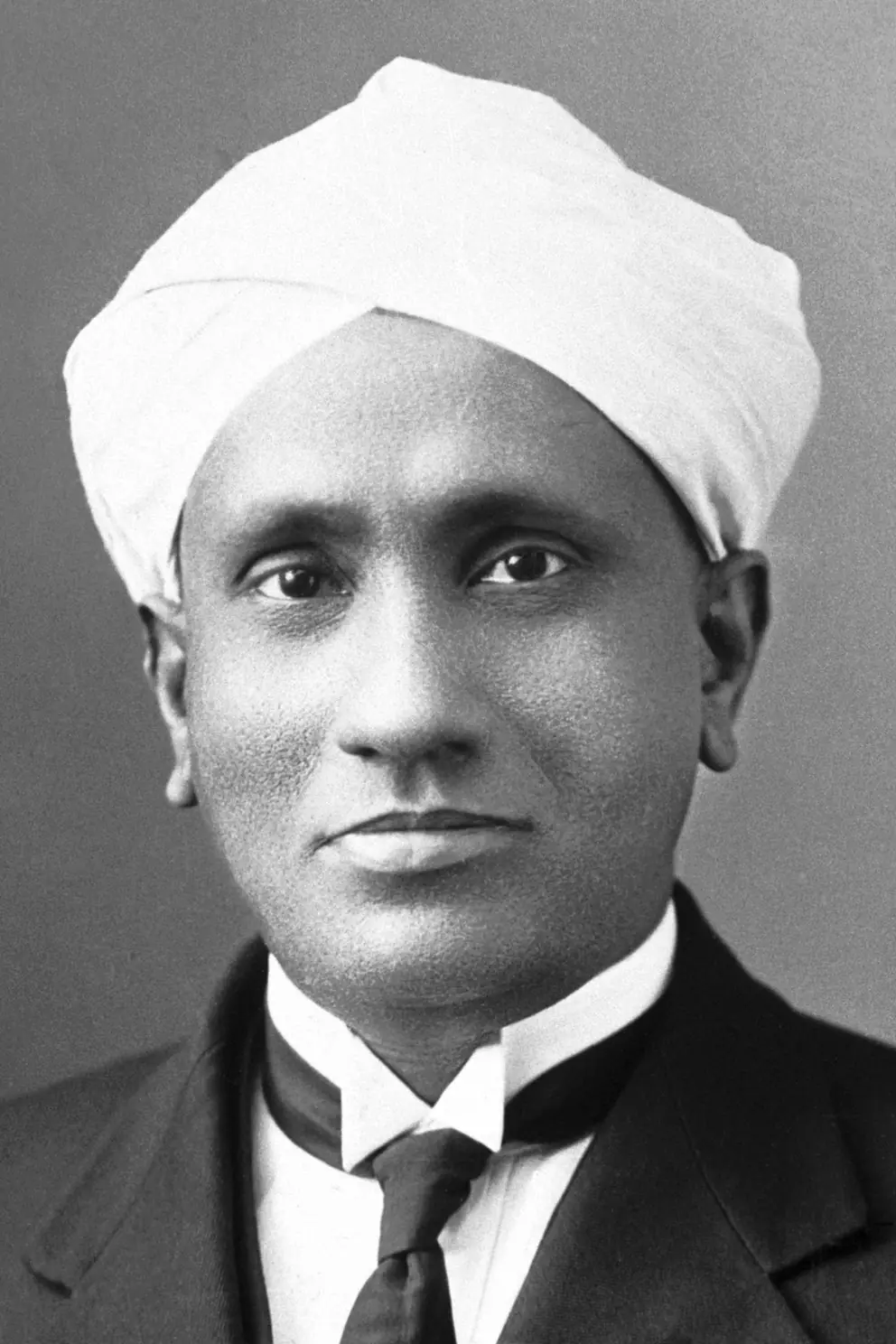
01An accountant in the laboratory
Born on 7 November 1888 at Tiruchirappalli, he took his MA from Presidency College, Madras, and in 1907 joined the Indian Finance Department as an Assistant Accountant General in Calcutta. Mornings and evenings he worked in the laboratory of the Indian Association for the Cultivation of Science at Bowbazar, on the acoustics of the violin, the veena and the mridangam. In 1917 he left government service to become Palit Professor of Physics at Calcutta University. On a voyage to Europe in 1921, watching the deep blue of the Mediterranean, he doubted the accepted explanation that the sea merely reflects the sky, and began studying how water and other substances scatter light.
0228 February 1928
With his student K. S. Krishnan, using sunlight focused through a telescope lens and coloured filters, and later a mercury lamp and a spectrograph, he found that a small part of the scattered light came out at changed wavelengths. Raman announced it on 28 February 1928; the paper, ‘A New Type of Secondary Radiation’, appeared in Nature on 31 March. Raman spectroscopy is now used everywhere, from identifying drugs to studying the rocks of Mars. He was knighted in 1929, won the Nobel in 1930, became the first Indian director of the Indian Institute of Science in 1933, founded the Raman Research Institute in Bengaluru in 1948 and received the Bharat Ratna in 1954. India keeps 28 February as National Science Day. He died in Bengaluru on 21 November 1970.