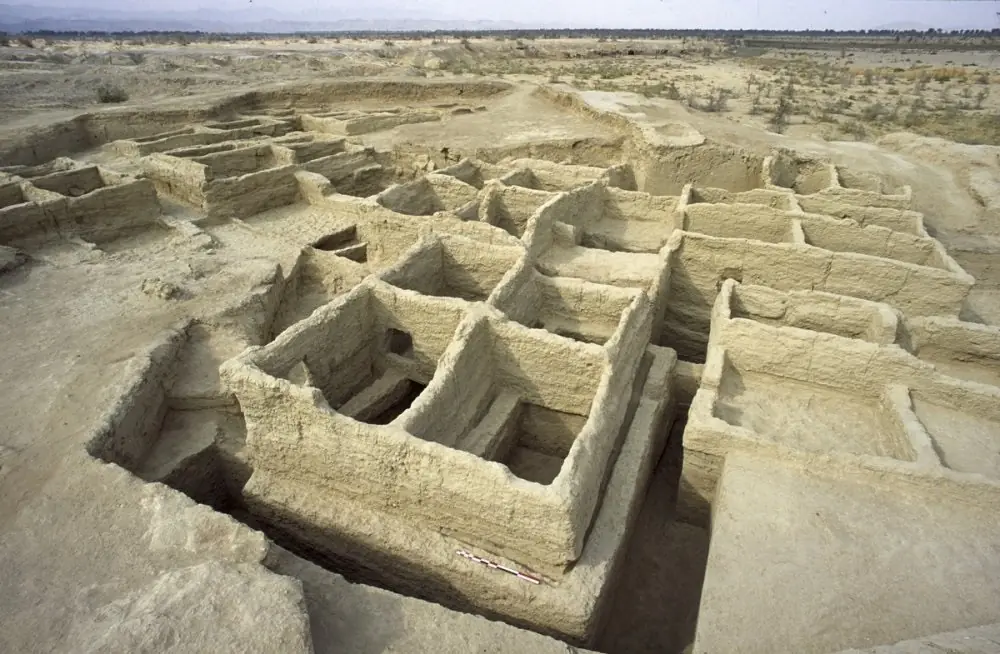
01Nine thousand years ago
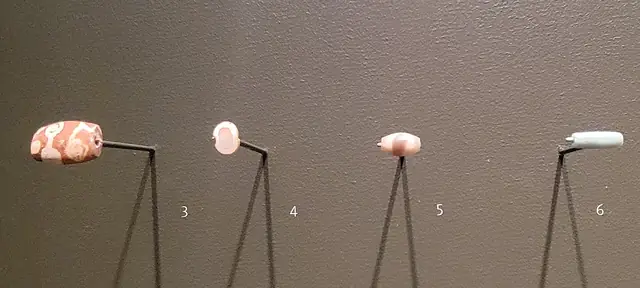
Jean-François Jarrige and Catherine Jarrige of the French Archaeological Mission found Mehrgarh in 1974 and dug here until 1986 and again from 1997 to 2000. The lowest levels, from c. 7000 BCE, hold houses of mud brick divided into small rooms, and graves where the dead were laid with shell beads, turquoise and lapis, and sometimes young goats. People grew six-row barley and wheat, and over the next two thousand years tamed the humped zebu, the cattle of India. A copper bead from a burial of the 6th millennium BCE held mineralised threads of cotton, the oldest cotton known.
02Dentists and potters
In 2006 a team writing in Nature reported eleven drilled molars from Mehrgarh graves, between about 7,500 and 9,000 years old, the holes made with flint bow-drills in living people. Later levels show the wheel-made pottery, terracotta figurines and copper of the 4th millennium BCE. The village was left c. 2600 BCE, just as the great cities rose, and its people seem to have moved to nearby Nausharo. Mehrgarh answers the old colonial claim that farming and settled life came to India from outside: here they grew up on the spot, in an unbroken line to Harappa.
The life of this place
- c. 7000 BCEThe first farming village is built of mud brick.
- c. 2600 BCEMehrgarh is abandoned; settlement shifts to Nausharo.
- 1974The French Archaeological Mission under J.-F. Jarrige discovers the site.
- 2006The drilled teeth of Mehrgarh are published in Nature.
Near Sibi in Balochistan; the area is not open to casual visitors. The finds are in the Karachi and Quetta museums and the Musée Guimet, Paris.