
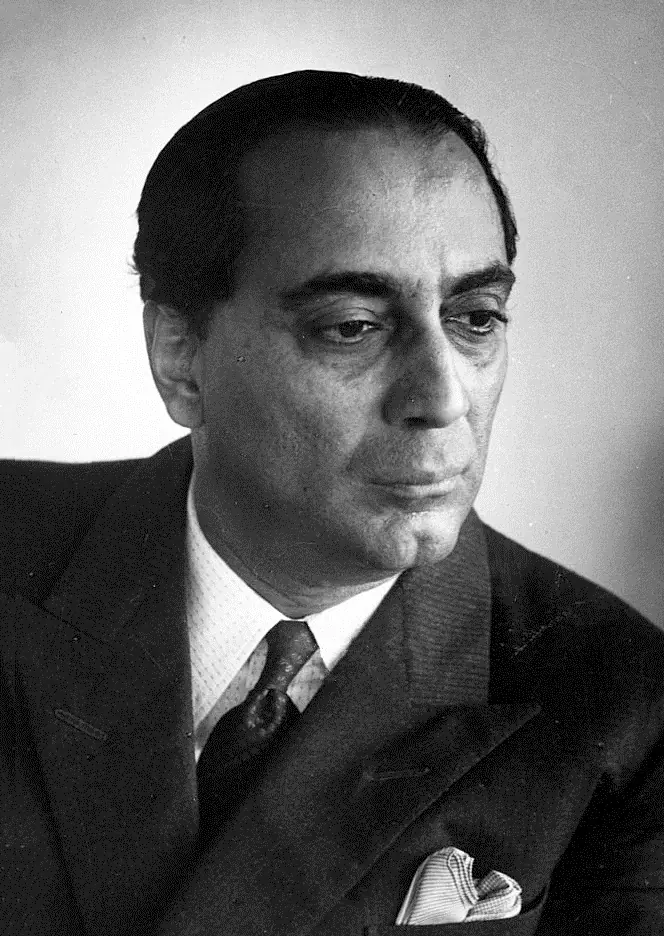
01Cambridge and cosmic rays
Born on 30 October 1909 in Bombay to a Parsi family, he was sent to Cambridge to study engineering and turned to theoretical physics. In 1935 he calculated the scattering of electrons by positrons, a process physicists still call Bhabha scattering. In 1937, with Walter Heitler, he explained how a cosmic-ray particle striking the atmosphere sets off a cascade shower of electrons, positrons and photons. On holiday in India when the Second World War broke out in 1939, he stayed and joined C. V. Raman at the Indian Institute of Science in Bangalore. He was elected FRS in 1941.
02TIFR, Trombay and three stages
In 1944 he wrote to the Sir Dorabji Tata Trust proposing an institute for fundamental physics; the Tata Institute of Fundamental Research opened on 1 June 1945. In 1948 he became the first chairman of the Atomic Energy Commission. He set up the atomic energy establishment at Trombay in 1954, where Apsara, the first nuclear reactor in Asia, went critical on 4 August 1956. Knowing India had little uranium but large thorium reserves in the monazite sands of Kerala, he laid out a three-stage plan to reach thorium-based power. He presided over the first United Nations conference on the peaceful uses of atomic energy at Geneva in 1955. He died on 24 January 1966 when Air India Flight 101 crashed into Mont Blanc. Trombay was renamed the Bhabha Atomic Research Centre in 1967.