
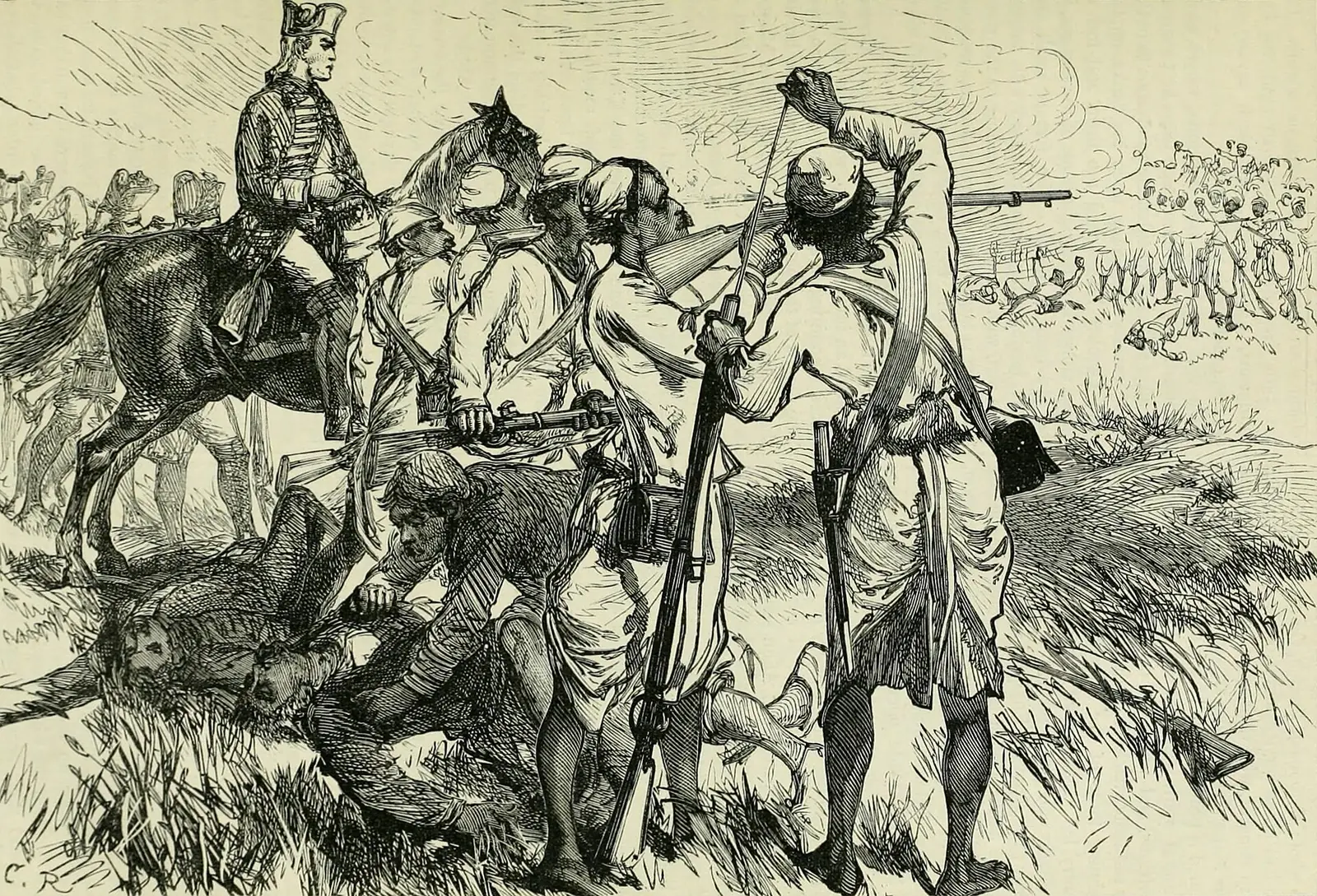
The allied army was beaten in a single day; in 1765 the emperor granted the Company the Diwani of Bengal, Bihar and Orissa.
01Three rulers against the Company
Mir Qasim, whom the Company had made Nawab of Bengal in 1760, tried to rule in earnest. He moved his capital to Munger, drilled his own troops and stopped the Company’s servants from trading free of duty. War broke out in 1763; beaten, he fled to Awadh and joined the Nawab Shuja-ud-Daula and the wandering emperor Shah Alam II. Their combined army, put by the Company at forty thousand or more, met Hector Munro’s seven thousand, most of them sepoys, at Buxar on the Ganga.
02From Buxar to the Diwani
The allies fought hard for some hours but without one command; Shah Alam stood apart. Munro’s disciplined battalions held, and Shuja’s army broke and fled across a stream behind it, where many drowned. Shah Alam came over to the Company. By the Treaty of Allahabad in August 1765, Clive restored Awadh to Shuja for a large payment and received from Shah Alam the Diwani, the right to collect the revenue of Bengal, Bihar and Orissa, in return for an annual tribute to the emperor.
After Buxar the Company was no longer a trader with an army but the revenue ruler of eastern Bharat, with the emperor himself as its pensioner.