What Bharat gave the world

Zero and the numerals you count with, yoga, chess, cotton, crystal sugar, steel, grammar and ahimsa: each gift with its proof and the road it travelled.

44Gifts to the World

44 shown

Cotton clothCraft
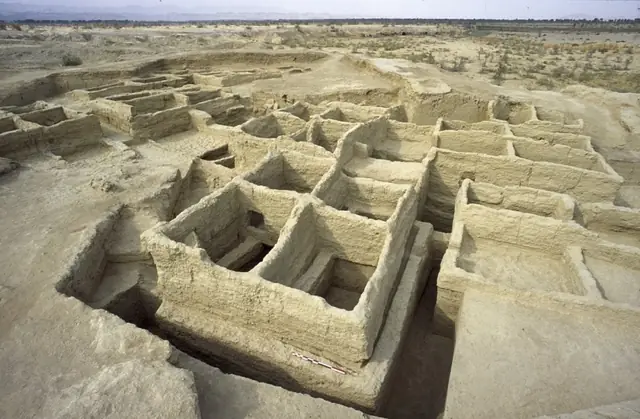
6th millennium BCE, Mehrgarh

Cotton cloth

The oldest cotton of the Old World, from Mehrgarh

The people of Bharat were growing, spinning and weaving cotton thousands of years before most of the world had seen it. For most of history Indian cotton cloth, from coarse calico to the Dhaka muslin so fine it was called “woven air”, clothed half the trading world.

How it travelled: Indian cottons went west through Gujarat and the Red Sea ports to Rome, and east to Southeast Asia, for two thousand years. The English word cotton itself is from Arabic qutn, the name the traders used.

Today: India is one of the two largest cotton growers in the world.

The proof (3)
  1. Mineralised cotton fibres preserved inside a copper bead from a Mehrgarh grave of the 6th millennium BCE are the earliest cotton known in the Old World (Moulherat et al., 2002).
  2. At Mohenjo-daro, cotton cloth was found preserved against a silver vessel, from around 2500 BCE.
  3. Herodotus (c. 440 BCE) wrote that in India wild trees bear a wool finer than a sheep’s, and the Indians make clothes of it.

C. Moulherat et al., “First Evidence of Cotton at Neolithic Mehrgarh, Pakistan”, Journal of Archaeological Science 29 (2002) · J. H. Marshall, Mohenjo-daro and the Indus Civilization (1931) · Herodotus, Histories 3.106
Standard weights and measuresScience
c. 2600–1900 BCE, Sindhu–Sarasvati cities

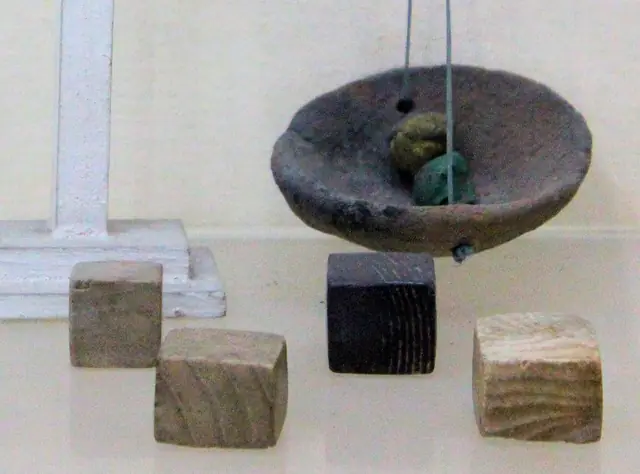
Standard weights and measures

The same chert cubes from Gujarat to the Gulf

The Sindhu–Sarasvati cities used cubes of polished chert to one standard: they double from the smallest (1, 2, 4, 8, 16, 32, 64) and then go up in decimal steps. Weights from Harappa, Mohenjo-daro and Lothal agree closely across hundreds of kilometres.

How it travelled: Traders carried the system west: the merchants of Dilmun (Bahrain) used the Indus standard for their own weights, and Harappan cubes have been found as far as Susa in Iran.

Today: The idea of one honest weight for a whole country is the basis of every market.

The proof (2)
  1. The common unit of 16 weighs about 13.7 g, found again and again in excavated sets.
  2. An ivory scale from Lothal carries fine divisions about 1.7 mm apart.

J. H. Marshall, Mohenjo-daro and the Indus Civilization (1931) · S. R. Rao, Lothal and the Indus Civilization (1973) · J. M. Kenoyer, Ancient Cities of the Indus Valley Civilization (1998)

Black pepperFood
Traded by 1213 BCE; the Roman trade 1st–2nd centuries CE

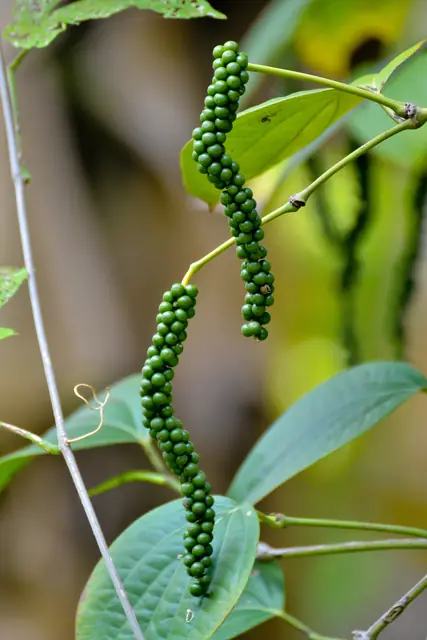
Black pepper

Malabar’s black gold, worth a sea route

Piper nigrum, the pepper vine, is native to the Western Ghats, and the Malabar coast of Kerala was its home market for thousands of years. Romans, Arabs, Venetians and the Portuguese all came for it.

How it travelled: Pepper went by Arab and Indian ships to the Red Sea, overland to Venice, and set Europe searching for a direct route. Vasco da Gama reached Calicut in 1498, guided across the Arabian Sea by a pilot taken on at Malindi, and loaded pepper.

Today: Pepper sits on dining tables in every country; Vietnam now grows the most, but Malabar pepper still sets the standard.

The proof (2)
  1. Peppercorns from India were placed in the nostrils of the mummy of Pharaoh Ramesses II, who died in 1213 BCE.
  2. The Muziris papyrus (2nd century CE, Vienna) records a loan on a ship’s cargo from Muziris, and Pliny complains of Rome’s gold draining to India.

A. J. Plu, “Bois et graines”, in La momie de Ramsès II (Paris, 1985) · Muziris papyrus, Papyrus Vindobonensis G 40822 · Pliny the Elder, Natural History 6.101 and 12.14

Panini’s grammarLanguage
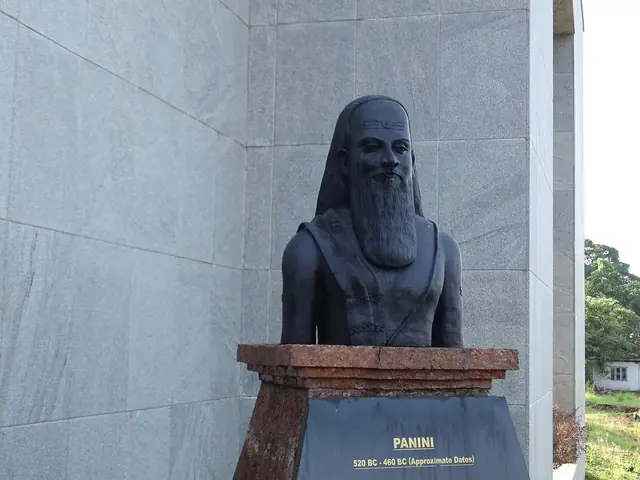
Panini, c. 5th–4th century BCE

Panini’s grammar

Four thousand rules that generate a whole language

Panini’s Ashtadhyayi describes Sanskrit in about 4,000 short sutras, with rules that call other rules, meta-rules that decide which rule wins, and a sound list (the Maheshvara Sutras) packed into shorthand. It works like a program that produces every correct word of the language.

How it travelled: European scholars met Panini in the 19th century, and his methods shaped comparative and descriptive linguistics, from Franz Bopp to Ferdinand de Saussure, who taught Sanskrit at Geneva. In 1967 the computer scientist Peter Ingerman proposed calling the notation for programming-language grammars the Panini–Backus form.

Today: Linguists still study the Ashtadhyayi, and Sanskrit is taught from it in pathshalas across Bharat.

The proof (2)
  1. The Ashtadhyayi has some 3,959 sutras in eight chapters, explained by Katyayana’s Varttikas and Patanjali’s Mahabhashya.
  2. Leonard Bloomfield called it “one of the greatest monuments of human intelligence” (Language, 1933).

Panini, Ashtadhyayi · Leonard Bloomfield, Language (1933) · P. Z. Ingerman, “Panini–Backus Form Suggested”, Communications of the ACM 10 (1967)

Wootz steelCraft
From the late centuries BCE into the 19th century

Wootz steel

The crucible steel behind the “Damascus” sword

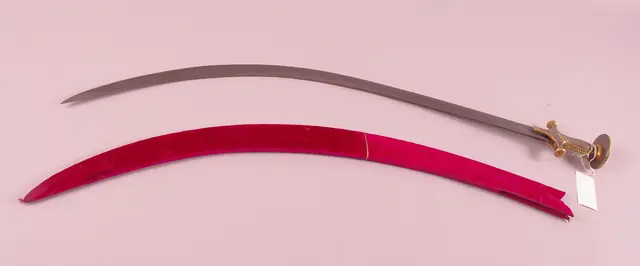
South Indian smiths sealed iron with wood and leaves in small clay crucibles, heated them for hours and cooled them slowly, making cakes of high-carbon steel. Forged with care, the steel showed a watered pattern on the blade and held a fierce edge.

How it travelled: Ingots went by sea and caravan to Persia and Syria, where smiths forged the famous Damascus blades. Crucible steel was also made in Sri Lanka and Central Asia; South India was its most famous source. Michael Faraday tried to copy it in London.

Today: Bladesmiths worldwide still chase the wootz pattern, and metallurgists still publish on it.

The proof (3)
  1. Crucible fragments with steel residues have been excavated at Kodumanal in Tamil Nadu.
  2. George Pearson reported on wootz to the Royal Society in 1795; the name comes from the Kannada ukku.
  3. In 2006 carbon nanotubes were found in a 17th-century sabre of this steel (Nature 444).

George Pearson, Philosophical Transactions of the Royal Society (1795) · Reibold et al., “Carbon nanotubes in an ancient Damascus sabre”, Nature 444 (2006) · Sharada Srinivasan and Srinivasa Ranganathan, India’s Legendary Wootz Steel (2004)

The Brahmi family of scriptsLanguage
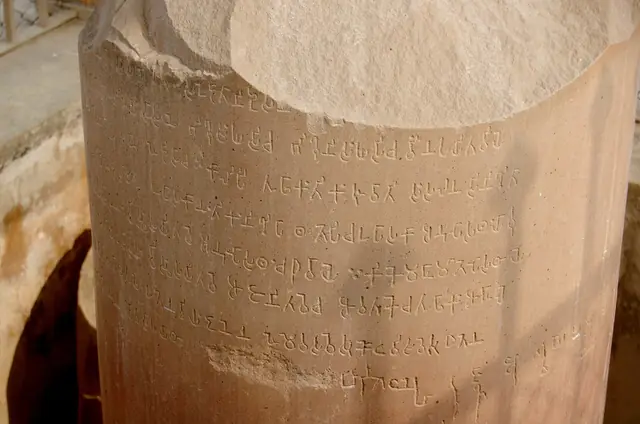
Ashoka’s edicts, 3rd century BCE

The Brahmi family of scripts

One script, mother of alphabets from Tibet to Bali

Brahmi, the script of Ashoka’s edicts, writes each consonant with a built-in vowel and marks other vowels with signs, and orders its letters by where in the mouth they are spoken. Every major script of Bharat descends from it, and so do the scripts of much of Asia.

How it travelled: Through trade and dharma, Brahmi’s children spread across Asia: Tibetan (7th century), Thai, Lao, Khmer, Burmese, Sinhala, Javanese and Balinese. Even the Japanese kana are arranged in the order of Sanskrit phonetics, learned from Siddham script.

Today: Well over a billion people read a Brahmi-derived script every day.

The proof (2)
  1. Ashoka’s rock and pillar edicts, from Girnar to Sarnath, are the earliest long texts in Brahmi; James Prinsep deciphered them in 1837.
  2. The Vo Canh inscription in Vietnam and the Kedukan Bukit inscription in Sumatra (682 CE) are written in scripts descended from Brahmi.

Edicts of Ashoka (Corpus Inscriptionum Indicarum, Vol. I) · James Prinsep, Journal of the Asiatic Society of Bengal (1837) · Richard Salomon, Indian Epigraphy (1998)

YogaYoga
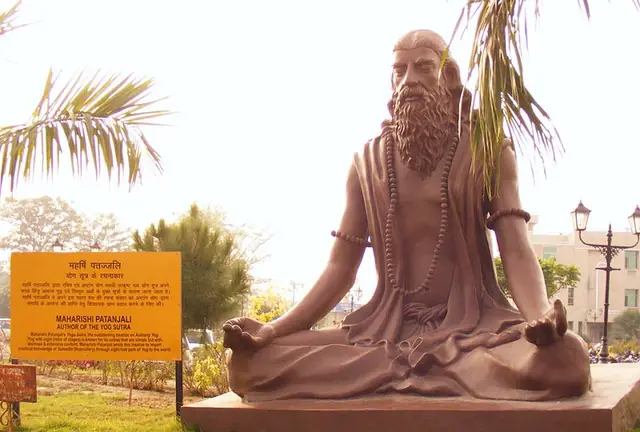
Patanjali, c. 2nd century BCE

Yoga

Yogash chitta-vritti-nirodhah: stilling the movements of the mind

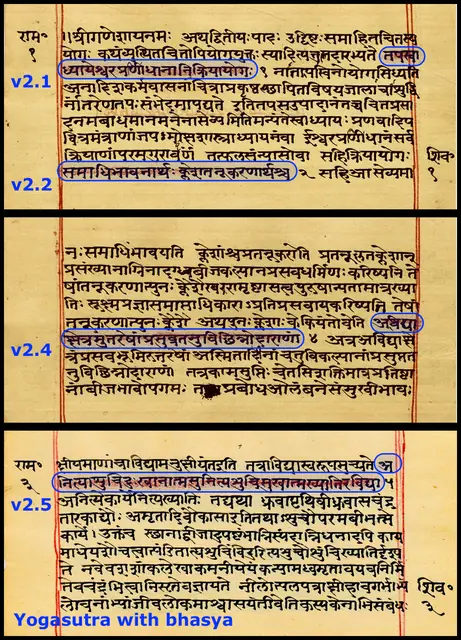
Yoga is the discipline of joining the self to the Supreme, taught in the Upanishads and the Gita and set out by Maharshi Patanjali in 195 sutras with eight limbs: yama, niyama, asana, pranayama, pratyahara, dharana, dhyana and samadhi. Hatha yoga texts such as the Hatha Yoga Pradipika added the bodily practices.

How it travelled: Al-Biruni translated the Yoga Sutras into Arabic in the 11th century. Swami Vivekananda’s Raja Yoga (1896) and Paramahansa Yogananda’s teaching in America carried it to the West.

Today: UNESCO added yoga to its list of the intangible heritage of humanity in 2016.

The proof (3)
  1. Yoga Sutra 1.2 defines yoga; 2.29 lists the eight limbs.
  2. Bhagavad Gita, chapter 6, teaches the seat, the posture and the steadying of the mind.
  3. UN General Assembly resolution 69/131 of 11 December 2014, co-sponsored by 177 countries, declared 21 June the International Day of Yoga.

Patanjali, Yoga Sutra 1.2, 2.29 · Bhagavad Gita, chapter 6 · UN General Assembly resolution A/RES/69/131 (2014) · UNESCO Intangible Cultural Heritage, decision 11.COM (2016)

P
Mathematics
Pingala, before the common era; Halayudha, 10th century CE

Pingala’s counting of metres

Short and long syllables, counted like binary numbers

Pingala’s Chhandahshastra, the Vedanga of metre, lists every pattern of short (laghu) and long (guru) syllables and gives rules to find a pattern’s serial number and back again. These rules work exactly like counting in base two. Halayudha’s 10th-century commentary arranges the counts in the triangle called meru-prastara.

How it travelled: No line of transmission is known. Leibniz worked out binary arithmetic on his own and published it in 1703; the Indian prosodists had reached the same structure through poetry.

Today: Every digital device counts in the zeros and ones that Pingala’s laghu and guru prefigure.

The proof (2)
  1. Chhandahshastra, chapter 8, sets out prastara (listing), nashta and uddishta (pattern to number and number to pattern) and sankhya (counting).
  2. Halayudha’s Mritasanjivani commentary describes the meru-prastara, the triangle Europe later named after Blaise Pascal (1654).

Pingala, Chhandahshastra, chapter 8 · Halayudha, Mritasanjivani commentary (10th century) · Kim Plofker, Mathematics in India (Princeton, 2009)

Baudhayana’s diagonal ruleMathematics
Vedic age, Baudhayana Shulbasutra

Baudhayana’s diagonal rule

Geometry laid out with a cord for the yajna

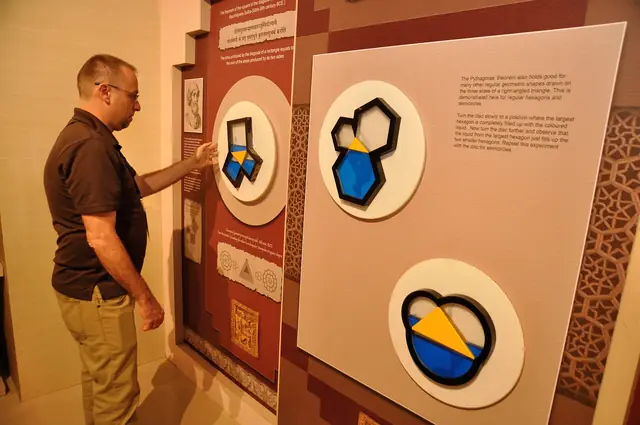
The Shulbasutras, manuals of the cord, tell how to lay out Vedic fire-altars of exact shape and area. Baudhayana states that the diagonal of a rectangle produces both areas that its two sides produce separately, the rule now called Pythagoras’ theorem.

How it travelled: Bharat shared this knowledge rather than owning it alone: Old Babylonian scribes listed such number triples around 1800 BCE (the tablet Plimpton 322), and Greek tradition credits Pythagoras. The Shulbasutras give no proof in the Greek sense, but state the rule generally.

Today: Masons still square a foundation with a 3-4-5 cord.

The proof (2)
  1. Baudhayana Shulbasutra 1.48 states the rule for any rectangle.
  2. The same text gives the diagonal of a square as 1 + 1/3 + 1/(3·4) − 1/(3·4·34) of its side, which is 1.4142156, close to the square root of two.

Baudhayana Shulbasutra 1.48 · S. N. Sen and A. K. Bag, The Sulbasutras (INSA, 1983) · Plimpton 322 tablet, Columbia University

AyurvedaMedicine
Charaka and Sushruta Samhitas, before the Gupta age

Ayurveda

The knowledge of life, an Upaveda of the Atharvaveda

Ayurveda treats health as a balance of the three doshas, vata, pitta and kapha, kept by diet, daily routine, season and medicine. Its two great samhitas are Charaka’s, on medicine, and Sushruta’s, on surgery; Vagbhata’s Ashtanga Hridaya later joined them.

How it travelled: Indian physicians served the Abbasid court, and the samhitas entered Arabic medicine in the 8th–9th centuries. The Ashtanga Hridaya was translated into Tibetan, and Tibetan medicine draws on it to this day.

Today: The WHO Global Centre for Traditional Medicine was founded at Jamnagar, Gujarat, in 2022.

The proof (3)
  1. The Bower manuscript (c. 6th century), found in Kucha on the Silk Road, holds the Navanitaka, drawing on the Charaka and Sushruta schools.
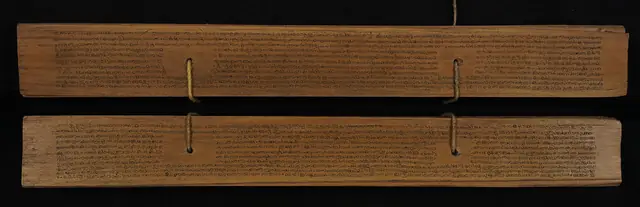
  2. A palm-leaf Sushruta Samhita copied in Nepal in 878 CE survives in the Kaiser Library, Kathmandu.
  3. Ibn al-Nadim’s Fihrist (987) lists Arabic translations of Charaka and Sushruta made in Abbasid Baghdad.

Charaka Samhita · Sushruta Samhita · A. F. R. Hoernle, The Bower Manuscript (ASI, 1893–1912) · Ibn al-Nadim, Kitab al-Fihrist (987)

Cataract couchingMedicine
Sushruta Samhita, Uttaratantra

Cataract couching

A needle that pushed the clouded lens aside

Sushruta describes a cataract, linganasha, and an operation to treat it: a lancet is passed into the eye at the side and the clouded lens is pushed down out of the line of sight. The patient then sees again, though without sharp focus.

How it travelled: Buddhist monk-physicians carried the method to Tang China, where it became known as the golden-needle technique, and Indian eye-doctors are named in Tang writings.

Today: Modern cataract surgery removes the lens instead, but couching was the main cure for the blind for two thousand years.

The proof (2)
  1. Sushruta Samhita, Uttaratantra 17, gives the position of the patient, the point of entry and the after-care.
  2. Couching was also practised in the Greek and Roman world (Celsus, 1st century CE), so Bharat shares this one.

Sushruta Samhita, Uttaratantra 17 · Celsus, De Medicina, Book VII

Dhyana: meditationYoga
Upanishads and Yoga Sutra; to China by the 5th–6th centuries

Dhyana: meditation

The Sanskrit word behind Chan and Zen

Dhyana, unbroken attention held on one object, is the seventh limb of Patanjali’s yoga and the heart of Upanishadic practice. The Buddha taught it as jhana, and Buddhist monks carried it across Asia.

How it travelled: The Chan school of China, which honours the Indian monk Bodhidharma as founder, passed to Japan as Zen and to Korea as Seon. In the 20th century teachers from Bharat brought meditation to the West directly.

Today: Hospitals, schools and offices worldwide teach meditation, often without naming its source.

The proof (2)
  1. Yoga Sutra 3.2: the unbroken flow of awareness toward one object is dhyana.
  2. Chinese chan is a short form of channa, the Chinese rendering of dhyana; Japanese zen is its Japanese reading.

Patanjali, Yoga Sutra 3.2 · Bhagavad Gita, chapter 6 · Heinrich Dumoulin, Zen Buddhism: A History, Vol. 1 (1988)

Natya Shastra and classical danceArts
Bharata Muni; in UNESCO’s register since 2025

Natya Shastra and classical dance

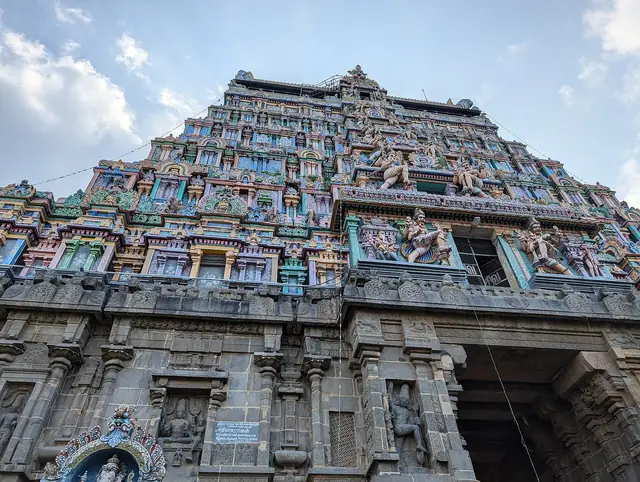
Bharata Muni’s rasa, carved in stone at Chidambaram

Bharata Muni’s Natya Shastra is the shastra of drama, dance and music: stage, gesture, costume, music and, above all, rasa, the flavour of feeling the audience tastes. Bharatanatyam, Kathak, Odissi, Kuchipudi, Kathakali, Mohiniyattam, Manipuri and Sattriya all look back to it.

How it travelled: Indian dance went with temple culture to Cambodia and Java, where the apsaras of Angkor and the reliefs of Prambanan show its poses. In the 1920s–30s Uday Shankar toured the West, first with Anna Pavlova and then with his own troupe.

Today: Classical dance schools teach Bharatanatyam and Kathak from London to Sydney.

The proof (3)
  1. The Natya Shastra’s fourth chapter defines 108 karanas, units of dance movement.
  2. The gopurams of the Nataraja temple at Chidambaram carry the 108 karanas in stone, with the verses labelled.
  3. UNESCO entered the Natya Shastra in its Memory of the World Register in April 2025.

Bharata Muni, Natya Shastra, chapter 4 · Kapila Vatsyayan, Classical Indian Dance in Literature and the Arts (1968) · UNESCO Memory of the World Register (2025)

IndigoCraft
Known to the Greeks and Romans as an Indian product

Indigo

The blue that carries India in its name

Indigo dye is made by steeping the leaves of Indigofera tinctoria, the nil plant, fermenting the liquor and beating it until the blue settles out as cakes. Indian dyers knew how to fix it on cotton in shades from sky to near black.

How it travelled: Indigo cakes went to Rome, then to medieval Europe by way of Venice and later by the Portuguese sea route. Under Company rule, European planters forced Bengal and Bihar cultivators to grow it, which led to the Indigo Revolt of 1859–60 and to Gandhi’s Champaran satyagraha of 1917.

Today: Every pair of blue jeans is dyed indigo, though the dye is now mostly made in factories.

The proof (2)
  1. The Greek name indikon and Latin indicum mean simply “the Indian (dye)”; Pliny’s Natural History (1st century CE) describes indicum brought from India.
  2. The Sanskrit nili gave the dye its name across Asia, through Arabic an-nil to the Portuguese anil.

Pliny the Elder, Natural History, Book 35 · Jenny Balfour-Paul, Indigo (British Museum Press, 1998) · Dinabandhu Mitra, Nil Darpan (1860)

T
Mathematics
By 499 CE, Aryabhata

The nine figures and place value

Ten signs that write every number there is

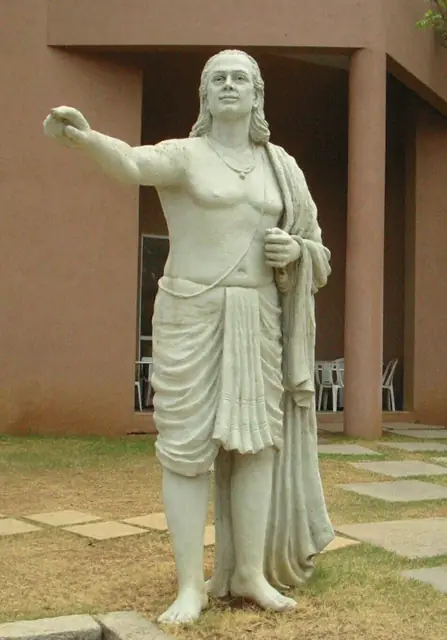
Indian astronomers wrote numbers with nine signs whose worth depends on their place, each place ten times the one to its right. Aryabhata states the rule in 499 CE, and the signs themselves grew out of Brahmi numerals. With a sign for the empty place, any number at all can be written and worked on paper.

How it travelled: Al-Khwarizmi wrote on reckoning with Hindu numerals in Baghdad around 825; in Latin his book became Algoritmi de numero Indorum, and his name became the word algorithm. Fibonacci taught Europe “the nine figures of the Indians” in Liber Abaci (1202).

Today: Every price tag, phone number and spreadsheet on earth is written in this system.

The proof (3)
  1. Aryabhatiya, Ganitapada 2: from place to place, each is ten times the one before (sthanat sthanam dashagunam).
  2. In 662 CE the Syrian bishop Severus Sebokht praised the Hindus’ way of reckoning “by means of nine signs”.
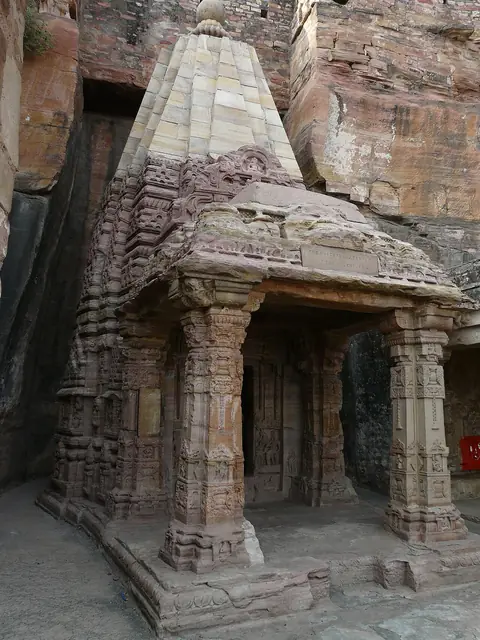
  3. The Chaturbhuj temple inscription at Gwalior (876 CE) writes 270 and 50 in place value with a round zero.

Aryabhatiya, Ganitapada 2 · Severus Sebokht, letter of 662 CE (quoted in F. Nau, Journal Asiatique, 1910) · Fibonacci, Liber Abaci (1202)

The sine (jya)Mathematics
499 CE, Aryabhata

The sine (jya)

The half-chord that became trigonometry’s first word

Greek astronomers measured with whole chords of a circle. Indian astronomers switched to the half-chord, ardha-jya, shortened to jya or jiva, which is the sine used today. Aryabhata gave a table of sine differences in 499 CE.

How it travelled: Arabic writers wrote jiva as jiba; later readers took it as jaib, “fold” or “pocket”, and 12th-century Latin translators rendered that as sinus. So the word sine is a Sanskrit word misread twice.

Today: Every sin key on a calculator traces back to jya.

The proof (2)
  1. The Aryabhatiya gives 24 sine differences for a quarter circle, at steps of 3¾ degrees.
  2. Varahamihira’s Panchasiddhantika (6th century) and the Surya Siddhanta use the same jya tables for planetary positions.

Aryabhatiya, Gitikapada 12 · Varahamihira, Panchasiddhantika · K. S. Shukla and K. V. Sarma, Aryabhatiya of Aryabhata (INSA, 1976)

Chess (chaturanga)Games
Gupta age or soon after; recorded by the 6th–7th centuries

Chess (chaturanga)

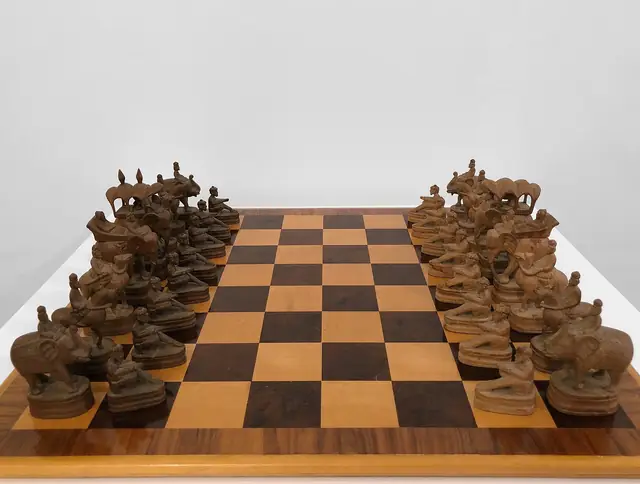
The four limbs of an army on sixty-four squares

Chaturanga, “four-limbed”, was the old name of an army of elephants, horses, chariots and foot soldiers. The game set them on the 64-square ashtapada board, with a king and his minister, and it is the ancestor of chess.

How it travelled: Persia called it chatrang, then shatranj; the Arabs took it from Persia, and Europe from the Arabs, by about 1000 CE. A minority of scholars have argued for an origin in China or Central Asia, but the Persian sources themselves name India.

Today: Chess is played by hundreds of millions, and India now produces world champions.

The proof (3)
  1. The Middle Persian Chatrang-namag tells how a king of Hind sent the game to Khosrow I (r. 531–579) as a challenge.
  2. Ferdowsi’s Shahnameh (1010) repeats that chess came from Hind.
  3. Banabhatta’s Harshacharita (7th century) puns on chaturanga, the game, in describing Harsha’s peaceful reign.

Chatrang-namag (Middle Persian) · Ferdowsi, Shahnameh (1010) · Banabhatta, Harshacharita · H. J. R. Murray, A History of Chess (1913)

The PanchatantraIdeas
Before c. 570 CE; Arabic c. 750

The Panchatantra

Animal tales for princes that crossed every border

The Panchatantra teaches niti, the wise conduct of life and statecraft, through tales of jackals, crows, lions and tortoises set one inside another. By its own frame story, the sage Vishnu Sharma told them to make three dull princes wise in six months.

How it travelled: From Arabic it went into Hebrew, Latin, German, Spanish and every major language of Europe and Asia; by the 20th century it had been translated more widely than almost any book of Bharat.

Today: Indian children still meet the monkey and the crocodile in school readers and on television.

The proof (3)
  1. The physician Burzoy translated it into Middle Persian for Khosrow I around 570 CE.
  2. Ibn al-Muqaffa’s Arabic Kalila wa Dimna (c. 750) is named for the two jackals Karataka and Damanaka.
  3. La Fontaine, in the preface to his second collection of fables (1678), names “Pilpay, the Indian sage” as a source.

Panchatantra (ed. Franklin Edgerton, The Panchatantra Reconstructed, 1924) · Ibn al-Muqaffa, Kalila wa Dimna (c. 750) · Jean de La Fontaine, Fables, second collection (1678), preface

Zero as a numberMathematics
628 CE, Brahmagupta

Zero as a number

Shunya: nothing, with rules of its own

Brahmagupta, writing at Bhinmal in 628 CE, treated shunya as a number you can add, subtract and multiply, and gave the rules. Before him the empty place was a gap or a dot; after him it was a quantity in its own right.

How it travelled: Arab mathematicians translated shunya as sifr, “empty”. From sifr came the Latin zephirum, the Italian zero, and the English cipher.

Today: Every computer runs on zeros and ones.

The proof (3)
  1. Brahmasphutasiddhanta, chapter 18: a number minus itself is zero; zero minus zero is zero; any number times zero is zero.
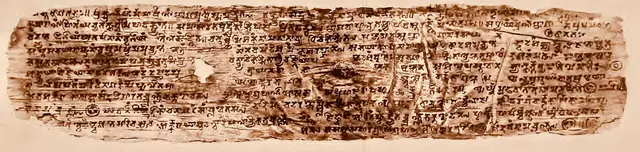
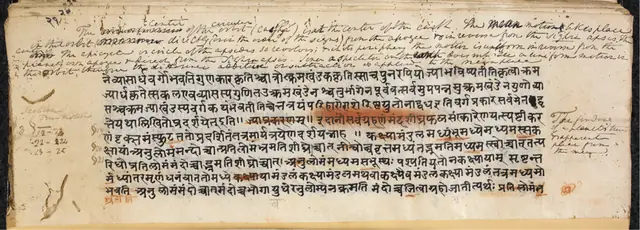
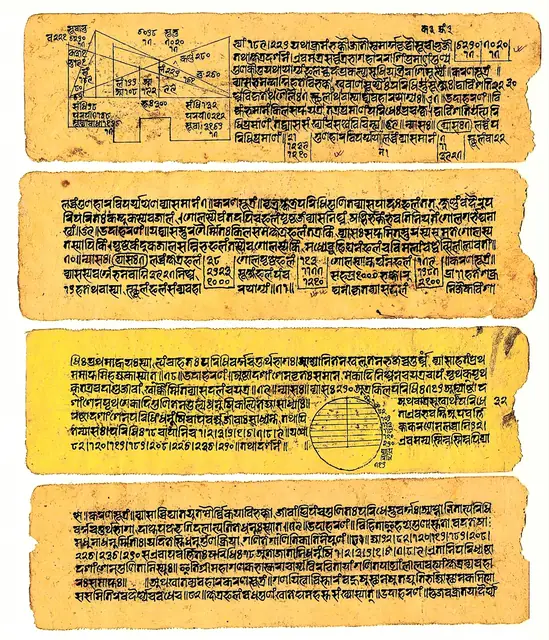
  2. The Bakhshali manuscript writes zero as a dot in empty places.
  3. The Gwalior inscription of 876 CE carves it as a small circle in stone.

Brahmasphutasiddhanta of Brahmagupta, chapter 18 (628 CE) · Gwalior inscription of the time of Bhojadeva (Epigraphia Indica Vol. I) · Bodleian Library, MS. Sansk. d. 14 (Bakhshali manuscript)

Negative numbers and the rules of algebraMathematics
628 CE, Brahmagupta

Negative numbers and the rules of algebra

Wealth and debt: dhana and rina

Brahmagupta called positive numbers dhana, wealth, and negative numbers rina, debt, and set down how they combine. In the same book he solved quadratic equations and worked with unknowns named by colours.

How it travelled: Brahmagupta’s book was put into Arabic at Baghdad in the 770s. Europe was slow to accept negative numbers and still called them “absurd” in the 16th century; H. T. Colebrooke’s English translation of 1817 showed how far ahead the Indian texts had been.

Today: A bank balance in the red is Brahmagupta’s rina.

The proof (3)
  1. Brahmasphutasiddhanta 18: the product of two debts is wealth; the product of wealth and debt is debt.
  2. The same chapter gives a rule for solving the quadratic equation.
  3. Bhaskara II’s Bijaganita (1150) carries the method on, with unknowns called yavat-tavat, kalaka and nilaka.

Brahmasphutasiddhanta, chapter 18 (Kuttakadhyaya) · Bhaskara II, Bijaganita (1150) · H. T. Colebrooke, Algebra, with Arithmetic and Mensuration, from the Sanscrit of Brahmegupta and Bháscara (1817)

Crystal sugar: sharkara and khandaFood
Before the Mauryas; China learned the method in 647 CE

Crystal sugar: sharkara and khanda

The words sugar and candy are Sanskrit

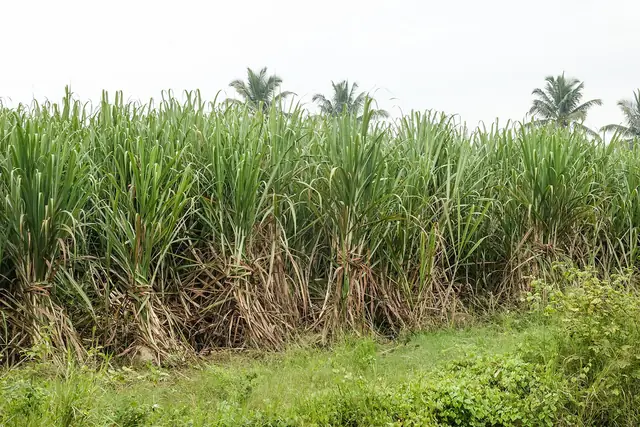
Sugarcane was first domesticated in New Guinea, but Bharat learned to boil its juice down and make solid, storable sugar in grades, from jaggery (guda) to crystals (khanda, sharkara). That turned a sweet cane into a commodity that could cross oceans.

How it travelled: Sharkara became Persian shakar, Arabic sukkar, and English sugar; khanda became Persian qand and Arabic qandi, and English candy. The Arabs carried cane to the Mediterranean, and Europeans later carried it to Atlantic plantations worked by enslaved Africans.

Today: Mishri and khand are still offered as prasad, and India is one of the world’s two largest sugar producers.

The proof (2)
  1. Kautilya’s Arthashastra lists the grades of cane sugar kept in the royal storehouse, among them guda, khanda and sharkara.
  2. Chinese records report that in 647 Emperor Taizong of Tang sent envoys to India to learn how sugar was boiled.

Kautilya, Arthashastra 2.15 · Xin Tangshu (New Book of Tang), account of the Western Regions · Sidney Mintz, Sweetness and Power (1985)

T
Mathematics
Virahanka (c. 7th century CE) to Hemachandra (c. 1150)

The “Fibonacci” numbers, counted first in metre

1, 2, 3, 5, 8: counted by poets before Fibonacci

In metres counted by beats (matra), a line can be built from short beats of one and long beats of two. Virahanka worked out that the number of such patterns for each length is the sum of the two before it. Gopala and then Hemachandra (c. 1150) stated the rule again.

How it travelled: Fibonacci reached the sequence through a rabbit puzzle in 1202, and no link to the Indian texts is known. The Indian priority is recorded in modern histories of mathematics, which now speak of Virahanka numbers too.

Today: The sequence turns up in sunflower heads, pine cones and computer search algorithms.

The proof (2)
  1. Virahanka’s Vrittajatisamuccaya gives the rule for counting matra-vritta patterns.
  2. The Jain acharya Hemachandra’s Chhandonushasana (c. 1150) states it again, half a century before Fibonacci’s Liber Abaci (1202).

Virahanka, Vrittajatisamuccaya · Hemachandra, Chhandonushasana (c. 1150) · Parmanand Singh, “The so-called Fibonacci numbers in ancient and medieval India”, Historia Mathematica 12 (1985)

S
Science
499–628 CE in Bharat; Baghdad, 770s

Siddhanta astronomy in Baghdad

Indian astronomical tables that taught the Abbasid court

The siddhantas of Aryabhata and Brahmagupta computed the places of sun, moon and planets with sine tables and long cycles of years. Aryabhata also held that the earth turns on its axis, and that the stars only seem to move.

How it travelled: An Indian astronomer reached the court of Caliph al-Mansur in the 770s with a siddhanta, which al-Fazari turned into Arabic as the Zij al-Sindhind. Al-Khwarizmi’s own astronomical tables built on it.

Today: The Panchang that fixes every Hindu festival still uses siddhanta methods.

The proof (2)
  1. Aryabhatiya, Golapada 9: as a man in a moving boat sees the bank go backwards, so the fixed stars seem to move west.
  2. Al-Biruni’s Kitab al-Hind (c. 1030) discusses Aryabhata and Brahmagupta by name.

Aryabhatiya, Golapada 9 · Al-Biruni, Kitab al-Hind (c. 1030) · David Pingree, “The Fragments of the Works of al-Fazari”, Journal of Near Eastern Studies 29 (1970)

Raga musicArts
Raga defined by Matanga (c. 9th century); Sangita Ratnakara 13th century

Raga music

From the Samaveda’s chant to the Voyager record

A raga is a melodic form with its own notes, its own turns of phrase, its own hour and mood, within which the musician improvises. The tradition traces its music to the chant of the Samaveda, and grew into the Hindustani and Carnatic systems.

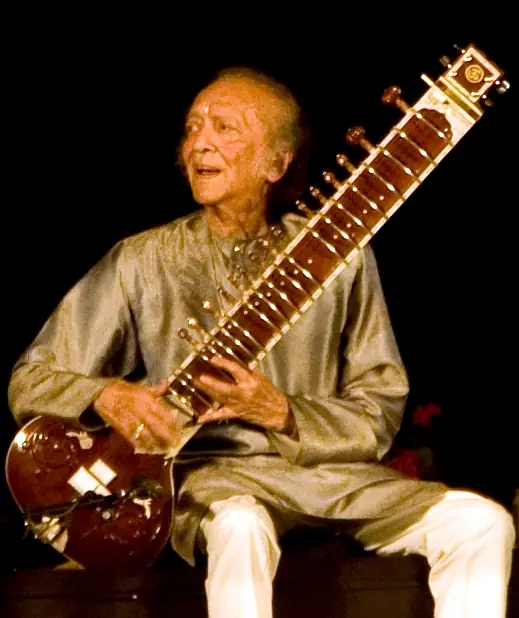
How it travelled: Ravi Shankar took the sitar to the West; George Harrison played it on the Beatles’ “Norwegian Wood” (1965), and Shankar played Monterey (1967) and Woodstock (1969). In 1977 NASA’s Voyager Golden Record carried Kesarbai Kerkar singing “Jaat kahan ho” in raga Bhairavi out of the solar system.

Today: Ragas run under most Indian film songs and are taught in conservatories abroad.

The proof (2)
  1. Matanga’s Brihaddeshi is the first text to define raga; Sharngadeva’s Sangita Ratnakara (13th century) became the standard work.
  2. The 7th-century music inscription at Kudumiyanmalai in Tamil Nadu sets out musical notation in stone.

Matanga, Brihaddeshi · Sharngadeva, Sangita Ratnakara (13th century) · NASA, Voyager Golden Record contents (1977)

The Ramayana across AsiaArts
Java 9th century; Thailand 1797 (Rama I’s Ramakien)

The Ramayana across Asia

Shri Ram’s story told in a dozen tongues

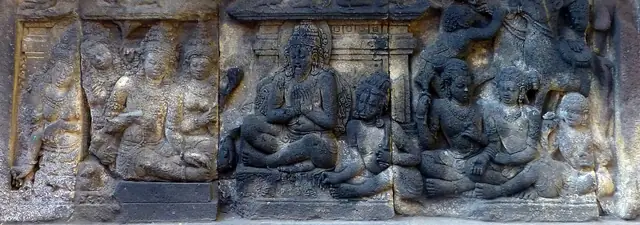
Maharshi Valmiki’s Ramayana travelled with traders, priests and kings across Southeast Asia, and each land made it its own. It is danced in Thai and Cambodian courts, sung in Java, and carved on temples from Prambanan to Angkor.

How it travelled: It spread from the early centuries CE with the Hindu kingdoms of Funan, Champa and Java, and stayed even where the people later became Buddhist or Muslim. The long Ramakien murals at Wat Phra Kaew in Bangkok are still restored and repainted.

Today: The Ramayana ballet is performed under the towers of Prambanan on full-moon nights.

The proof (3)
  1. The balustrades of the Shiva temple at Prambanan (9th century) carry the Ramayana in relief panels.
  2. The Old Javanese Kakawin Ramayana, the Khmer Reamker, the Thai Ramakien, the Lao Phra Lak Phra Lam and the Malay Hikayat Seri Rama all retell it.
  3. The Thai capital Ayutthaya, founded in 1351, was named after Ayodhya.

Valmiki Ramayana · Kakawin Ramayana (Old Javanese) · Ramakien of King Rama I (1797) · Prambanan temple compound, UNESCO World Heritage nomination (1991)

The chakravala methodMathematics
628 CE (Brahmagupta) to 1150 CE (Bhaskara II)

The chakravala method

A cyclic method that cracked Fermat’s challenge centuries early

Equations of the form Nx² + 1 = y² ask for whole-number answers, and some have enormous ones. Brahmagupta found a way to build new solutions from old (bhavana), and Bhaskara II in 1150 set out the chakravala, a cycle of steps that always reaches a solution.

How it travelled: It did not travel. In 1657 Pierre de Fermat set the very case N = 61 as a challenge to European mathematicians, and Lagrange published a full proof in 1768. Europe learned of the Indian method only in the 19th century.

Today: Number theorists still cite chakravala as one of the high points of medieval mathematics.

The proof (2)
  1. Bhaskara II’s Bijaganita solves 61x² + 1 = y², whose smallest answer is x = 22,61,53,980 and y = 1,76,63,19,049.
  2. An earlier form of the cyclic method is credited to Jayadeva and quoted by Udayadivakara in 1073.

Bhaskara II, Bijaganita (1150) · Brahmasphutasiddhanta, chapter 18 · K. S. Shukla, “Acarya Jayadeva, the mathematician”, Ganita 5 (1954)

Z
Science
Furnaces of the 14th century CE excavated; working into the 19th

Zinc by distillation

The first industrial-scale zinc, at Zawar in Rajasthan

Zinc boils away before it melts out of its ore, so it cannot be smelted like copper. At Zawar near Udaipur, smiths packed ore into clay retorts set upside down over a cool chamber, where the zinc vapour condensed and dripped down as metal.

How it travelled: Zinc distillation was also worked out in China by the 17th century. William Champion patented a downward-distillation process at Bristol in 1738; whether he knew of the Indian method is not proven.

Today: Galvanised steel and brass both depend on zinc, and Zawar is still mined today.

The proof (2)
  1. Excavations at Zawar by Paul Craddock and Indian colleagues found banks of furnaces, each holding 36 retorts, and heaps of spent retorts.
  2. Radiocarbon dates from timbers in the old Zawar mine galleries go back about two thousand years.

P. T. Craddock (ed.), 2000 Years of Zinc and Brass (British Museum Occasional Paper 50, 1990) · P. T. Craddock, L. K. Gurjar and K. T. M. Hegde, “Zinc production in medieval India”, World Archaeology 15 (1983)

Infinite series for pi and sineMathematics
c. 1340–1425 CE, Madhava; Yuktibhasha c. 1530

Infinite series for pi and sine

Kerala’s answer, three centuries before Newton and Leibniz

Madhava of Sangamagrama, near Irinjalakuda in Kerala, found that pi can be written as an endless sum, and gave endless series for sine and cosine too. His pupils down the line, Nilakantha Somayaji and Jyeshthadeva, wrote them down with proofs.

How it travelled: Charles Whish brought the Kerala series to European notice in 1834. Some historians suggest Jesuits in Kerala may have carried the ideas to Europe in the 16th century, but no document proving it has been found.

Today: Calculus classes teach the same series under the names Gregory and Leibniz; many textbooks now add Madhava’s name.

The proof (2)
  1. Pi/4 = 1 − 1/3 + 1/5 − 1/7 + …, with correction terms for the tail, set out in Nilakantha’s Tantrasangraha (1500).
  2. Jyeshthadeva’s Yuktibhasha (c. 1530), in Malayalam, gives the reasoning step by step.

Nilakantha Somayaji, Tantrasangraha (1500) · Jyeshthadeva, Yuktibhasha (c. 1530); K. V. Sarma (ed., tr.), Ganita-Yukti-Bhasa (2008) · C. M. Whish, Transactions of the Royal Asiatic Society, Vol. 3 (1834)

The Kashmir shawlCraft
Flourishing from the 16th century; craze in Europe c. 1800

The Kashmir shawl

Pashmina and the buta, copied in a Scottish town

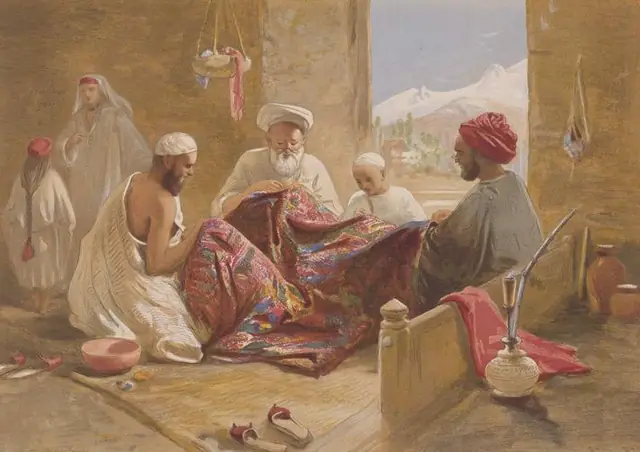
Kashmiri weavers spun the soft under-fleece of Himalayan goats, pashm, and wove shawls on the kani method, with dozens of small wooden bobbins (tojli) for the pattern. Their curving buta motif became one of the most copied designs in the world.

How it travelled: Shawls sent home by Company officers became the fashion of Napoleonic France and Regency Britain. Weavers at Paisley in Scotland copied them on mechanised looms from the early 19th century, so the buta is now known in English as “paisley”.

Today: Kashmir Pashmina carries a Geographical Indication tag, and the buta is printed on cloth the world over.

The proof (2)
  1. The Ain-i-Akbari (1590s) records Akbar’s interest in Kashmir shawls and the varieties made for his court.
  2. Kashmiri tradition credits Sultan Zain-ul-Abidin (15th century) with bringing in master weavers, so the craft grew from Kashmiri skill joined with Central Asian technique.

Abul Fazl, Ain-i-Akbari, Book I · Frank Ames, The Kashmir Shawl and its Indo-French Influence (1986) · Paisley Museum shawl collection

Diamonds of GolcondaCraft
Ancient times to 1725 CE

Diamonds of Golconda

For two thousand years, nearly every diamond came from Bharat

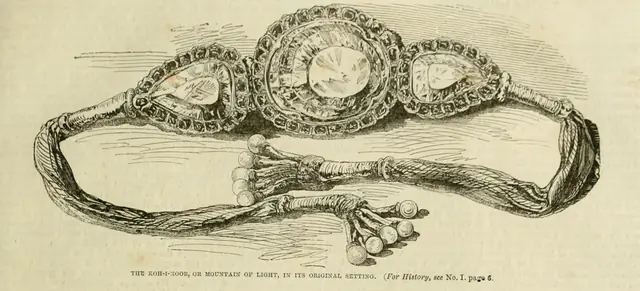
Diamonds were dug from the gravels of the Krishna and Godavari valleys and the Panna region long before they were found anywhere else in quantity. The Kollur mines on the Krishna yielded the most famous stones, and the market town of Golconda gave the whole trade its name.

How it travelled: Indian diamonds reached Rome, the courts of Persia, and from the 17th century the crowns of Europe. The Koh-i-Noor, the Hope, the Regent and the Daria-i-Noor all came from these mines.

Today: Jewellers still call the purest, most limpid diamonds “Golconda” stones, and Surat now cuts most of the world’s diamonds.

The proof (3)
  1. Kautilya’s Arthashastra lists vajra (diamond) among the gems of the royal treasury and describes how to judge it.
  2. The French jeweller Tavernier visited the Kollur mines in the 1640s–60s and sold Louis XIV the blue stone later cut into the Hope diamond.
  3. Apart from small finds in Borneo, Bharat was the world’s only known source until diamonds were found in Brazil around 1725.

Kautilya, Arthashastra 2.11 · Jean-Baptiste Tavernier, Les Six Voyages (1676) · Smithsonian National Museum of Natural History, Hope Diamond records

T
Ideas
Shruti; Persian 1657, Latin 1801–02

The Upanishads

“The solace of my life”, said Schopenhauer

The Upanishads are the Vedanta, the end and summit of the Vedas, teaching that Atman, the Self, is Brahman. Their great sayings, tat tvam asi and aham brahmasmi, are the ground of Adi Shankaracharya’s Advaita and of every school of Vedanta.

How it travelled: From Schopenhauer the Upanishads passed into European philosophy. T. S. Eliot closed The Waste Land (1922) with “Datta. Dayadhvam. Damyata.” from the Brihadaranyaka Upanishad and “Shantih shantih shantih”.

Today: The Upanishads are read in translation in universities and homes the world over.

The proof (2)
  1. Dara Shikoh, with the help of pandits of Varanasi, had fifty Upanishads translated into Persian in 1657 as the Sirr-i-Akbar, “the greatest secret”.
  2. Anquetil-Duperron turned the Persian into Latin as the Oupnek’hat (1801–02); Schopenhauer wrote of it in 1851: “It has been the solace of my life, it will be the solace of my death.”

Brihadaranyaka Upanishad 5.2; Chandogya Upanishad 6.8.7 · Dara Shikoh, Sirr-i-Akbar (1657) · A. H. Anquetil-Duperron, Oupnek’hat (1801–02) · Arthur Schopenhauer, Parerga and Paralipomena (1851)

Chintz and calicoCraft
Traded for centuries; height of the trade 17th–18th centuries

Chintz and calico

Printed cottons so loved that Britain banned them

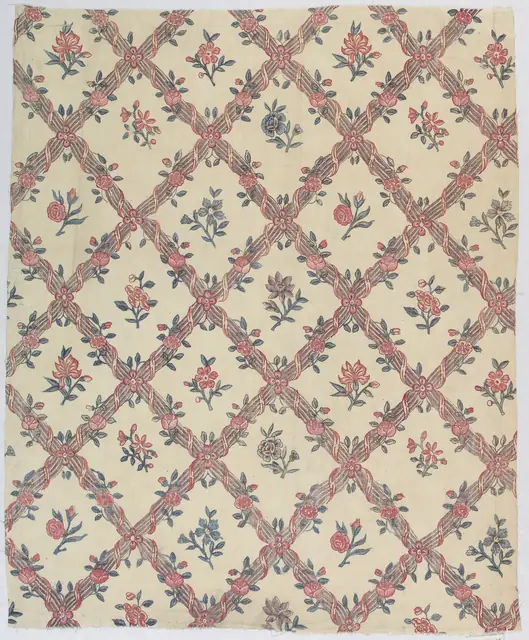
Indian dyers mastered fast colours on cotton: madder reds and indigo blues fixed with mordants, printed with wooden blocks or drawn by hand with the kalam pen. The bright, washable cloth was called chint, “spotted”, and the plain cloth from Calicut gave English the word calico.

How it travelled: The East India Companies shipped Coromandel and Gujarat chintz to Europe by the shipload. The bans pushed English and French manufacturers to copy Indian dyeing, which helped start the mechanised cotton industry of Lancashire.

Today: Kalamkari from Srikalahasti and Machilipatnam and the block prints of Bagru and Sanganer still use the old methods.

The proof (2)
  1. Block-printed Gujarati cottons have been excavated at Fustat (old Cairo) in Egypt; many are now in the Ashmolean Museum, Oxford.
  2. Britain’s Calico Acts of 1700 and 1721 banned the import and then the wearing of printed Indian cottons, to protect English wool and silk.

Ruth Barnes, Indian Block-Printed Textiles in Egypt: The Newberry Collection in the Ashmolean Museum (1997) · Calico Act 1700 (11 & 12 Will. III c. 10); Calico Act 1721 (7 Geo. I c. 7) · John Irwin and Katharine Brett, Origins of Chintz (V&A, 1970)

I
Medicine
Recorded in Bengal, 18th century; Holwell 1767

Inoculation against smallpox

Bengal’s tikadars, described to London doctors in 1767

Before vaccination, smallpox was prevented by giving a mild case on purpose, with matter taken from a pustule and put into a small cut. In Bengal travelling Brahmin inoculators, the tikadars, did this every spring, with rules of diet and cool water for the patient.

How it travelled: Bharat was one of several homes of the practice: China blew powdered scabs into the nose, and Lady Mary Wortley Montagu brought the Ottoman method to England in 1721. Holwell’s account added the Indian evidence, and Jenner’s cowpox vaccine of 1796 later replaced all of them.

Today: Smallpox was declared eradicated in 1980; India’s last case was in 1975.

The proof (2)
  1. J. Z. Holwell, An Account of the Manner of Inoculating for the Small Pox in the East Indies, read to the College of Physicians in London and printed in 1767.
  2. Holwell describes the tikadars’ round of the villages before the smallpox season and their strict rules for after-care.

J. Z. Holwell, An Account of the Manner of Inoculating for the Small Pox in the East Indies (London, 1767) · Dharampal, Indian Science and Technology in the Eighteenth Century (1971)

The Bhagavad GitaIdeas
Kurukshetra, end of the Dvapara Yuga (traditional reckoning); English 1785

The Bhagavad Gita

Shri Krishna’s 700 verses, read from Concord to Los Alamos

The Gita is Shri Krishna’s teaching to Arjuna on the field of Kurukshetra, in 18 chapters of the Mahabharata’s Bhishma Parva: act without craving for the fruit, know the Self that does not die, surrender to the Bhagwan. Adi Shankaracharya, Ramanujacharya and Madhvacharya each wrote commentaries on it.

How it travelled: From Wilkins it passed to Emerson and Thoreau in New England, Wilhelm von Humboldt in Germany, and in the 20th century to Aldous Huxley and countless readers through the editions of Gita Press and ISKCON.

Today: UNESCO entered the Gita in its Memory of the World Register in April 2025.

The proof (3)
  1. Charles Wilkins published the first English translation in London in 1785, with a preface by Warren Hastings.
  2. Thoreau wrote in Walden (1854): “In the morning I bathe my intellect in the stupendous and cosmogonal philosophy of the Bhagvat Geeta.”
  3. J. Robert Oppenheimer recalled, in a 1965 television interview, that Gita 11.32 came to his mind at the first atomic test on 16 July 1945; Krishna there declares himself Kala, Time, the destroyer of worlds.

Bhagavad Gita 2.47, 11.32 (Gita Press) · Charles Wilkins, The Bhagvat-Geeta (London, 1785) · H. D. Thoreau, Walden (1854) · UNESCO Memory of the World Register (2025)

Rebuilding the noseMedicine
Sushruta Samhita; seen at Pune in 1794

Rebuilding the nose

Sushruta’s skin flap, learned by London surgeons in 1814

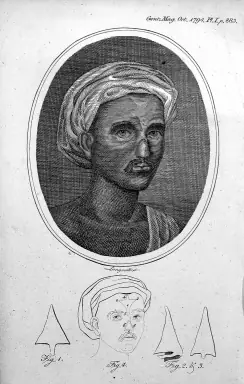
The Sushruta Samhita describes rebuilding a cut nose with a flap of living skin from the cheek, kept attached by a pedicle so it stays alive. The craft survived in Indian families for centuries, outside the courts and colleges.

How it travelled: Joseph Carpue performed the Indian method in London in 1814 and published it in 1816, naming its source. German surgeons took it up as “the Indian method”.

Today: The forehead flap is still taught in plastic surgery as the Indian flap.

The proof (2)
  1. Sushruta Samhita, Sutrasthana 16, gives the method step by step.
  2. The Gentleman’s Magazine of October 1794 printed an account, with an engraving, of the forehead-flap operation done near Pune on Cowasjee, a bullock-driver.

Sushruta Samhita, Sutrasthana 16 · The Gentleman’s Magazine, October 1794 · J. C. Carpue, An Account of Two Successful Operations for Restoring a Lost Nose (1816)

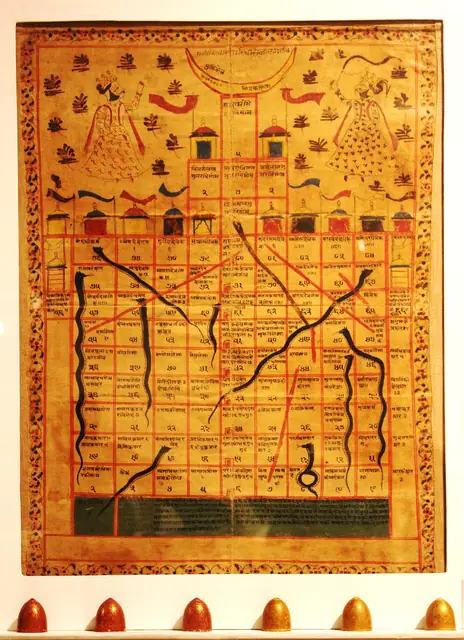
Snakes and ladders (Gyan Chaupar)Games
Surviving boards from the 18th–19th centuries; the game is older

Snakes and ladders (Gyan Chaupar)

Climb by virtue, fall by vice, reach moksha

Gyan Chaupar, also called Moksha Patam in the south, is a board of squares where ladders stand for virtues and snakes for vices, and the last square is liberation. Hindu, Jain and Sufi versions were painted on cloth and paper, with more snakes than ladders.

How it travelled: The game reached Victorian England, where a version was registered in 1892 with Indian virtues swapped for English ones and the snakes and ladders made equal in number. Milton Bradley sold it in America as Chutes and Ladders from 1943.

Today: Children everywhere learn to count on its hundred squares.

The proof (2)
  1. Painted Gyan Chaupar boards survive in the National Museum, New Delhi, and other collections, with squares named for virtues, vices and lokas.
  2. The popular claim that Sant Jnaneshwar made the game in the 13th century has no early source behind it.

Gyan Chaupar boards, National Museum, New Delhi · Andrew Topsfield, “The Indian Game of Snakes and Ladders”, Artibus Asiae 46 (1985)

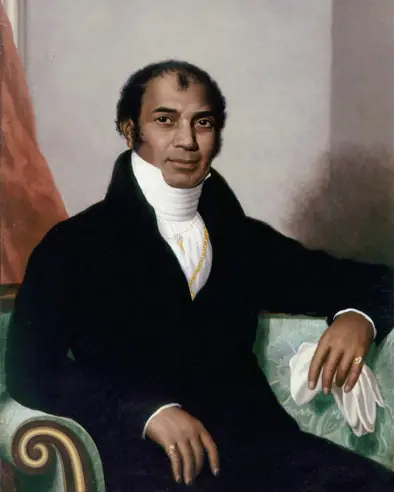
ShampooCraft
Word in English from the 1760s; Brighton baths 1814

Shampoo

From champo, “press!”, to a Brighton bathhouse

Champo is the Hindi command “press!” from champna, to knead: the head-and-body massage with oils given in Indian homes and baths. English borrowed it in the 18th century for the massage, and only later for washing hair.

How it travelled: From Brighton the word spread through Britain; by the late 19th century “shampoo” meant washing the hair, and the first bottled shampoos followed in the early 20th century.

Today: Shampoo sits in every bathroom, and the head massage with oil, champi, is still a Sunday ritual in Indian homes.

The proof (2)
  1. Sake Dean Mahomed, born at Patna in 1759, came to Brighton in 1814 and soon opened a bath there; around 1820 his larger Mahomed’s Baths rose on the seafront, where the Queen’s Hotel now stands.
  2. He was appointed “shampooing surgeon” to George IV and William IV, and published Shampooing, or Benefits Resulting from the Use of the Indian Medicated Vapour Bath (1822).

Sake Dean Mahomed, Shampooing, or Benefits Resulting from the Use of the Indian Medicated Vapour Bath (1822) · Michael H. Fisher, The First Indian Author in English: Dean Mahomed (1996) · Brighton & Hove Museums, Sake Dean Mahomed collection

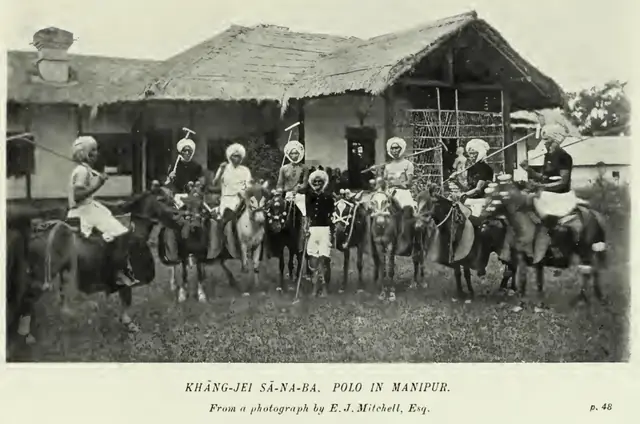
Modern polo (sagol kangjei)Games
Played in Manipur for centuries; Silchar club 1859

Modern polo (sagol kangjei)

Manipur’s pony game, learned by British planters at Silchar

In Manipur, sagol kangjei is played on the small, hardy Manipuri pony, with a stick and a bamboo-root ball. Horse-and-ball games are old in Persia and Central Asia too, but the modern sport was learned from Manipur.

How it travelled: Officers carried the game to England, where the first match was played in 1869 and the Hurlingham Club wrote the rules in 1874. The English word polo comes from pulu, the ball.

Today: Polo is played in more than 80 countries, from Argentina to England.

The proof (3)
  1. Lieutenant Joseph Sherer and Robert Stewart founded the first European polo club at Silchar, Cachar, in 1859, after watching Manipuri players.
  2. The Calcutta Polo Club, founded in 1862, is the oldest polo club still active.
  3. The Mapal Kangjeibung in Imphal is counted among the oldest polo grounds in the world.

Horace A. Laffaye, The Evolution of Polo (2009) · Silchar polo club memorial inscription · Hurlingham Polo Association rules (1874)

Words English took from BharatLanguage
Mostly 17th–19th centuries

Words English took from Bharat

Karma, guru, jungle, loot and juggernaut

English carries hundreds of words from Sanskrit and the languages of Bharat. Some kept their meaning, like karma, guru, mantra, yoga and avatar; others changed on the way, like pundit from pandita, a learned man, and jungle from jangala, which in Sanskrit means dry, open country.

How it travelled: Traders, soldiers and Company officials carried the words home from the 17th century on; scholars of Sanskrit and, in the 20th century, teachers of yoga and Vedanta added the rest.

Today: An “avatar” on every screen and “karma” in everyday speech are Sanskrit at work.

The proof (3)
  1. Loot is Hindi lut; thug is thag, a cheat; bungalow is bangla, a house in the Bengal style; shampoo is champo; dungarees is from dungri cloth.
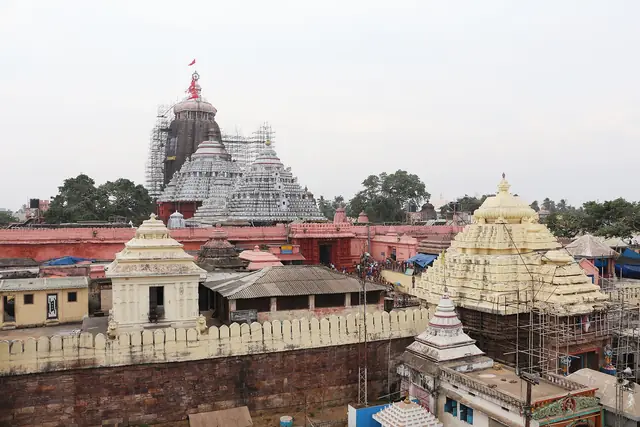
  2. Juggernaut comes from Jagannath of Puri, from European travellers’ exaggerated tales of the great chariots of the Rath Yatra.
  3. Yule and Burnell’s Hobson-Jobson (1886) collected these borrowings in one dictionary.

Henry Yule and A. C. Burnell, Hobson-Jobson (1886) · Oxford English Dictionary, etymologies of loot, thug, jungle, bungalow, shampoo, juggernaut

P
Games
Played across Bharat for centuries; Ludo patented 1896

Pachisi and chaupar: the parent of Ludo

A cross-shaped cloth board, cowries and four colours

Pachisi, “twenty-five”, is a race game on a cross-shaped board, played with cowrie shells; chaupar is its cousin played with long dice. Pieces race around the arms and home to the centre, and they can be captured and sent back.

How it travelled: British families in India took the game home. Ludo, Parcheesi, the German Mensch ärgere Dich nicht and the Spanish parchís are all its descendants.

Today: Ludo apps on phones are played by millions every day.

The proof (2)
  1. At Fatehpur Sikri a pachisi board is laid out in the paving of a courtyard, linked by tradition to Akbar’s court.
  2. In America the game was copyrighted as Parcheesi in 1867, and in England Ludo, with a die and cup, was patented in 1896.

H. J. R. Murray, A History of Board-Games Other than Chess (1952) · British patent for Ludo (1896)

Ahimsa: non-violenceIdeas
Upanishads; satyagraha from 1906

Ahimsa: non-violence

From the Upanishads to Gandhi, to Martin Luther King

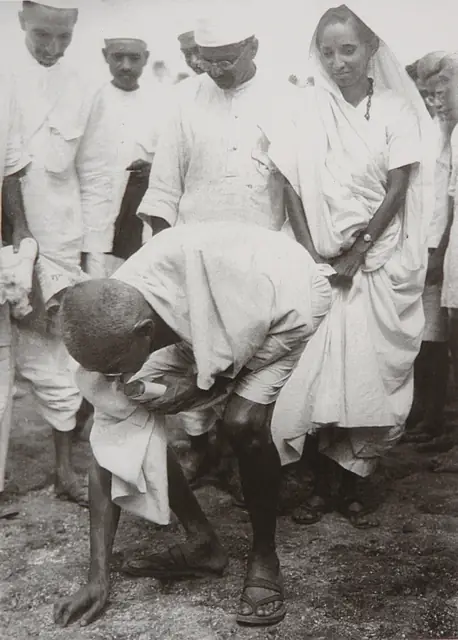
Ahimsa, not harming any living being in thought, word or deed, is the first of Patanjali’s yamas and the first great vow of the Jains, and the Buddha taught it too. Gandhi turned it into a method of mass struggle, satyagraha.

How it travelled: Gandhi first used satyagraha in South Africa in 1906 and then in India. The American civil-rights movement, Nelson Mandela’s generation and later peaceful movements studied his methods.

Today: The UN marks 2 October, Gandhi’s birthday, as the International Day of Non-Violence.

The proof (3)
  1. Chandogya Upanishad 3.17.4 names ahimsa among the virtues that are the dakshina of the inner yajna.
  2. Yoga Sutra 2.35: when one is established in ahimsa, enmity falls away in his presence.
  3. Martin Luther King Jr. credited Gandhi in Stride Toward Freedom (1958) and travelled to India in 1959 to learn more.

Chandogya Upanishad 3.17.4 · Patanjali, Yoga Sutra 2.35 · M. K. Gandhi, Satyagraha in South Africa (1928) · Martin Luther King Jr., Stride Toward Freedom (1958)

KabaddiGames
Traditional; Asian Games since 1990

Kabaddi

One breath, one raid, seven defenders

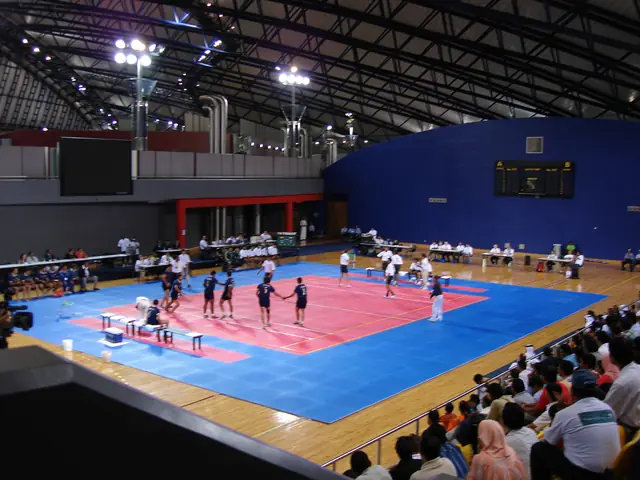
A raider crosses into the other half on a single breath, chanting “kabaddi”, touches whom he can and gets back before the defenders pin him. Village Bharat has played it for generations under many names: hu-tu-tu in Maharashtra, chedugudu in the south, ha-du-du in Bengal.

How it travelled: From Bharat it spread across South Asia; it is the national game of Bangladesh. Iran, Korea and Japan now field strong teams, and a Kabaddi World Cup has been held since 2004.

Today: The Pro Kabaddi League, started in 2014, is one of India’s most-watched sports leagues.

The proof (2)
  1. The Hanuman Vyayam Prasarak Mandal of Amravati demonstrated kabaddi in Berlin during the 1936 Olympic Games, as an exhibition outside the official programme.
  2. Kabaddi entered the Asian Games at Beijing in 1990, and India won every men’s gold until 2018.

Hanuman Vyayam Prasarak Mandal, Amravati, records of the 1936 Berlin demonstration · Olympic Council of Asia, Asian Games results (1990–2018) · Amateur Kabaddi Federation of India

Turmeric and neemMedicine
Ayurvedic samhitas; patent cases 1997 and 2000

Turmeric and neem

Household medicines whose patents the world had to cancel

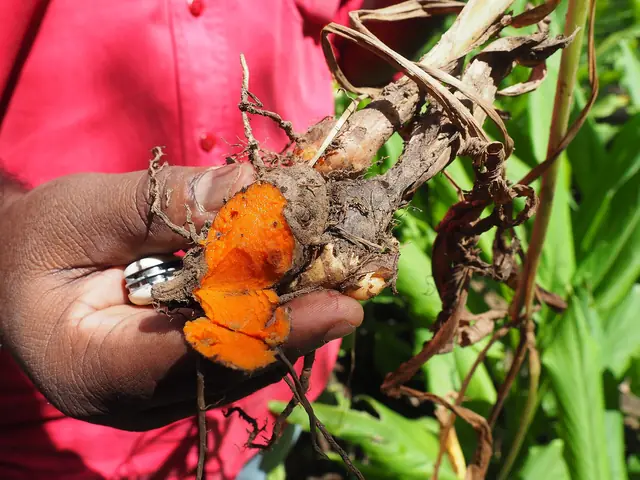
Haridra (turmeric) and nimba (neem) are named again and again in the Ayurvedic samhitas, for wounds, skin and fevers. Every Indian kitchen and village knew them, and that common knowledge later won two legal fights abroad.

How it travelled: Turmeric travelled with the spice trade across Asia and to Europe as “Indian saffron”. The patent cases led India to build the Traditional Knowledge Digital Library (2001), which patent offices now search.

Today: India grows most of the world’s turmeric.

The proof (2)
  1. US patent 5,401,504 (1995) on turmeric for healing wounds was revoked in 1997 after India’s CSIR showed it was old knowledge, citing Sanskrit texts and a 1953 Indian medical paper.
  2. The European Patent Office revoked a patent on a neem-oil fungicide in 2000, and upheld the revocation in 2005.

US Patent 5,401,504, re-examination certificate (USPTO, 1997) · European Patent Office, revocation of EP 0436257 (2000; Board of Appeal 2005) · Charaka Samhita

Diwali and Holi around the worldArts
Ancient; UNESCO listed Deepavali in December 2025

Diwali and Holi around the world

Lamps and colours from Ayodhya and Braj to every continent

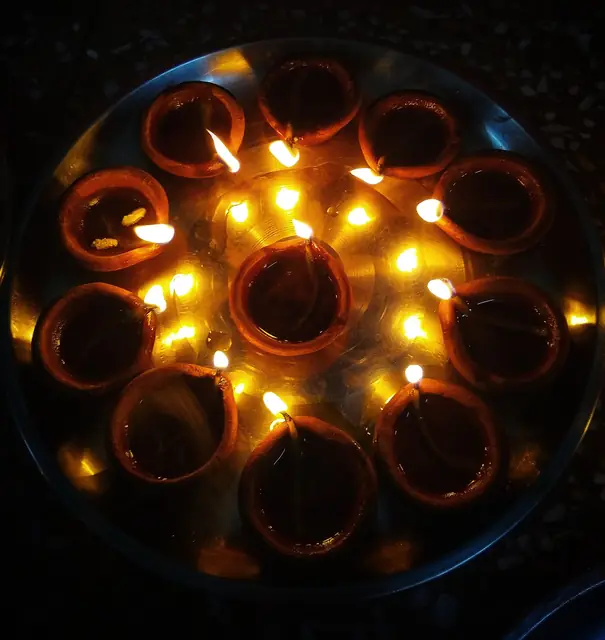
Deepavali celebrates Shri Ram’s return to Ayodhya and the victory of light, with rows of lamps on the new-moon night of Kartik. Holi, the spring festival of Braj, recalls Prahlad’s rescue from Holika’s fire and Shri Krishna’s play with colours.

How it travelled: Girmitiya labourers carried the festivals to the Caribbean, Fiji and Mauritius in the 19th century, and later migrants to Britain, North America and the Gulf. The White House has marked Diwali since 2003, and New York City’s public schools close for it since 2023.

Today: Holi colour runs and Diwali lights now fill cities from Leicester to Sydney.

The proof (2)
  1. UNESCO inscribed Deepavali on the Representative List of the Intangible Cultural Heritage of Humanity on 10 December 2025, at its session held at the Red Fort, Delhi.
  2. Diwali is a public holiday in Nepal, Sri Lanka, Mauritius, Fiji, Trinidad and Tobago, Guyana, Suriname, Malaysia and Singapore.

Valmiki Ramayana, Yuddha Kanda · UNESCO Intangible Cultural Heritage, 20th session of the Intergovernmental Committee (Delhi, December 2025) · Bhagavata Purana, Skandha 7 (Prahlada)