01Fortunes, debts and zero
He tells us he wrote the work in Shaka 550 (628 CE), at the age of thirty, in the reign of King Vyaghramukha of the Chapa dynasty. Chapter 18 sets out arithmetic with dhana (fortunes, positive numbers), rina (debts, negative numbers) and shunya. A debt minus zero is a debt; a fortune minus zero is a fortune; zero minus zero is zero. The product of zero with a debt or a fortune is zero, and the product of two debts is a fortune. On zero divided by zero he said the answer is zero, which later mathematicians corrected, but the step he took, making zero something you compute with, is the one all modern arithmetic stands on.
02Quadrilaterals, equations and Baghdad
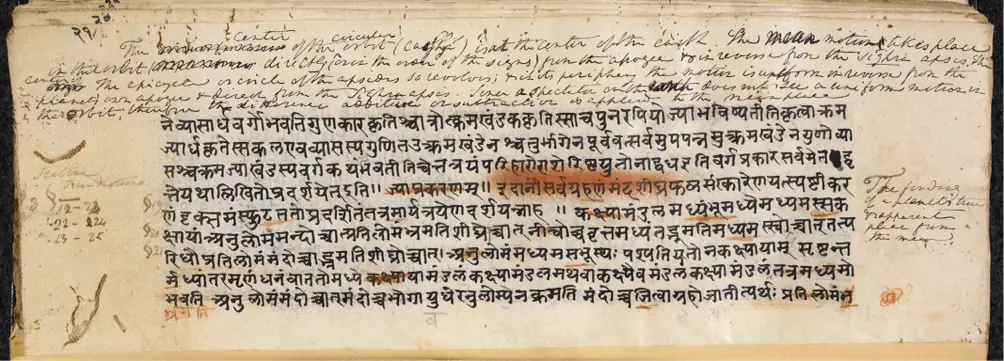
Brahmagupta gave the area of a cyclic quadrilateral from its four sides, a formula still taught under his name. He solved quadratic equations and found a method, bhavana, for building new solutions of the equation Nx² + 1 = y² from known ones, which Bhaskara II later completed. In 665 CE, aged 67, he wrote the Khandakhadyaka, a handbook for calendar-makers. Around 771 CE, an Indian astronomer brought his siddhanta to the court of Caliph al-Mansur in Baghdad, where it was translated into Arabic as the Sindhind, and Indian numerals and methods travelled west with it. Bhaskara II called him Ganakachakrachudamani, the crest-jewel of mathematicians.