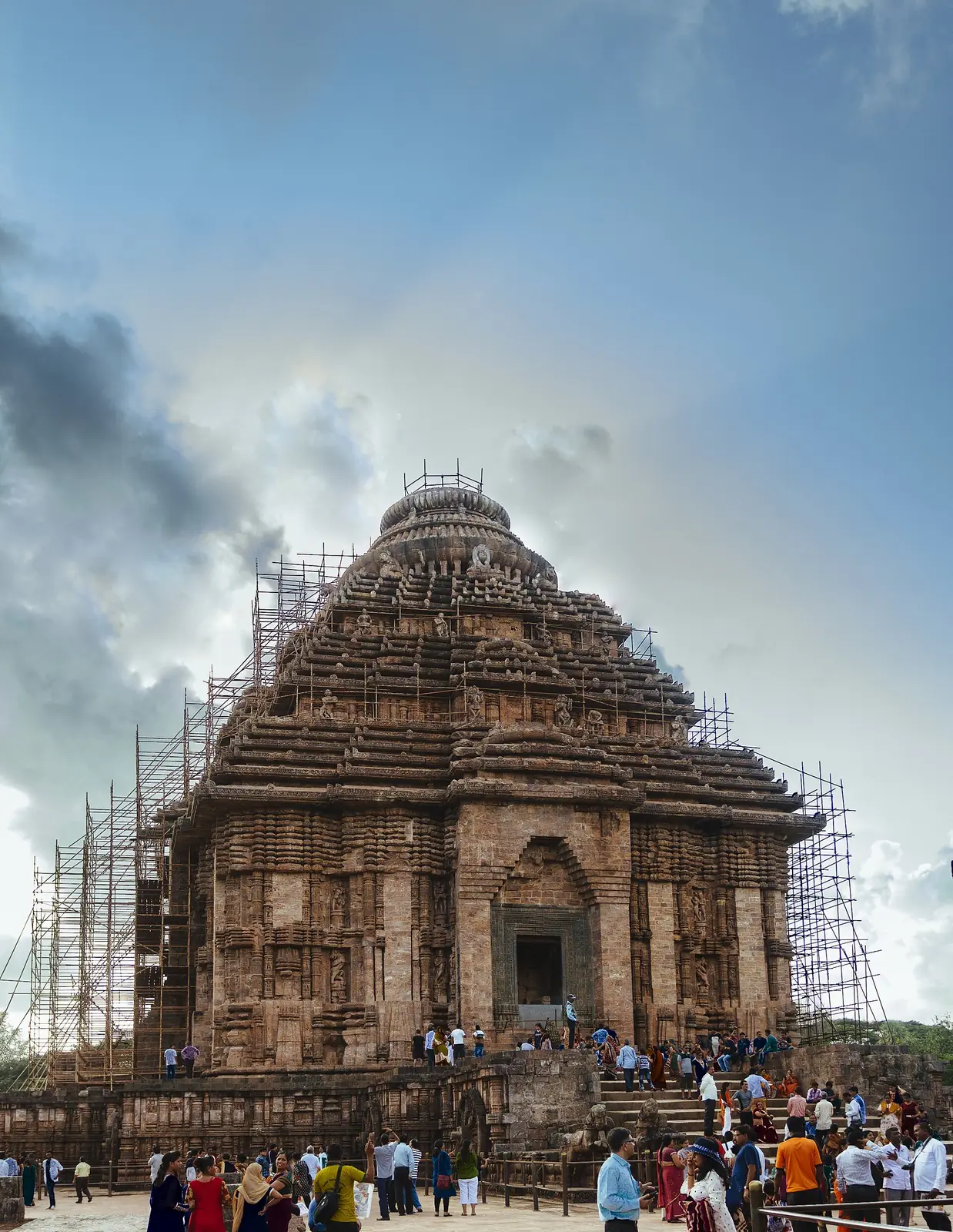
01The chariot of the Sun
The whole temple is the ratha of Surya. Twelve pairs of wheels, each about three metres across, run along the plinth; their spokes double as sundials, and the beads on the rims mark divisions of the day. Seven horses strain at the front. The Samba Purana tells how Samba, son of Shri Krishna, was cured of leprosy by worshipping Surya at Mitravana on the Chandrabhaga, and Konark keeps that memory: on Magha Shukla Saptami pilgrims bathe at Chandrabhaga beach before dawn and face the rising sun.
02Built by Narasimhadeva I
Narasimhadeva I (r. 1238–1264) was the Ganga king who carried the war into Bengal against the Delhi Sultanate’s governors, and Konark was raised in his reign, around 1250. The main deula once rose far above the surviving jagamohana; sailors used it as a landmark and called it the Black Pagoda. Its walls carry the life of a kingdom: musicians, dancers, hunts, elephants, a giraffe, the king himself at worship. Three green chlorite images of Surya, for morning, noon and evening, still stand in niches on the tower base.
03Fall and the sand fill
When and how the great tower fell is not recorded with certainty; by the early 19th century travellers found it a heap of stone. In 1903, with the jagamohana cracking, the Bengal government had its doorways walled up and the hall filled with sand to keep the roof from collapsing. The Archaeological Survey has guarded the site since, and UNESCO listed it as a World Heritage Site in 1984. The Konark Dance Festival is held against its walls each December.
The life of this place
- c. 1250Narasimhadeva I builds the Surya temple at Konark.
- 1903The jagamohana is sealed and filled with sand to stop its collapse.
- 1984Inscribed as a UNESCO World Heritage Site.
Open sunrise to sunset; go early for the light on the wheels. Chandrabhaga beach is 3 km away.