
01Long and short
Every Sanskrit metre is a pattern of guru (heavy) and laghu (light) syllables. Pingala asked: for a line of n syllables, how many patterns are there, how do you list them all in order (prastara), and given a pattern, what is its place in the list? His answers, in terse sutras in eight chapters, amount to writing numbers in base two with laghu and guru for the two digits. In one of these procedures he uses the word shunya for an empty place, an early use of the term. Tradition, through the commentator Shadgurushishya, calls him the younger brother of Panini.
02The Meru of numbers
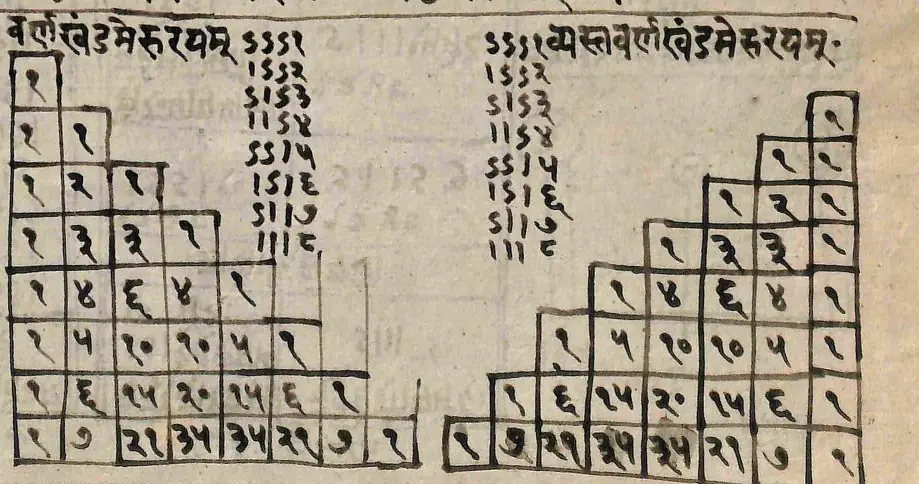
How many patterns of n syllables have exactly k gurus? Pingala gave a rule for it. In the 10th century, Halayudha, in his commentary Mritasanjivani, laid the answer out as a pyramid of numbers, each the sum of the two above it, and called it Meru-prastara, the mountain of combinations. Blaise Pascal wrote on the same triangle in 1654. Later Prakrit metrists, counting metres by duration rather than syllables, arrived at the sequence 1, 2, 3, 5, 8, 13…, which Virahanka and Hemachandra described before Fibonacci.