Cite
MLA
“François Bernier.” Hindu History, 2026, https://www.hinduhistory.in/sakshi/francois-bernier/. Accessed .
APA
Hindu History. (2026). François Bernier. Retrieved , from https://www.hinduhistory.in/sakshi/francois-bernier/
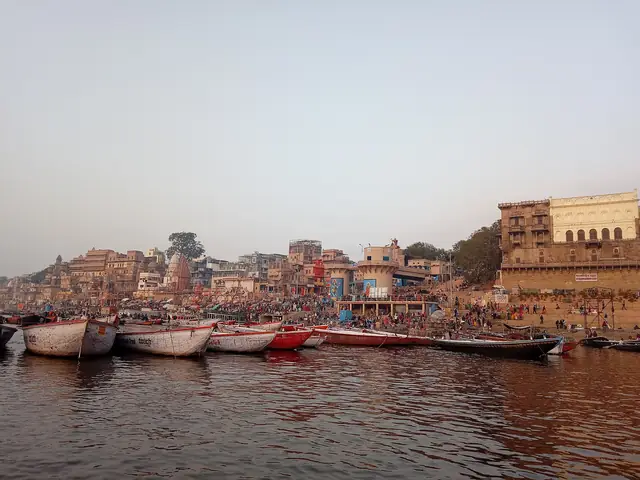
The town of Benares, seated on the Ganges, in a beautiful situation, and in the midst of an extremely fine and rich country, may be considered the general school of the Gentiles. It is the Athens of India
The route
What defines it
- 01
Arrived at Surat as Aurangzeb took the throne
- 02
Physician to Dara Shikoh, then to Danishmand Khan
- 03
Benares, ‘the Athens of India’, its teachers and pupils
- 04
Letter to Colbert on Mughal land and ruin
- 05
Shaped the European idea of Oriental despotism
01A doctor in the war of succession
Bernier, a pupil of the philosopher Gassendi, landed at Surat towards the end of 1658 or early in 1659, by his editor Archibald Constable’s reckoning, after Aurangzeb had already proclaimed himself emperor. On his way to Agra he met the defeated Dara Shikoh near Ahmedabad and was made to go with him as physician, then left him when Dara fled towards Sindh. At Delhi he entered the service of Danishmand Khan, a learned noble for whom he explained Descartes and Gassendi, and who kept a pandit in his household. In 1665 he went with Aurangzeb’s court to Kashmir; that winter he travelled to Bengal with Tavernier, and then by Masulipatam to Golconda, before sailing from Surat for Persia around 1667.
02Benares, the Athens of India
His long letter to Jean Chapelain on the ‘superstitions, strange customs and doctrines of the Indous or Gentiles’ is the part a Hindu reader will turn to first. Benares, he writes, seated on the Ganga in a fine and rich country, is the general school of the Gentiles, the Athens of India, where Brahmins and devotees come to study. There were no colleges as in Europe; teachers were spread through the town in private houses and in the gardens of the suburbs that rich merchants lent them, each with four to fifteen pupils who stayed ten or twelve years. He says the chief pandit there showed him a hall full of books. He also describes the four Vedas, the six systems as he understood them, the great crowds bathing at an eclipse at Delhi, and the Rath Yatra of Jagannath from hearsay.
03A brilliant witness with an argument to make
Bernier saw the war of succession, the court and the army at close range, and his narrative of 1658–59 is valuable beside the Persian chronicles. But he came with a thesis. In his letter to Colbert he argued that because the emperor owned all the land, no one improved it, and the country was being ruined; he wanted to warn France against royal monopoly. That claim was overstated, since zamindars and peasants held hereditary rights the Mughal records recognise, yet it passed through Montesquieu to Marx and coloured European views of India for generations. His contempt for Hindu ‘superstition’ is that of a rationalist Frenchman of his day, and he records sati with horror and some sympathy for the women. Constable’s edition of 1891 is the standard English text.
In the texts
- Histoire de la dernière révolution des États du Grand Mogol (1670–71)
- Archibald Constable (ed.), Travels in the Mogul Empire, A.D. 1656–1668 (1891)