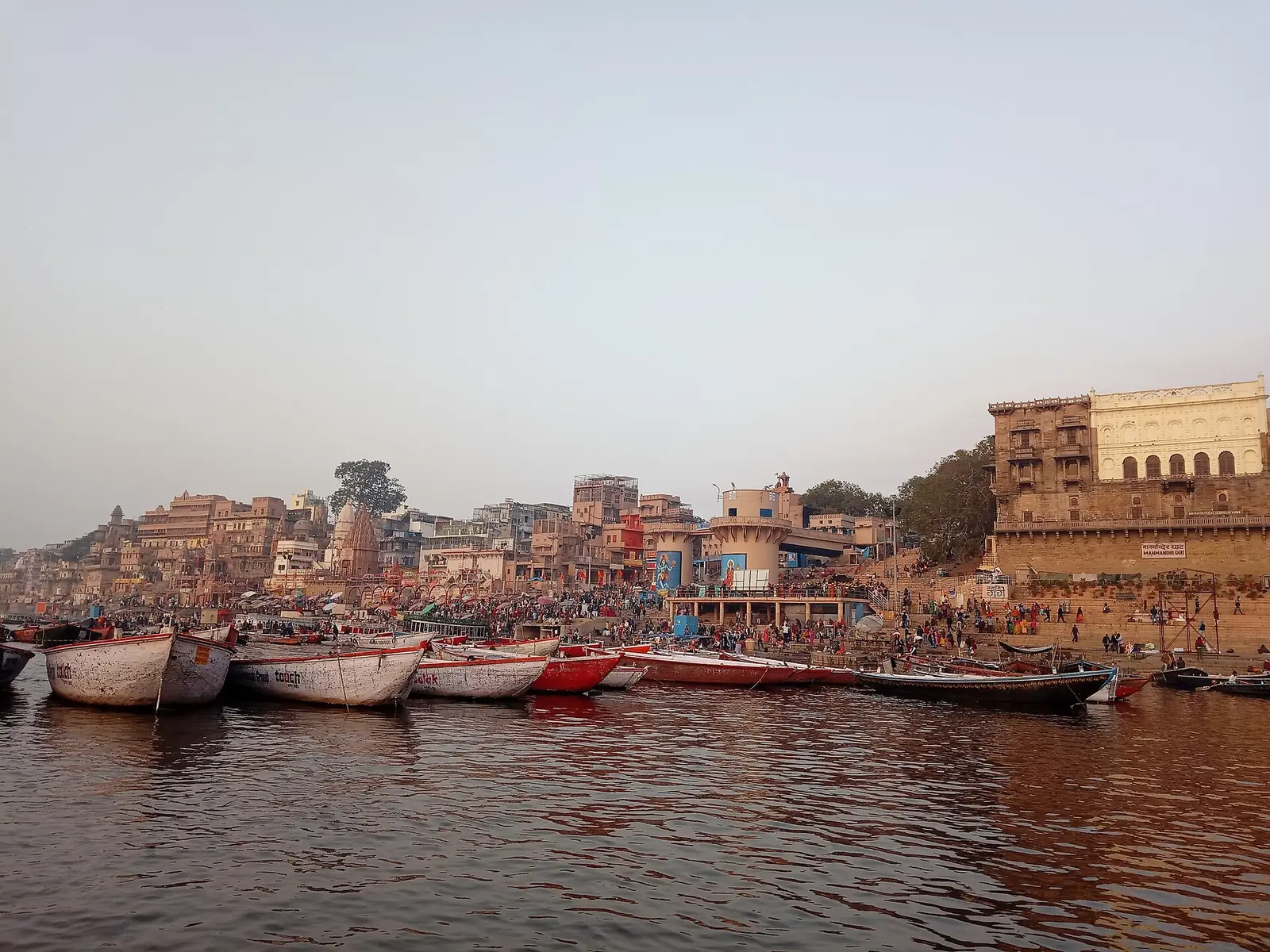
01Five tirthas in one walk
The Panchatirthi of Kashi is bathed in one morning: Assi, where the Assi stream joins the Ganga; Dashashwamedh, where Brahma performed ten ashvamedha sacrifices; Manikarnika, where Parvati’s earring fell into the kund Vishnu dug with his chakra; Panchganga, where four hidden rivers join the Ganga; and Adi Keshava at the confluence with the Varuna. At Manikarnika and Harishchandra ghats the dead are burnt day and night. King Harishchandra, in the katha, served as a keeper of the burning ground here rather than break his word.
02Who built the steps
Around 1600 Raja Man Singh of Amber built the palace at Man Mandir Ghat, and in the 1730s Sawai Jai Singh II added an observatory on its roof. In the 18th and 19th centuries the Marathas rebuilt much of the riverfront: Ahilyabai Holkar, the Peshwas, the Bhonsles and the Scindias all built ghats that carry their names. At Panchganga the Bindu Madhav temple was pulled down under Aurangzeb and a mosque with tall minarets raised over it; Bindu Madhav is worshipped now in a smaller shrine beside it. Tulsidas lived at the ghat now named for him and wrote parts of the Ramcharitmanas there.
03Aarti and Dev Deepawali
Every evening at Dashashwamedh a row of young priests in saffron raise many-tiered brass lamps to the river, with conch, bells and the Ganga stotra; the aarti in its present form, now kept by the Ganga Seva Nidhi, dates from the late 20th century. On Kartik Purnima, fifteen days after Diwali, the whole crescent is lit with lakhs of diyas for Dev Deepawali, the night the devas are said to come down to bathe in the Ganga.
The life of this place
- c. 1600Raja Man Singh builds the Man Mandir palace on the ghats.
- 1730sSawai Jai Singh II adds the observatory at Man Mandir.
Take a rowing boat at dawn from Assi to Manikarnika. Photography of cremations at Manikarnika is not appropriate; ask before photographing anyone at the ghats.