01Indraprastha
The Mahabharata tells that Dhritarashtra gave the Pandavas the wild Khandava country as their half of the kingdom. Shri Krishna and Arjuna cleared the Khandava forest, the asura architect Maya built the sabha hall whose floors looked like water, and Yudhishthira performed the Rajasuya yajna there. Delhi tradition has always placed Indraprastha at the mound of the Purana Qila, where a village called Indarpat survived inside the walls into the 20th century. B. B. Lal found Painted Grey Ware there in the 1950s and 1969–73, and the ASI digs of 2013–14, 2017–18 and 2022–23 found an unbroken run of layers from the Maurya age to the Mughal.
02Dhillika of the Tomaras and Chauhans
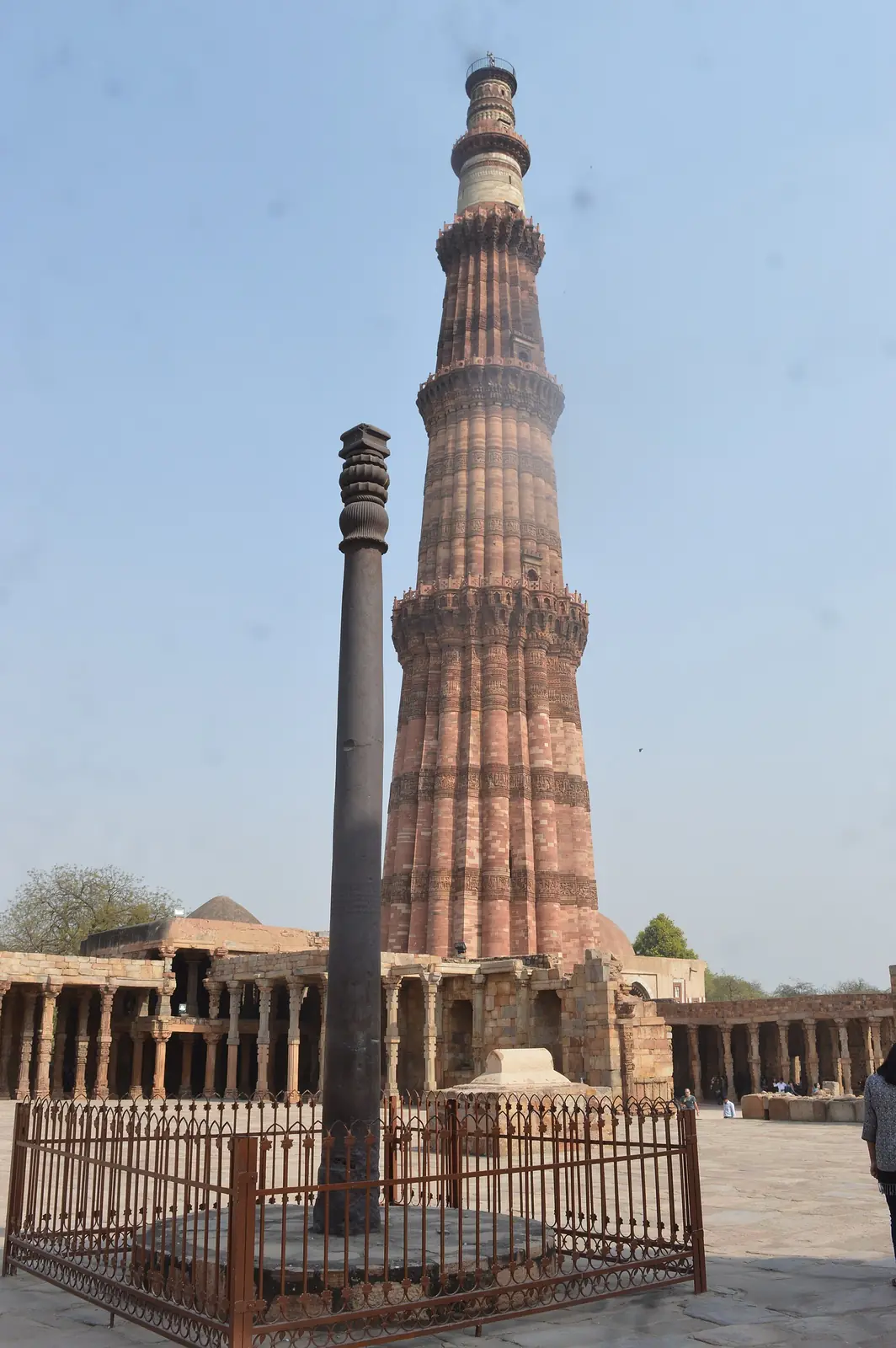
The name Dhillika appears with the Tomara Rajputs. Anangpal Tomara built the walls of Lal Kot at Mehrauli in the 11th century; a short line cut on the iron pillar, read as ‘Samvat 1109 Angpal bahi’, is taken to mean 1052 CE. That pillar is older than any wall in Delhi. It carries a Gupta inscription of a king named Chandra and once stood before a Vishnu temple elsewhere. The Chahamanas took Delhi in the mid-12th century, and Prithviraj III widened the walls into Qila Rai Pithora. After his defeat at Tarain in 1192 the city fell, and its temples were taken apart for the Quwwat-ul-Islam mosque (see qila-rai-pithora).
03Sacked, held, won back
Delhi was sacked by Timur in December 1398 and by Nadir Shah in March 1739, when tens of thousands were killed in a single day. In between, Hemu, the general of the Sur dynasty, won the battle of Tughlaqabad in October 1556 and was crowned Vikramaditya in Delhi, only to fall at Panipat a month later. The Marathas entered Delhi in 1757, and in 1771 Mahadji Scindia brought the Mughal emperor Shah Alam II back to the city under Maratha protection. The British took it in 1803, lost it in May 1857 and retook it that September. On 15 August 1947 Delhi became the capital of free Bharat.
The life of this place
- c. 1052 (Samvat 1109)Anangpal Tomara builds Lal Kot; the date is read from a line on the iron pillar.
- 1164 (Samvat 1220)The Chahamana Vigraharaja IV adds his inscription to the Ashokan pillar now called Delhi-Topra, recording his rule as far as the Himalaya.
- 1192After the second battle of Tarain, Delhi falls to the Ghurid army under Qutbuddin Aibak.
- December 1398Timur sacks Delhi and massacres its people.
- October 1556Hemu wins at Tughlaqabad and is crowned Vikramaditya in Delhi.
- March 1739Nadir Shah sacks Delhi and carries off the Peacock Throne.
- 1771Mahadji Scindia restores Shah Alam II to Delhi under Maratha protection.
- May–September 1857The sepoys of Meerut take Delhi; the British retake it after a long siege.
- 15 August 1947Delhi becomes the capital of independent Bharat.
Start at the Purana Qila mound and its site museum, then go south to Mehrauli for the iron pillar and the Lal Kot walls. The National Museum holds the Harappan and Gupta galleries.