Cite
MLA
“Sulaiman the Merchant and the Accounts of China and India.” Hindu History, 2026, https://www.hinduhistory.in/sakshi/sulaiman-the-merchant/. Accessed .
APA
Hindu History. (2026). Sulaiman the Merchant and the Accounts of China and India. Retrieved , from https://www.hinduhistory.in/sakshi/sulaiman-the-merchant/
so fine and delicate is this material that a dress made of it may be passed through a signet-ring. It is made of cotton, and we have seen a piece of it.
What defines it
- 01
Dated 851 CE; second part by Abu Zayd of Siraf, c. 916
- 02
Balhara (Vallabha-raja) of the Rashtrakutas, foremost king
- 03
King of Jurz (Gurjara-Pratihara), enemy of the Arabs, safe roads
- 04
Rahma’s muslin that passes through a signet ring
- 05
Authorship anonymous; Sulaiman only an informant
01Who wrote it
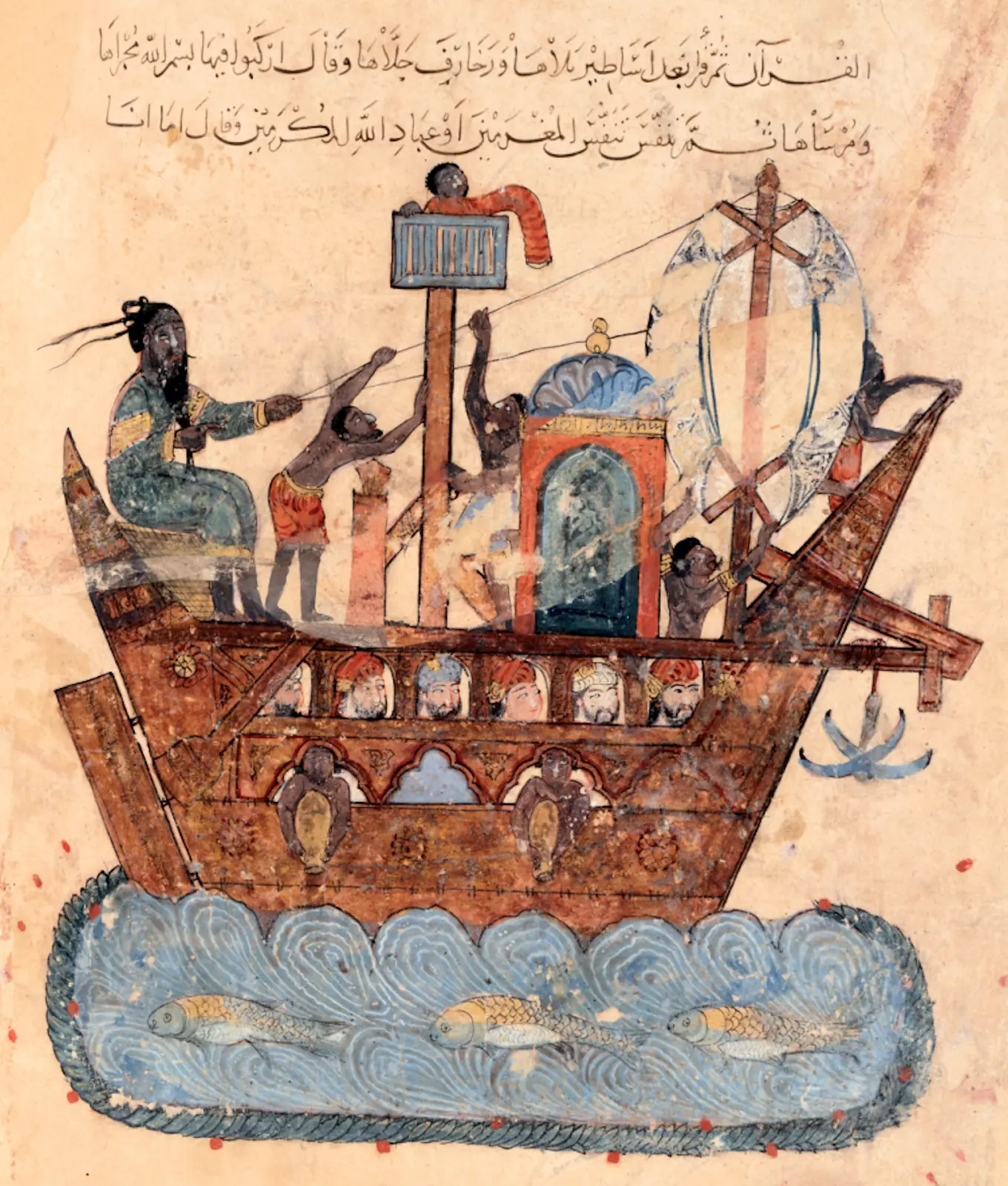
The book is dated 237 of the Hijra, 851 CE. Its first editor in Europe, Eusebius Renaudot, published it in French in 1718 as the work of two travellers, and an English version followed in 1733. Joseph Reinaud showed in 1845 that the first part rests on a merchant named Sulaiman who sailed from the Persian Gulf to India and China, and that the second part was added around 916 by Abu Zayd of Siraf, who never travelled himself but questioned sailors. Later scholars, beginning with Jean Sauvaget in 1948, went further: Sulaiman is named only once as an informant, and the first part is best seen as an anonymous gathering of sea-traders’ reports. So it is a merchants’ witness, not one man’s diary.
02The Balhara, the king of Jurz and the king of the east
The Balhara, it says, is the most eminent of the princes of India; all the others pay homage to him and his envoys are received with deep respect. He pays his troops regularly, has many horses and elephants and great wealth, and his kingdom begins on the sea at the Konkan. Balhara is the Arab ear catching Vallabha-raja, the title of the Rashtrakuta emperors, who in 851 meant Amoghavarsha I at Manyakheta. Next comes the king of Jurz, with the finest cavalry in India and no greater foe of Islam among Indian princes, yet his land is the safest from robbers. Jurz is Gurjara, the Pratihara kingdom of Mihira Bhoja. Beyond lies Rahma, whose king takes the field with some fifty thousand elephants and whose country makes cotton cloth so fine it passes through a signet ring. Most identify him with the Pala kings of Bengal.
03What can be checked
The three-way contest the merchants describe, Rashtrakuta, Pratihara and Pala, is exactly what the inscriptions of the ninth century show, and the Pratihara king’s hostility to the Arabs of Sindh is borne out by his own records of wars on the western frontier. The note that Indian kings dated by their own dynastic eras rather than the Hijra is correct. The muslin of Bengal was famous for centuries. What the book adds is a trader’s angle: which king paid his soldiers, which roads were safe, what coin passed. Its limits are also a trader’s. It knows the coast and hears of the interior; it praises the Balhara for favouring the Arabs because Arab merchants did well in his ports; and its notes on Indian customs mix close observation with sailors’ wonders.
In the texts
- Akhbar al-Sin wa al-Hind (851 CE)
- Abu Zayd al-Sirafi, continuation (c. 916)