Cite
MLA
“Pala Manuscript Painting.” Hindu History, 2026, https://www.hinduhistory.in/kala/pala-manuscripts/. Accessed .
APA
Hindu History. (2026). Pala Manuscript Painting. Retrieved , from https://www.hinduhistory.in/kala/pala-manuscripts/
What defines it
- 01
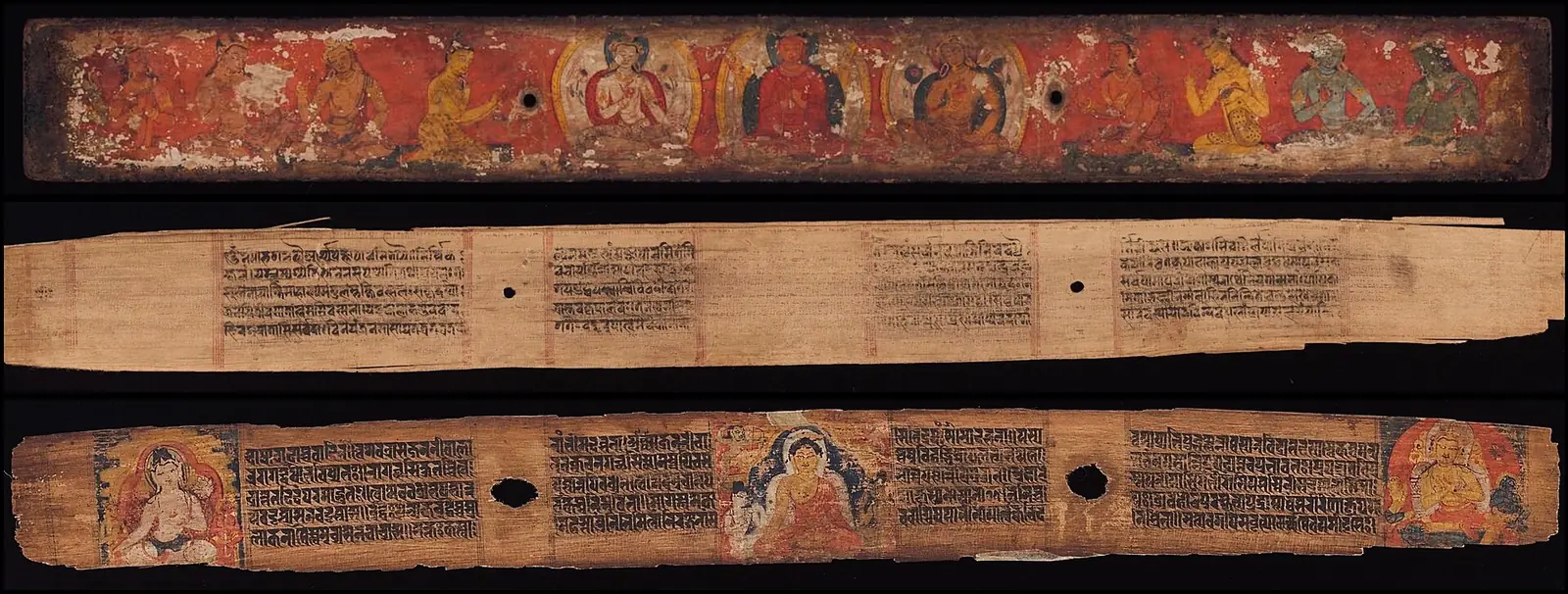
Palm-leaf folios with small painted panels
- 02
Painted wooden covers
- 03
Deities on red grounds
- 04
Flowing Ajanta-style line in miniature
01Books of the monasteries
The Pala kings, from Dharmapala onward, endowed Nalanda and founded Vikramashila and Odantapuri. Scribes there copied Buddhist texts, above all the Ashtasahasrika Prajnaparamita, on long strips of palm leaf, and painters set small panels into the text, two or three inches high, of the Buddha’s life and of deities such as Tara and Prajnaparamita. The earliest dated one, in Cambridge University Library, was copied in the fifth year of a king Mahipala, most likely around 985 CE.
02Line and colour
The painters followed Ajanta’s smooth, flowing line in miniature, outlining figures in red or black and filling them with flat mineral colours: red, yellow, blue, green and white. Deities sit in shrines or on lotuses, often against a red ground. The wooden covers of the books were painted too. The manuscripts were treated as sacred objects; to read and copy the Prajnaparamita was itself merit.
03The end and the afterlife
Around 1200 Bakhtiyar Khalji’s troops sacked Odantapuri and the monasteries of Bihar; Minhaj-us-Siraj’s Tabaqat-i-Nasiri records that the shaven-headed inhabitants were killed and that a great store of books was found which no one was left alive to read. Monks fled to Nepal and Tibet with what manuscripts they could carry, and the Pala style lived on in Nepali painting. Today the leaves are scattered: Cambridge University Library, the British Library, the Asiatic Society in Kolkata and museums in Patna and abroad.