Cite
MLA
“Rajput and Pahari Miniatures.” Hindu History, 2026, https://www.hinduhistory.in/kala/rajput-pahari-miniatures/. Accessed .
APA
Hindu History. (2026). Rajput and Pahari Miniatures. Retrieved , from https://www.hinduhistory.in/kala/rajput-pahari-miniatures/
What defines it
- 01
Burnished paper and mineral colours
- 02
Krishna leela, Ramayana and Ragamala sets
- 03
Bold Rajput colour; soft Kangra naturalism
- 04
Hereditary painter families
01Mewar, Bundi, Kishangarh
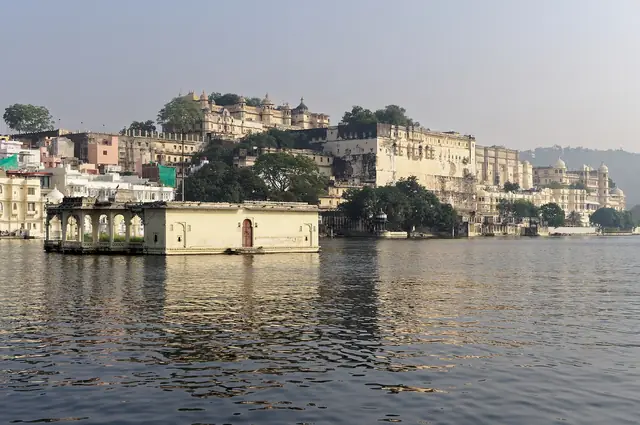
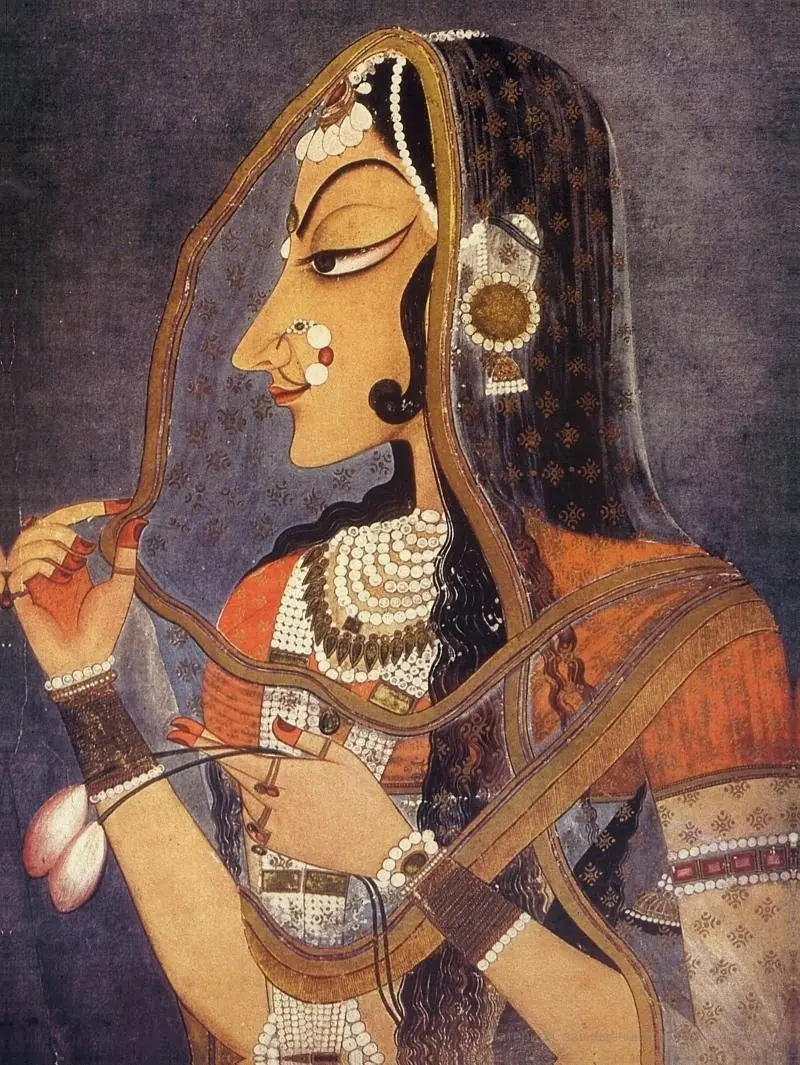
In 1605, at Chawand, the hill capital of Mewar during the long war with the Mughals, a Ragamala set was painted, one of the earliest dated Rajput works. Under Rana Jagat Singh I the painter Sahibdin led the great illustrated Ramayana of 1649–53. Bundi and Kota painted lush gardens, monsoon skies and hunts. At Kishangarh, Raja Sawant Singh, the poet Nagari Das, and his painter Nihal Chand created around 1750 the long-eyed Radha known as Bani Thani.
02The hills: Basohli to Kangra
In the hills, Basohli painters about 1694–95 made a Rasamanjari in hot reds and yellows, with beetle-wing cases set in as emeralds; the painter Devidasa signed it. The family of Pandit Seu of Guler then changed everything: his sons Manaku and Nainsukh painted with a cooler, observed naturalism, Nainsukh mostly for Raja Balwant Singh of Jasrota. Their descendants painted the Gita Govinda, the Bhagavata and the Ramayana for Raja Sansar Chand of Kangra (r. 1775–1823), the high point of Pahari painting.
03Method and museums
Paper was burnished smooth, the drawing laid in with a fine squirrel-hair brush, then filled with mineral and vegetable colours, gold and silver, layer by layer, and burnished again. Families of painters worked for generations at one court and moved when patrons changed. See the City Palace Museum in Udaipur, the Bhuri Singh Museum in Chamba, the Kangra Art Museum at Dharamshala and the National Museum in New Delhi.