Cite
MLA
“Ajanta Murals.” Hindu History, 2026, https://www.hinduhistory.in/kala/ajanta-murals/. Accessed .
APA
Hindu History. (2026). Ajanta Murals. Retrieved , from https://www.hinduhistory.in/kala/ajanta-murals/
What defines it
- 01
Tempera on lime-coated clay plaster
- 02
Mineral colours, lapis-lazuli blue
- 03
Jataka narratives across whole walls
- 04
Shading and graceful hand mudras
01Two phases
Thirty caves are cut into a horseshoe cliff above the Waghora river. Caves 9 and 10, chaitya halls of the Satavahana period, carry the oldest paintings, of around the 2nd century BCE. The great phase came under the Vakataka king Harishena in the later 5th century: an inscription in Cave 16 records that his minister Varahadeva had that vihara made. Caves 1, 2, 16 and 17 hold the finest murals. A British officer, John Smith, stumbled on the caves while hunting a tiger in April 1819 and scratched his name in Cave 10.
02What the painters knew
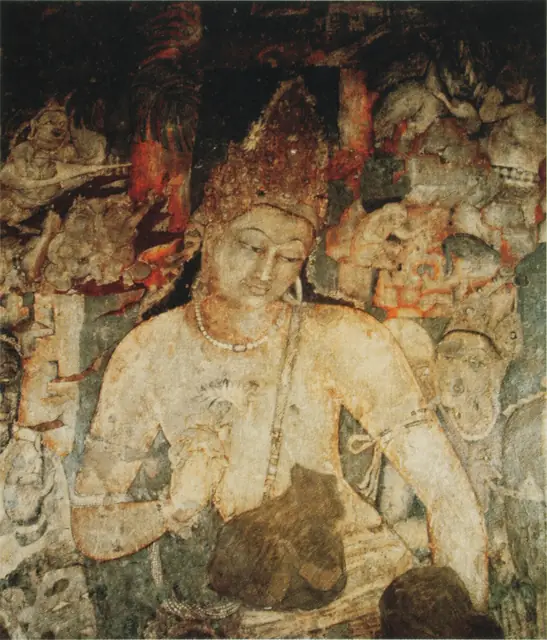
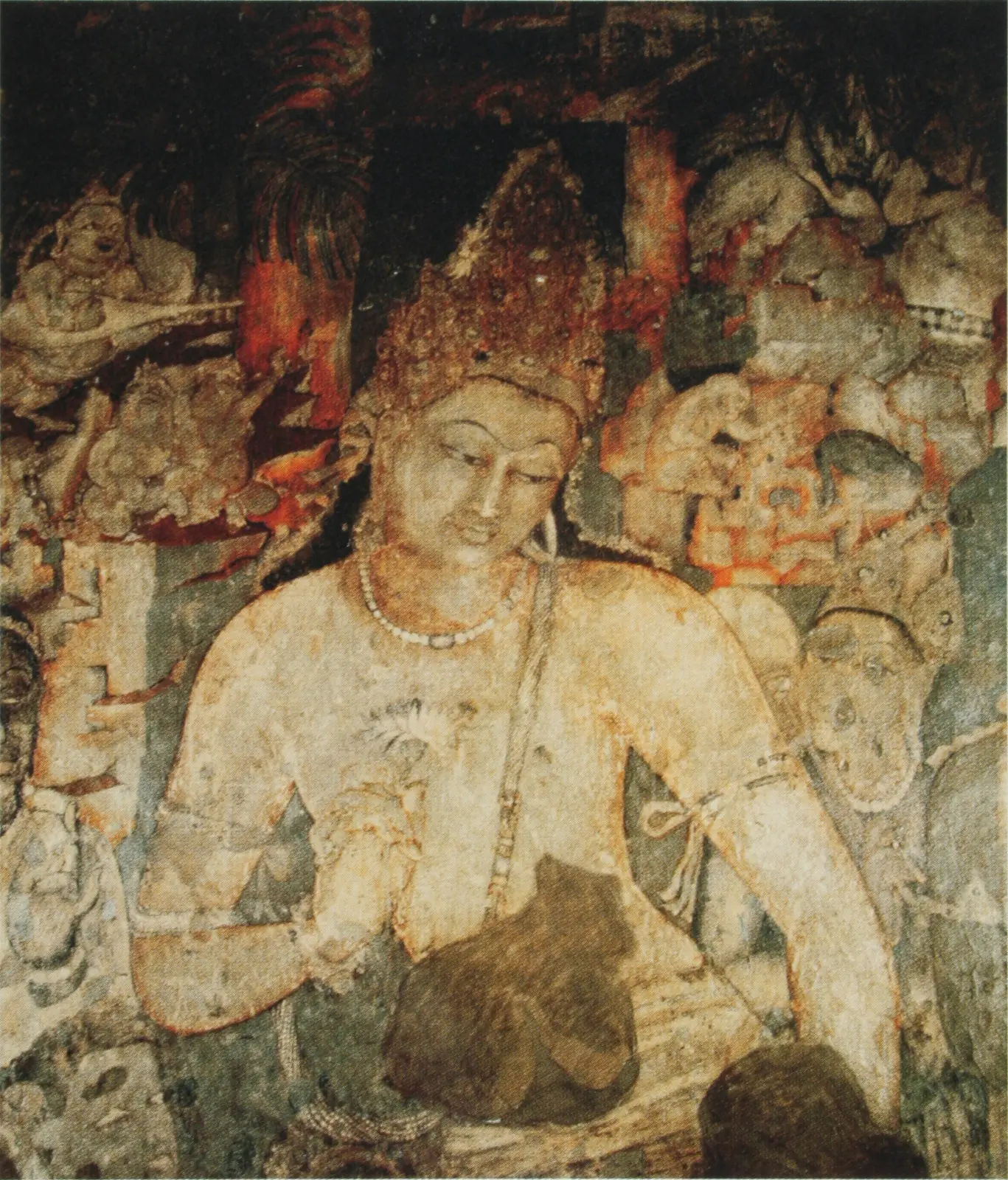
The Vishnudharmottara Purana, in its Chitrasutra, says that painting is the foremost of the arts, and that no one can understand painting without knowing dance, nor dance without music. Ajanta shows that knowledge. The walls were laid with a plaster of clay, cow dung and rice husk, coated with lime, and painted with mineral colours: red and yellow ochre, lamp black, white, and blue from lapis lazuli. Figures are modelled with shading, hands are drawn in the mudras of dance. The Jatakas, the Buddha’s past lives, fill the walls; in Cave 1 the Bodhisattva Padmapani holds a blue lotus.
03Visiting Ajanta
UNESCO inscribed the caves as a World Heritage Site in 1983. They lie about 100 km north of Chhatrapati Sambhajinagar (Aurangabad). Light is kept low to protect the paint, so give your eyes a minute in each cave. Go on a weekday, start with Cave 1 and Cave 2, and do not miss the Mahajanaka Jataka in Cave 1. The caves are closed on Mondays.