
Cite
MLA
“Warli Painting.” Hindu History, 2026, https://www.hinduhistory.in/kala/warli-painting/. Accessed .
APA
Hindu History. (2026). Warli Painting. Retrieved , from https://www.hinduhistory.in/kala/warli-painting/
What defines it
- 01
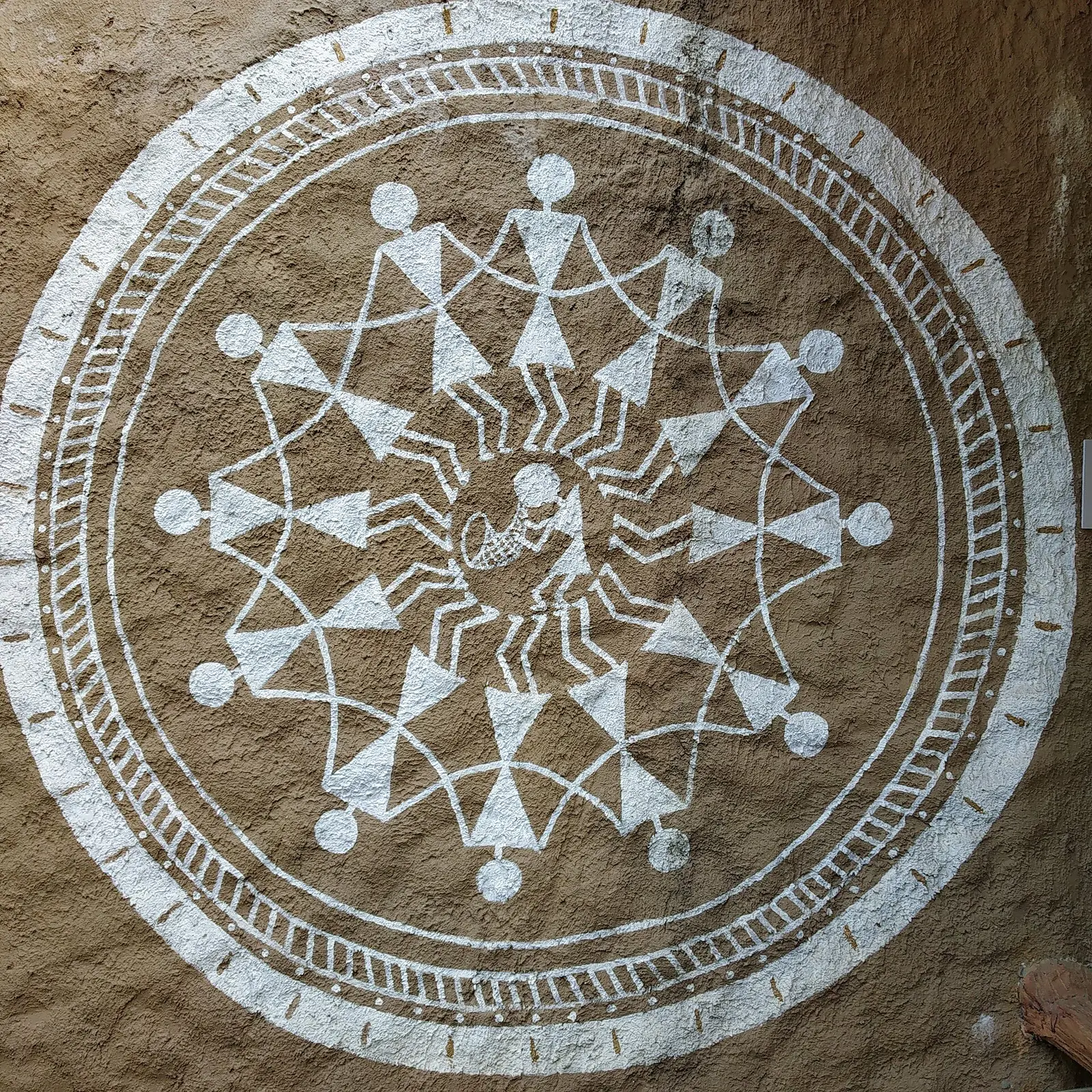
White rice paste on red-brown mud wall
- 02
Figures from circles and triangles
- 03
Chauk of Palaghata at weddings
- 04
Spiral tarpa dance
01The chauk of Palaghata
At weddings Warli women, the suvasinis, paint the chauk, a square on the inside wall of the house enclosing Palaghata, the mother goddess of fertility and harvest, and her guardian. Around it they draw the life of the village: the tarpa dance in a spiral, farmers ploughing, women at the well, trees, birds, animals. The wall is plastered with mud and cow dung and given a red-brown wash; the white is rice ground with water and gum, put on with a chewed bamboo stick.
02Circle, triangle, square
Warli figures are made of three shapes. The circle and the triangle come from the sun and moon, the mountains and the pointed trees; the square marks a sacred enclosure. A person is two triangles joined at the tip, with a circle for the head, so that the whole crowd of a painting seems to move. There is no perspective and no single scene; the eye wanders the way it would across a village on a festival day.
03Jivya Soma Mashe
In the 1970s the artist Bhaskar Kulkarni, sent by the Handicrafts Board, encouraged Warli painters to work on paper and cloth. Jivya Soma Mashe of Ganjad village in Dahanu (1934–2018), a man painting what had been women’s work, took it to galleries in India and abroad and received the Padma Shri in 2011. Today Warli figures are on station walls and fabric across Bharat, but the chauk is still painted for weddings in the hamlets around Dahanu and Jawhar.