Cite
MLA
“Thanjavur (Tanjore) Painting.” Hindu History, 2026, https://www.hinduhistory.in/kala/tanjore-painting/. Accessed .
APA
Hindu History. (2026). Thanjavur (Tanjore) Painting. Retrieved , from https://www.hinduhistory.in/kala/tanjore-painting/
What defines it
- 01
Wooden plank with cloth and chalk ground
- 02
Raised gesso relief
- 03
Gold leaf and inlaid glass stones
- 04
Large central deity under an arch
01From the Nayakas to Serfoji
When Vijayanagara fell in 1565, painters moved south to the Nayaka courts of Thanjavur and Madurai. Under the Thanjavur Nayakas and then the Maratha rulers, especially Serfoji II (r. 1798–1832), they made icons for the puja room and the palace. The painters came from the Raju and Naidu communities who had migrated from the Telugu country. The pictures were meant for worship first, and many still hang in home shrines across Tamil Nadu.
02Gesso, gold and stones
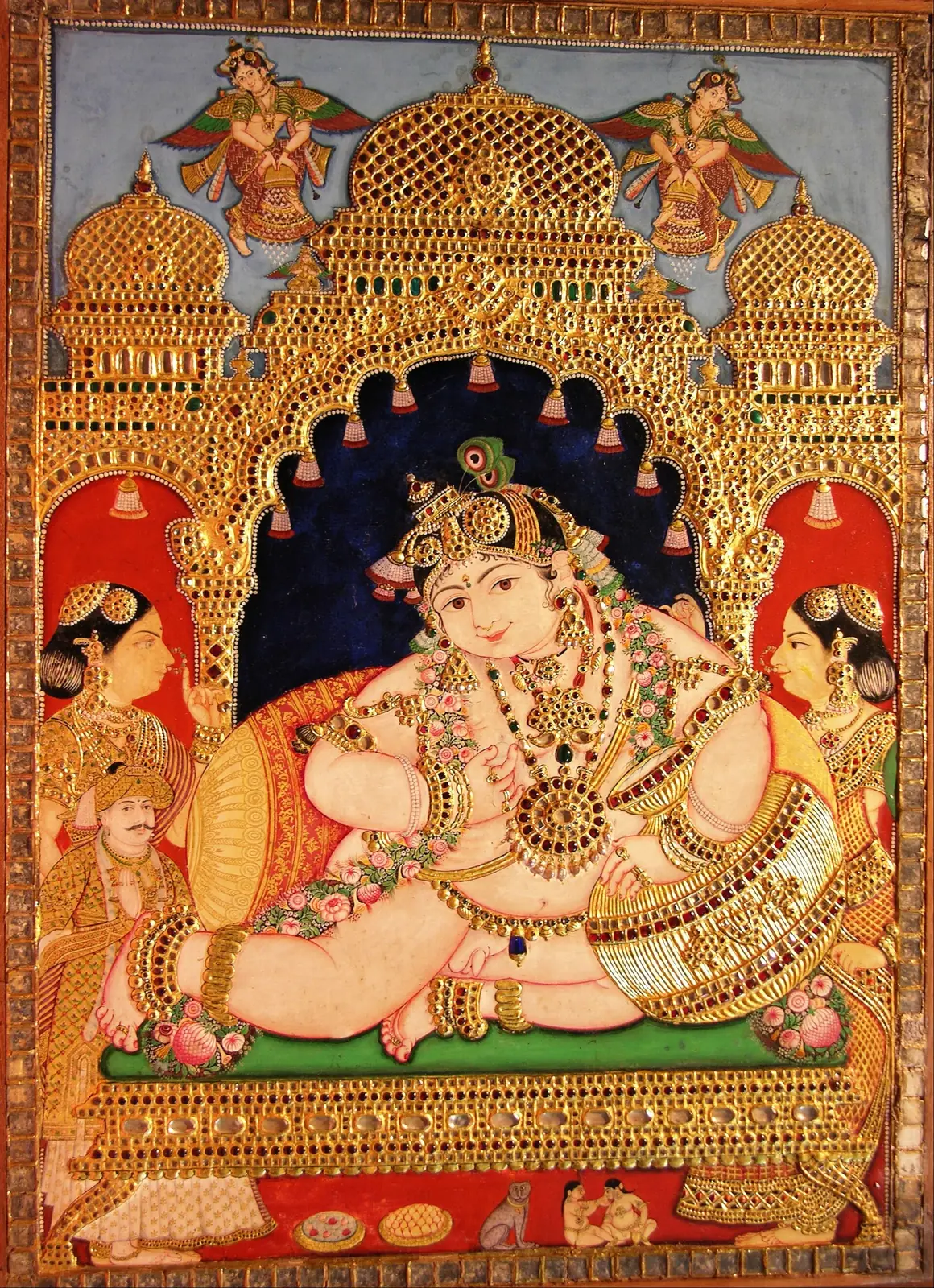
A plank of jackwood or teak is covered with cloth and coated with a paste of chalk and gum. The outline is drawn, then the jewellery, crowns, pillars and arches are built up in relief with a thicker paste. Gold leaf is laid over the raised parts, and glass beads or stones are set in. The rest is painted in strong flat colours: deep red, green and blue. The figures are round-faced, the central deity much larger than those around him, and framed by an arch or a curtain.
03Today
Thanjavur painting is still made in Thanjavur, Tiruchirappalli, Kumbakonam and Chennai, now often with 22-carat gold foil and semi-precious stones. The Thanjavur Art Gallery in the Thanjavur Palace and the Government Museum in Chennai hold fine old pieces. The Thanjavur Maratha palace complex, with the Saraswati Mahal Library that Serfoji II enriched, is the place to start. Painters in Thanjavur town still work from home studios, and many will show how the gesso is raised.