Cite
MLA
“Madhubani (Mithila) Painting.” Hindu History, 2026, https://www.hinduhistory.in/kala/madhubani-painting/. Accessed .
APA
Hindu History. (2026). Madhubani (Mithila) Painting. Retrieved , from https://www.hinduhistory.in/kala/madhubani-painting/
What defines it
- 01
Double outlines, no empty space
- 02
Kohbar and aripana
- 03
Bharni, kachni, tantrik and godna styles
- 04
Natural colours, bamboo-twig brushes
01The kohbar and Sita’s wedding
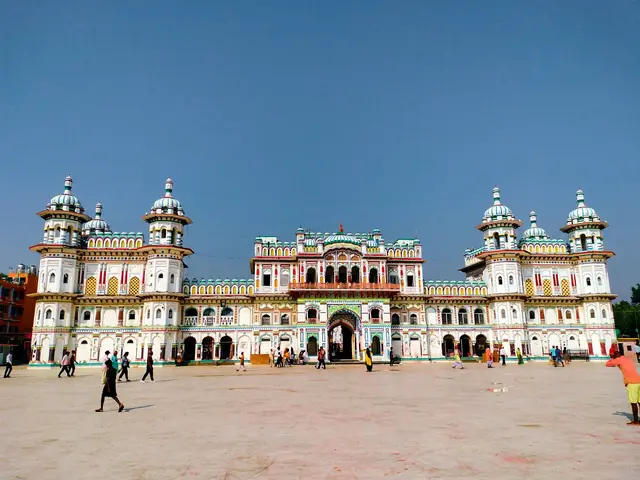
Mithila is Sita’s land, and the women say the custom began when Raja Janaka had his city painted for her wedding. For every wedding they paint the kohbar ghar, the chamber of the newly married couple, with lotuses, bamboo, fish, parrots, the sun and moon, and the Devatas, as signs of fertility and long marriage. Aripana, floor designs in rice paste, are drawn for pujas. The art passed from mother to daughter. The world outside noticed it when W. G. Archer, a British officer, saw the walls exposed by the earthquake of 1934.
02Bharni, kachni and the double line
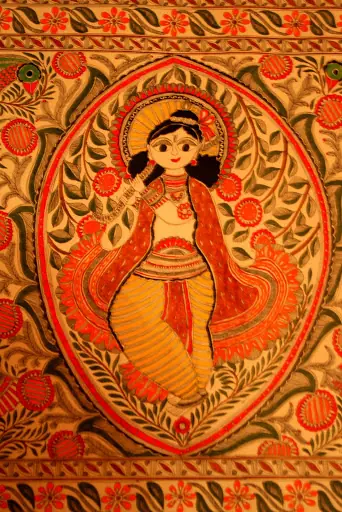
Figures are outlined in a double line and every space is filled, with no empty ground. The bharni style fills shapes with bright colour; the kachni style works in fine hatched lines, often in black and red. Godna painting takes its patterns from tattoo designs. Colours were made from soot, turmeric, flowers, indigo, leaves and clay, and the brush was a bamboo twig or a cotton-tipped stick. Krishna, Durga, Kali, Shiva-Parvati and the Ramayana are the great subjects.
03From walls to paper
During the Bihar drought of the late 1960s the All India Handicrafts Board sent the artist Bhaskar Kulkarni to Mithila to encourage women to paint on paper for sale. Jagdamba Devi, Sita Devi, Ganga Devi, Mahasundari Devi, Baua Devi and Dulari Devi became known across the world, and several received the Padma Shri. Jitwarpur and Ranti villages near Madhubani are still full of painters; Madhubani railway station has its walls painted end to end.