Cite
MLA
“Kumarila Bhatta and the Buddhist logicians.” Hindu History, 2026, https://www.hinduhistory.in/darshana/kumarila-and-the-buddhists/. Accessed .
APA
Hindu History. (2026). Kumarila Bhatta and the Buddhist logicians. Retrieved , from https://www.hinduhistory.in/darshana/kumarila-and-the-buddhists/
What defines it
- 01
Svatah pramanya against Buddhist critique
- 02
Real outer objects against idealism
- 03
Real universals against apoha
- 04
Rejection of human omniscience as a source of dharma
- 05
Shantarakshita’s Tattvasangraha as the Buddhist reply
01The Shlokavarttika
Kumarila’s Shlokavarttika is a verse commentary on the first part of Shabara’s bhashya, and it is where most of the battle is fought. Against the Buddhists he defended svatah pramanya, that a cognition is valid of itself until shown false, and argued that the Veda, having no author, has no author’s faults. In the chapters on the idealist view (Niralambanavada) and on emptiness (Shunyavada) he argued that cognitions must have real outer objects. In the Apohavada chapter he attacked Dignaga’s theory that a word means only the exclusion of what it is not, holding that words name real universals. He also argued against the Buddhist claim that the Buddha was all-knowing, since no human testimony can establish omniscience.
02The story the tradition tells
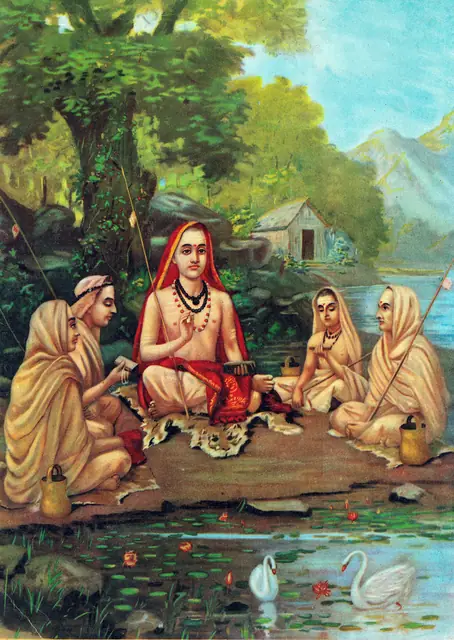
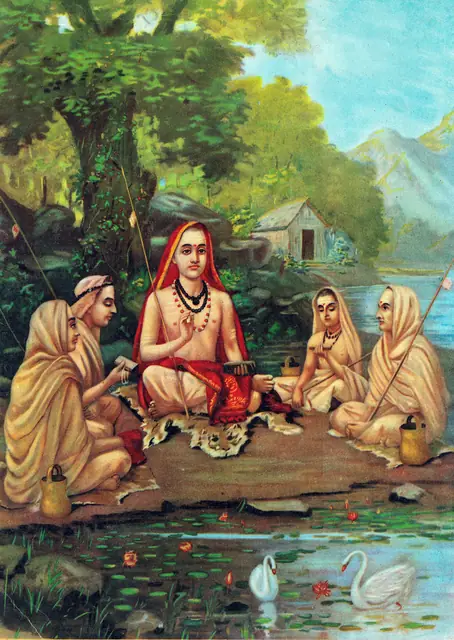
Later lives of Shankara, and the Buddhist histories too, tell vivid stories about Kumarila. In one, he studied in disguise under Buddhist teachers so as to learn their arguments, and when a teacher mocked the Vedas he wept; the monks threw him from a tower, and he cried that if the Vedas are true he would live. He lived, but lost an eye, the story says, because he had said “if”. The Shankara Digvijaya says he later sat in a slow fire of husk at Prayag to atone for having deceived his teachers, and there met Adi Shankaracharya. Tibetan historians have their own version, making Dharmakirti his nephew. These are traditions, not records, and are given here as such.
03The answers
The Buddhist side did not let Kumarila go unanswered. Dharmakirti, in the 7th century, defended Dignaga’s logic and the theory of apoha, and scholars still debate whether he and Kumarila were answering each other directly; John Taber has argued that Kumarila wrote against a stage of Buddhist logic before Dharmakirti. In the 8th century Shantarakshita’s Tattvasangraha, with Kamalashila’s commentary, quotes Kumarila’s verses at length to refute them, which is one reason so much of his reasoning is well known. On the Hindu side, Kumarila’s defence of the Veda became the base on which later Mimamsakas and Vedantins built, and Mandana Mishra carried his line forward.
Great masters
In the texts
- Shlokavarttika: Niralambanavada, Shunyavada, Apohavada chapters
- Pramanavarttika of Dharmakirti
- Tattvasangraha of Shantarakshita with Kamalashila’s Panjika