Cite
MLA
“Vishnuvardhana (Bittideva).” Hindu History, 2026, https://www.hinduhistory.in/people/vishnuvardhana-hoysala/. Accessed .
APA
Hindu History. (2026). Vishnuvardhana (Bittideva). Retrieved , from https://www.hinduhistory.in/people/vishnuvardhana-hoysala/
Life in moments
- 011108
Born Bittideva; succeeded his brother Veera Ballala I in 1108.
- 02
Drove the Cholas from Talakad and took the title Talakadugonda.
- 03
Took the name Vishnuvardhana under the influence of Ramanujacharya; his queen Shantala Devi remained a Jain.
- 041117
Built the Chennakeshava (Vijayanarayana) temple at Belur, consecrated 1117.
- 052023
Belur and Halebidu were inscribed by UNESCO in 2023 as the Sacred Ensembles of the Hoysalas.
01Talakadugonda
Bittideva governed parts of Gangavadi for his elder brother Veera Ballala I, and came to the throne when Ballala died in 1108. The Cholas had held Gangavadi, the old Ganga country of southern Karnataka, since the days of Rajaraja, with Talakad on the Kaveri as their seat. Bittideva struck at them, broke the Chola general Adiyamma near Talakad, and took the country back, earning the title Talakadugonda, lord of Talakad. By about 1117 he had beaten the Chengalvas, the Kongalvas and the Nidugal Cholas, crossed the Nilgiris, and his armies are said to have reached Kanchi. The Kadambas of Banavasi and Goa, the Alupas of Mangalore, the Santaras and the Pandyas of Uchchangi accepted him as overlord. He then turned on his own overlords, the Chalukyas of Kalyani.
02Ramanuja and the Jain queen
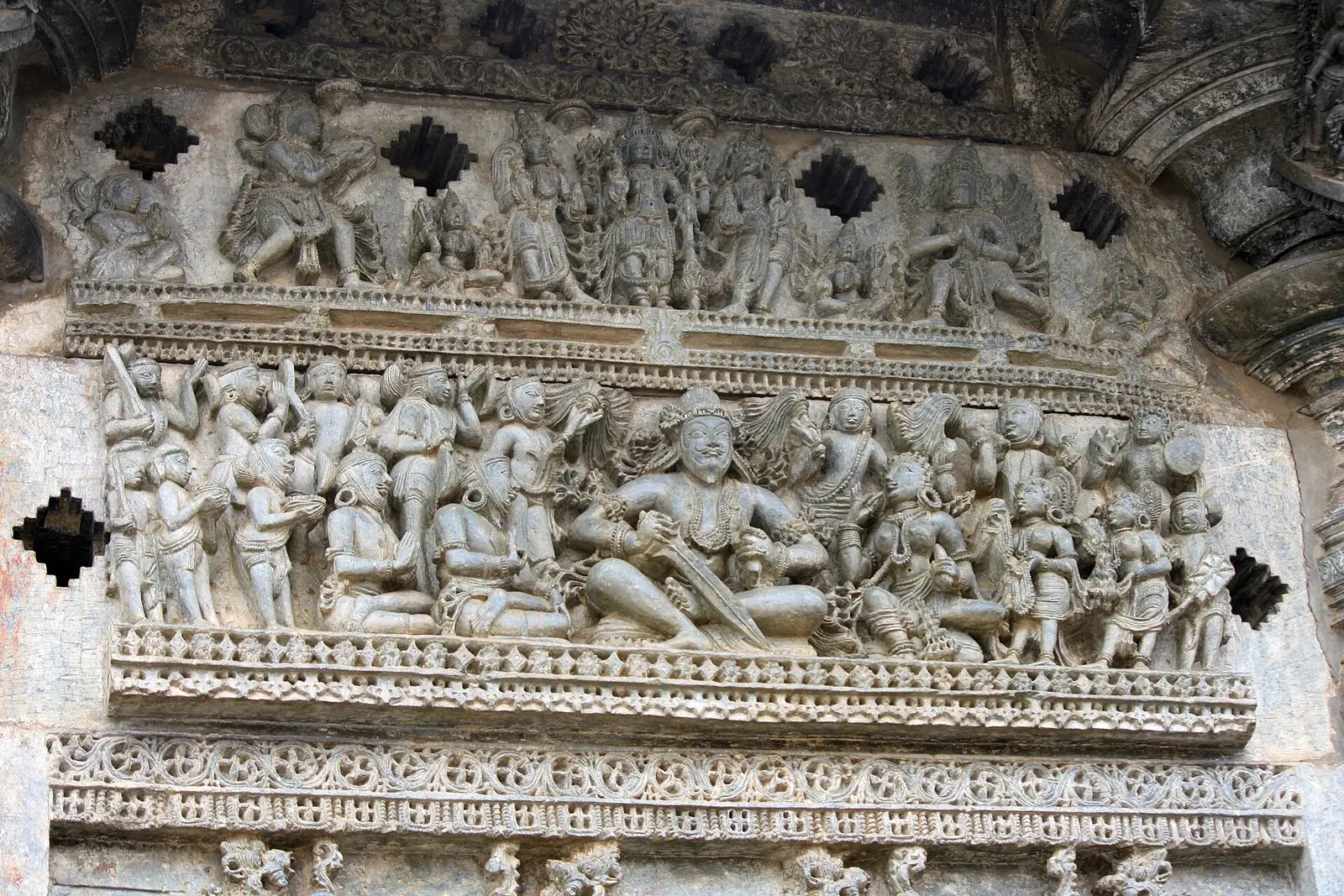
Bittideva was born into a Jain household, and after the victory at Talakad he made rich grants to the Jain basadis at Shravanabelagola and Kambadahalli. When Ramanujacharya came to the Hoysala country, having left the Chola lands, the king came under his influence and took up the worship of Vishnu, and it was Ramanuja, the Sri Vaishnava tradition says, who gave him the name Vishnuvardhana. A frieze on the outer wall of the Belur temple shows the king seated with his queen Shantala Devi on one side and Ramanujacharya on the other. Shantala stayed a Jain all her life, and so did much of the family; she built the small, finely carved Kappe Chennigaraya shrine beside the main temple. The Kannada Jain poet Nagachandra wrote his Ramachandra Charita Purana, the earliest Jain Ramayana in Kannada, under the king’s patronage, and Rajaditya wrote on mathematics.
03Belur, and the march to the Krishna
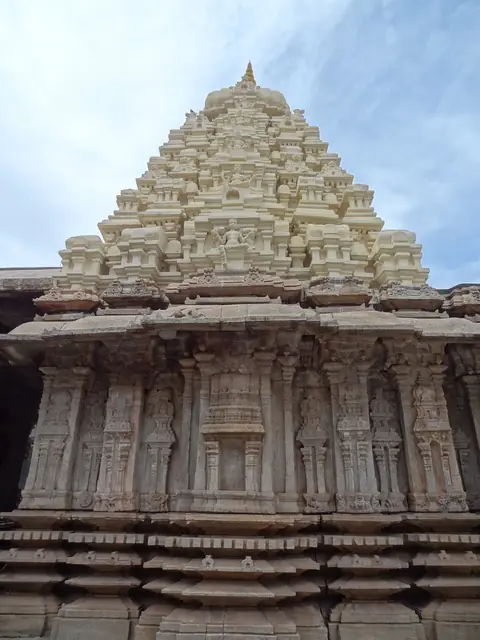
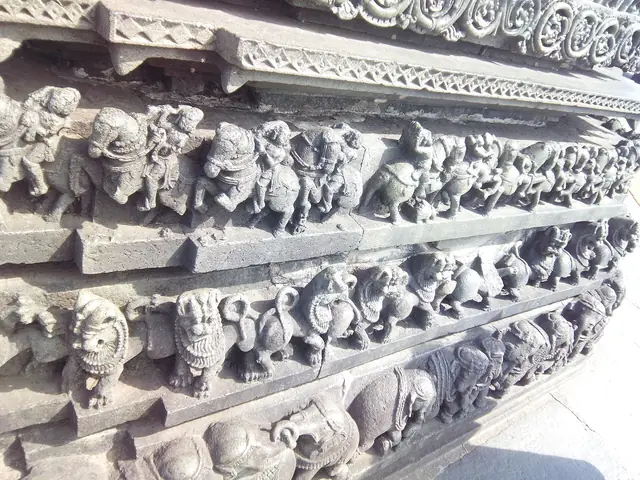
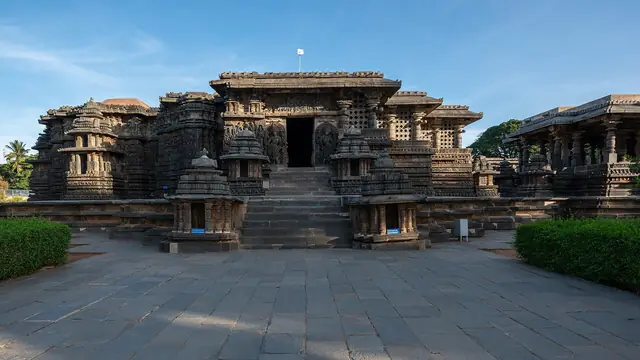
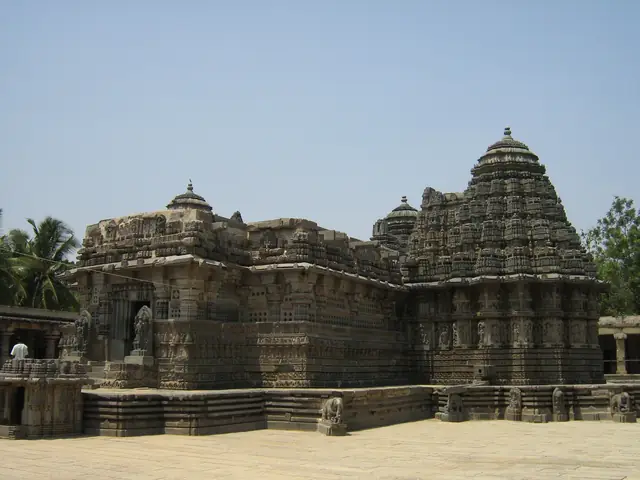
To celebrate the victory over the Cholas he built at Belur, on the Yagachi, the temple of Vijayanarayana, now called Chennakeshava, consecrated in 1117. Its star-shaped plinth, lathe-turned pillars and the bracket figures of dancers that lean out under its eaves set the Hoysala style. The Hoysaleshvara temple at Halebidu, the capital Dvarasamudra, was raised to Shiva in his reign by his officers, more ornate still. Both, with the Keshava temple at Somanathapura, were inscribed by UNESCO in 2023 as the Sacred Ensembles of the Hoysalas. In the north he beat the Chalukya armies at Kannegala around 1118 and Hallur around 1120, took Hanagal, and reached the Krishna, where the Sinda chief Achugi stopped him about 1122. After Vikramaditya VI died he took Hanagal, Uchchangi and Bankapura again and performed the Tulapurusha, the weighing against gold. Historians differ on whether he died about 1152 or some years earlier.