
Cite
MLA
“The Raga System.” Hindu History, 2026, https://www.hinduhistory.in/kala/raga-system/. Accessed .
APA
Hindu History. (2026). The Raga System. Retrieved , from https://www.hinduhistory.in/kala/raga-system/
What defines it
- 01
Aroha and avaroha, the ascent and descent
- 02
Vadi and samvadi notes
- 03
Pakad, the catch-phrase that names the raga
- 04
Time of day and season
- 05
72 melakartas (south), 10 thaats (north)
01That which colours the mind
Matanga’s Brihaddeshi is the first text to define raga as a technical term: a particular arrangement of notes that delights, rañjayati, the minds of people. Before it, the Natya Shastra worked with jatis, melody types drawn from the gramas. Sharngadeva, who wrote the Sangita Ratnakara at the Yadava court of Devagiri under Singhana in the 13th century, gathered everything before him and listed 264 ragas. That book is the last common text of north and south.
02Melakarta and thaat
In the 17th century Venkatamakhin, in the Chaturdandi Prakashika written at Thanjavur, showed that all scales can be ordered into 72 parent scales, the melakartas; Carnatic music still teaches ragas by this grid. In the north Vishnu Narayan Bhatkhande, travelling and collecting compositions in the early 20th century, grouped Hindustani ragas into ten thaats such as Bilawal, Kalyan, Bhairav and Kafi. A raga also has its vadi and samvadi, the ruling and answering notes, and its proper hour.
03Hour, season and picture
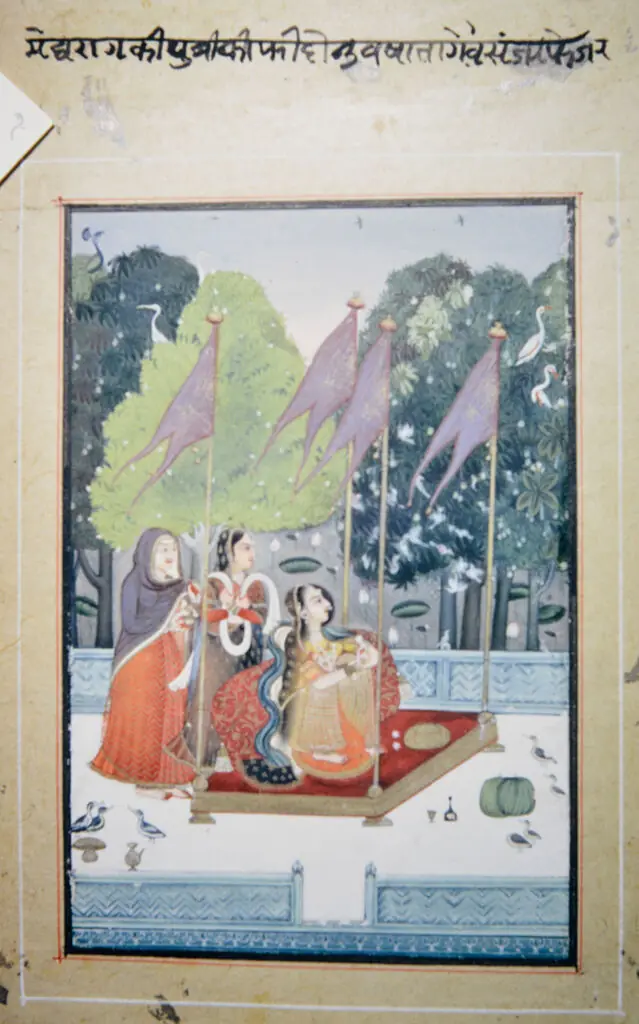
Bhairav belongs to dawn, Yaman to early night, Malhar to the rains and Basant to spring. From the 15th century painters gave each raga a picture: the Ragamala sets of Mewar, Bundi, the Deccan and the Pahari hills show Bhairav as an ascetic, Todi as a lady with a veena among deer. Today ragas are heard every night of the Sawai Gandharva festival in Pune, the Harivallabh in Jalandhar and the December season in Chennai.