
Cite
MLA
“Kuchipudi.” Hindu History, 2026, https://www.hinduhistory.in/kala/kuchipudi/. Accessed .
APA
Hindu History. (2026). Kuchipudi. Retrieved , from https://www.hinduhistory.in/kala/kuchipudi/
What defines it
- 01
Spoken and sung lines by the dancer
- 02
Daruvu, the entrance song
- 03
Tarangam on the rim of a brass plate
- 04
Bhama Kalapam dance-drama
01Siddhendra Yogi and Bhama Kalapam
The village tradition credits Siddhendra Yogi with composing the Bhama Kalapam, the dance-drama of Satyabhama’s pride and longing for Krishna, and with teaching it to the young Brahmin men of Kuchipudi, who vowed to perform it. The families of the village, the Bhagavatulu, also hold that in the 1670s Abul Hasan Tana Shah of Golconda, pleased by their performance, confirmed the village to them. Men played all roles, women’s parts included, until the 20th century.
02Speech, song and the brass plate
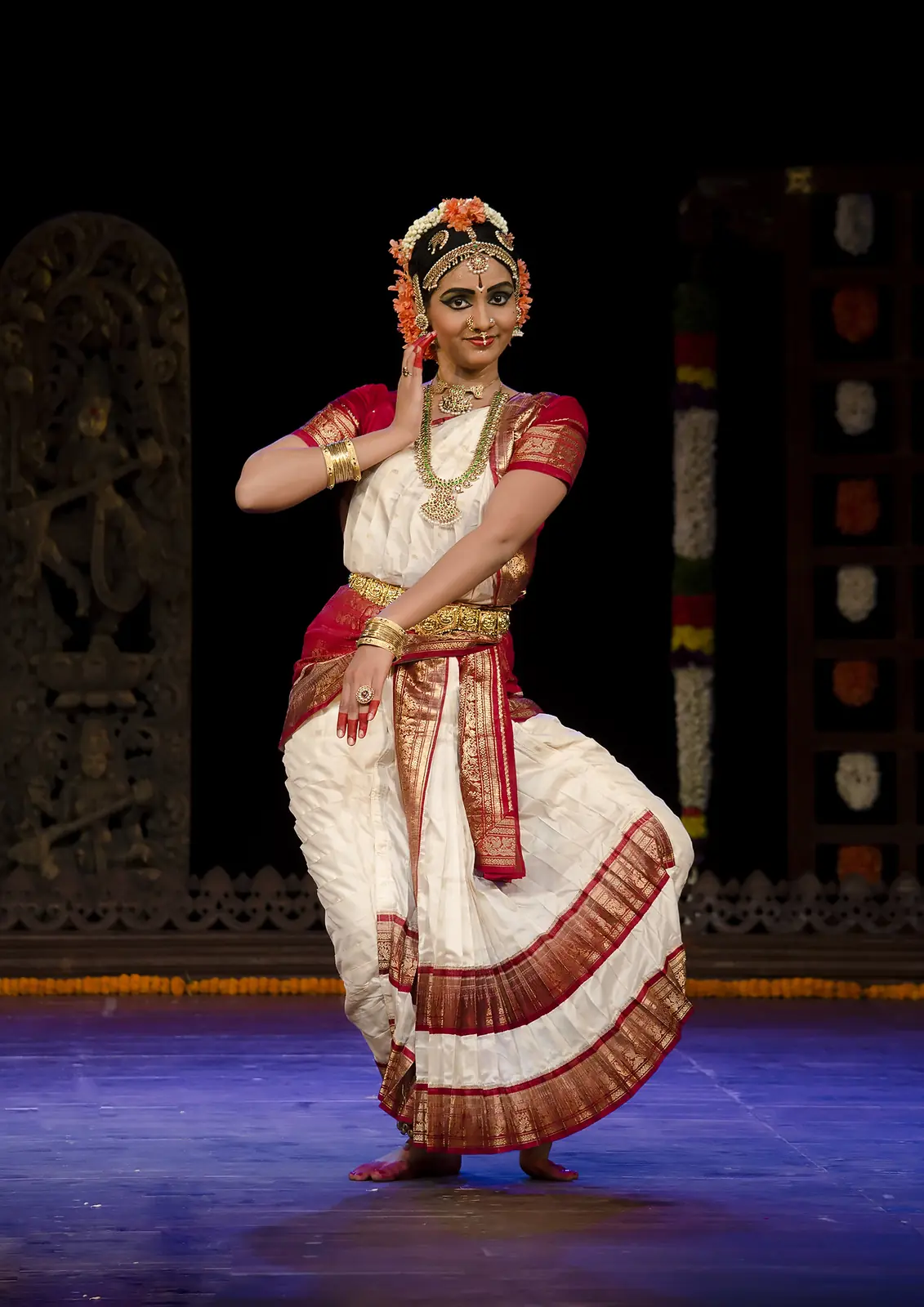
Unlike most classical dances, the Kuchipudi dancer may speak and sing the lines. Each character enters behind a hand-held curtain, the yavanika, with a daruvu, a song of self-introduction. The best-known solo item is the tarangam, from Narayana Tirtha’s Krishna Leela Tarangini: the dancer performs on the rim of a brass plate, sometimes with a pot of water on the head, keeping perfect rhythm. Movements are quicker and more rounded than in Bharatanatyam.
03From the village to the world
Vedantam Lakshminarayana Sastri began teaching solo Kuchipudi to women in the early 20th century. Vempati Chinna Satyam founded the Kuchipudi Art Academy in Chennai in 1963, choreographed dozens of dance-dramas and gave the form its modern stage. Yamini Krishnamurthy and the couple Raja and Radha Reddy made it known across Bharat. The Siddhendra Kalakshetram in Kuchipudi village still trains boys and girls, and the village holds an annual festival of the dance.