
Cite
MLA
“Chhau.” Hindu History, 2026, https://www.hinduhistory.in/kala/chhau/. Accessed .
APA
Hindu History. (2026). Chhau. Retrieved , from https://www.hinduhistory.in/kala/chhau/
What defines it
- 01
Masks in Purulia and Seraikela, none in Mayurbhanj
- 02
Martial leaps and somersaults
- 03
Animal and bird gaits
- 04
Danced at the Chaitra Parva
- 05
Dhol, dhamsa and shehnai
01Three styles
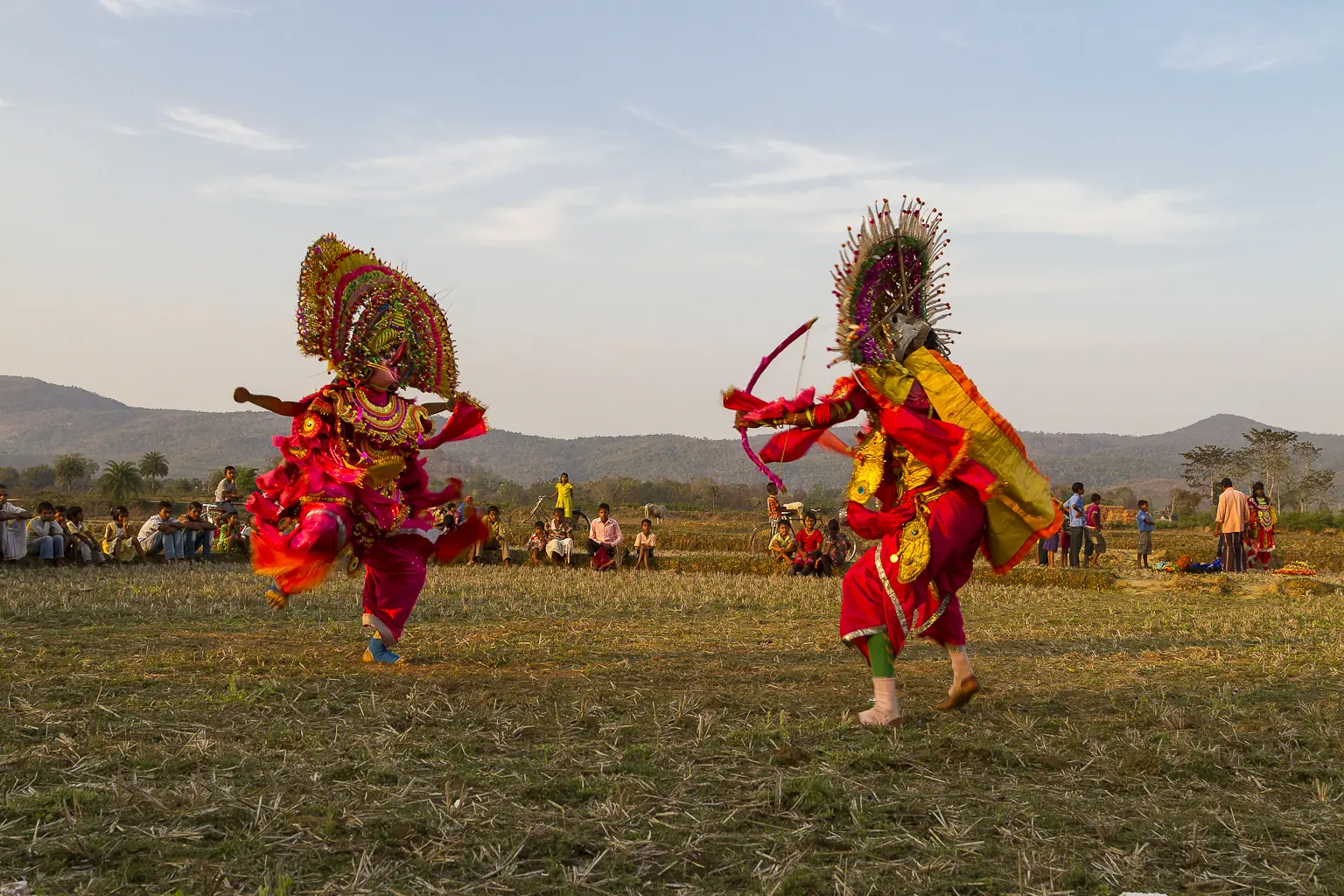
There are three Chhau, each named after its home. In Purulia the dancers wear huge painted masks of papier-mâché and clay, made in the village of Charida, and leap and somersault to the dhol and the shehnai; Durga slaying Mahishasura is a favourite. In Seraikela the masks are smaller and subtler, and the dance was refined under the royal family of Seraikela. In Mayurbhanj there are no masks at all, and the face itself must hold still while the body tells the story.
02Chaitra Parva
Chhau is danced at the Chaitra Parva, the spring festival of Shiva at the end of Chaitra, after days of fasting and rites to Bhairava and Ardhanarishvara. Its movement vocabulary comes from mock combat with sword and shield, and from the gait of animals and birds: the peacock, the deer, the lion. Units of movement are called topkas, chalis and uflis. All the dancers were traditionally men, and whole villages trained and danced together.
03Gurus and where to see
Gambhir Singh Mura of Purulia, a leading dancer and mask-maker, received the Padma Shri; Kedar Nath Sahoo taught Seraikela Chhau; Guru Krushna Chandra Naik and Shashadhar Acharya are other names associated with it. Today the government Chhau centres at Seraikela and Baripada teach it, and Charida village in Purulia district is full of mask workshops. The Chaitra Parva at Seraikela and Baripada in April is the time to go.