Cite
MLA
“Purva Mimamsa.” Hindu History, 2026, https://www.hinduhistory.in/darshana/purva-mimamsa/. Accessed .
APA
Hindu History. (2026). Purva Mimamsa. Retrieved , from https://www.hinduhistory.in/darshana/purva-mimamsa/
What defines it
- 01
Dharma is known through Vedic injunction (1.1.2)
- 02
Apaurusheyatva: the Veda has no author
- 03
Svatah pramanya: knowledge is valid of itself
- 04
Apurva: the unseen link between rite and fruit
- 05
Five or six pramanas: arthapatti and anupalabdhi
01Jaimini’s inquiry into dharma
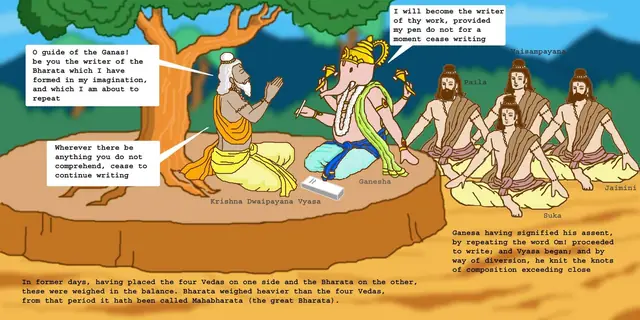
The Puranas say Maharshi Vyasa divided the Veda among four disciples and gave the Sama Veda to Jaimini. Jaimini’s Mimamsa Sutra is the longest of the darshana sutras: twelve adhyayas and about 2,700 sutras. It opens “Now, therefore, the inquiry into dharma” (1.1.1) and defines dharma at once: that good which is known through Vedic injunction, chodana (1.1.2). Perception cannot show it, because dharma concerns what is yet to come. The rest of the work sets out how to tell a command from a description, how to decide which rite a sentence belongs to, and what to do when two texts seem to clash. It is called Purva, earlier, because it reads the karma-kanda of the Veda, as Uttara Mimamsa or Vedanta reads the Upanishads.
02The Veda without an author
Mimamsa’s great thesis is that the Veda is apaurusheya, not made by any person, human or divine, and therefore free of the faults a speaker brings. The bond between word and meaning is itself eternal (Mimamsa Sutra 1.1.5). Knowledge is svatah pramana, valid of itself, until something shows it false. A yajna works through apurva, an unseen potency that links today’s act to a fruit that ripens later, even in another life. On means of knowledge the school split: Prabhakara accepted five pramanas, adding arthapatti, postulation, to the Nyaya four; Kumarila Bhatta added a sixth, anupalabdhi, knowing absence by non-perception. Mimamsa did not argue for a creator of the world, and later Vedanta and Nyaya teachers answered it on that point.
03Shabara, Kumarila, Prabhakara
Shabara Svamin’s bhashya is the oldest surviving commentary on Jaimini. In the 7th century two readers of Shabara founded the two great schools: Kumarila Bhatta, whose Shlokavarttika, Tantravarttika and Tuptika defended the Veda against Buddhist critics, and Prabhakara Mishra, whose Brihati gave a stricter reading. Mandana Mishra, Parthasarathi Mishra and, much later, Khandadeva carried the Bhatta line. Apadeva’s Mimamsa Nyaya Prakasha is still a standard primer. The school’s maxims, called nyayas, moved into Dharmashastra commentaries, where jurists used them to settle conflicts between smritis. Every Vedanta acharya trained in Mimamsa first, which is why its vocabulary fills the bhashyas.
Great masters
In the texts
- Mimamsa Sutra 1.1.1–1.1.5
- Shabara Bhashya
- Shlokavarttika and Tantravarttika of Kumarila
- Mimamsa Nyaya Prakasha of Apadeva