Cite
MLA
“Madhava and the Kerala school.” Hindu History, 2026, https://www.hinduhistory.in/vijnana/kerala-school-madhava/. Accessed .
APA
Hindu History. (2026). Madhava and the Kerala school. Retrieved , from https://www.hinduhistory.in/vijnana/kerala-school-madhava/
01Teacher to student
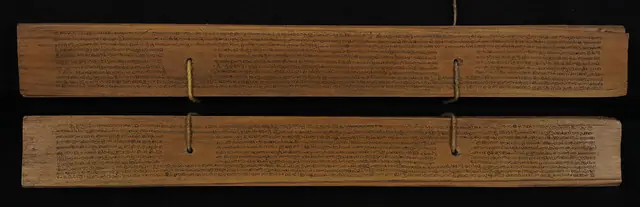
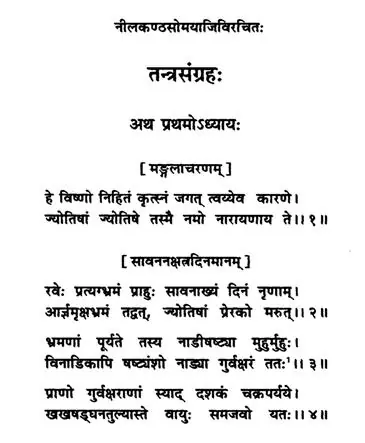
Madhava lived at Sangamagrama, near Irinjalakuda, roughly 1340 to 1425. Few of his own works survive; his results come down through his students. Parameshvara made eclipse observations for 55 years. Nilakantha Somayaji finished the Tantrasangraha in 1500. Jyeshthadeva wrote the Yuktibhasha around 1530 in Malayalam, not Sanskrit, and in it set out step by step why the series are true. Numbers were stored in the katapayadi code, where consonants stand for digits, so Madhava’s sine table could be learned as verse.
02What they found
The Kerala texts give pi divided by 4 as 1 − 1/3 + 1/5 − 1/7 and so on, the series Europe names after Leibniz (1674) and Gregory, together with correction terms that make it converge fast. They give the power series for sine and cosine that Europe credits to Newton (around 1670), and the series for the arctangent. Madhava’s value of pi is correct to 11 decimal places. The Yuktibhasha’s arguments use the idea of summing ever-smaller pieces, the heart of what became calculus, though without its later notation.
03Did it reach Europe?
Charles Whish of the Madras civil service first reported these series to the Royal Asiatic Society in 1834. Since then the open question has been transmission. Jesuit missionaries lived in Kerala in the 16th century, learned the languages and wrote about Indian calendars, and George Gheverghese Joseph and Dennis Almeida have argued that the knowledge could have travelled with them. No document has yet been found that carries a Kerala series to Europe, so most historians treat independent discovery as the safer reading.
In the texts
- Tantrasangraha of Nilakantha Somayaji (1500)
- Yuktibhasha of Jyeshthadeva
- Kriyakramakari