Cite
MLA
“Geometry of the Sulba Sutras.” Hindu History, 2026, https://www.hinduhistory.in/vijnana/sulba-sutra-geometry/. Accessed .
APA
Hindu History. (2026). Geometry of the Sulba Sutras. Retrieved , from https://www.hinduhistory.in/vijnana/sulba-sutra-geometry/
01Altars drawn with a cord
Sulba means cord. With a cord and two pegs the priest marked an east-west line, then set out squares, rectangles, trapeziums and the great falcon-shaped altar, the shyenachiti, built of a fixed count of bricks. The rule of the yajna was strict: if the altar grew, it had to grow in exact proportion. So the sutras teach how to turn a square into a rectangle of equal area, how to join two squares into one, and how to turn a square into a circle and back as nearly as possible.
02What the texts say
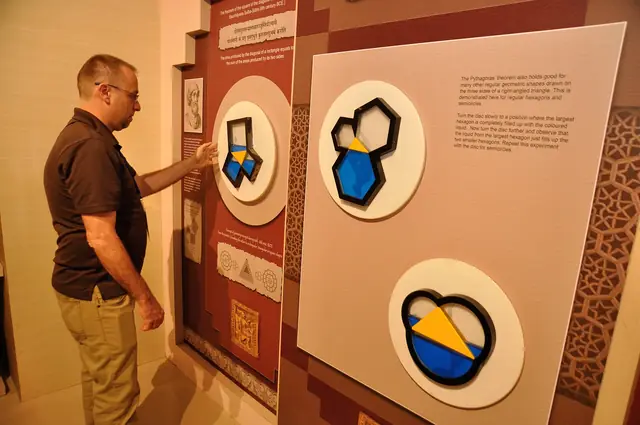
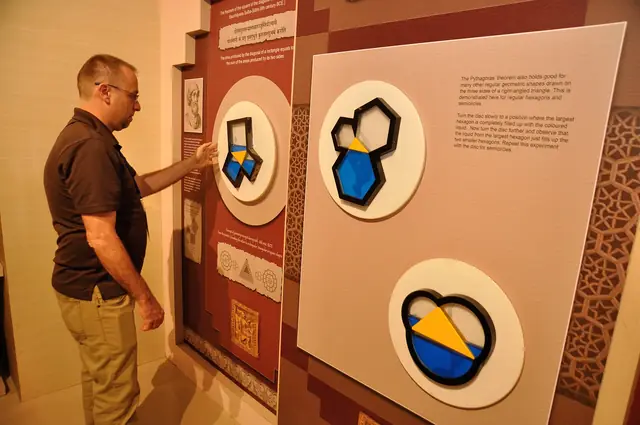
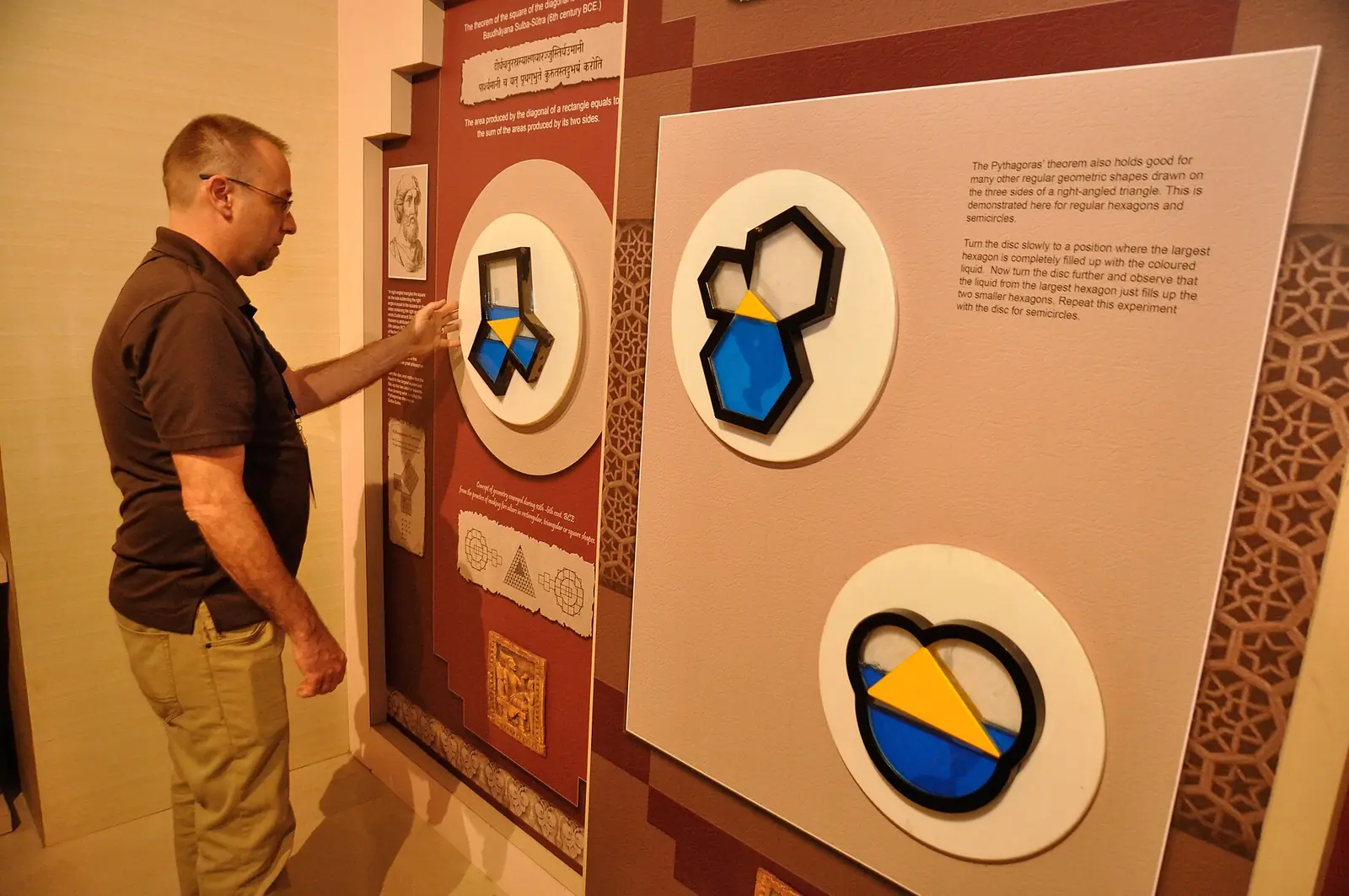
Four Sulba Sutras matter most, those of Baudhayana, Apastamba, Katyayana and Manava. Baudhayana (1.12) states that the cord stretched along the diagonal of a rectangle makes as much as the two sides make separately: the rule Europe names after Pythagoras. The same text gives triples such as 3, 4, 5 and 5, 12, 13. For the diagonal of a square, Baudhayana (2.12) adds to one side a third of it, a fourth of that third, less a thirty-fourth of that fourth. Worked out, this is 1.4142156, against the true 1.4142135.
03What is argued over
Nobody doubts the rule is in Baudhayana. The argument is about proof and priority. The sutras state rules, not proofs, and Old Babylonian tablets such as Plimpton 322 show Pythagorean triples in Mesopotamia as well. Most historians therefore say the rule was known in more than one place, and that Bharat’s share is a clear general statement tied to construction. The circle-square conversions are approximations, and the sutras themselves call some results savishesha, “with a little extra”, which is an honest note in an old text.
In the texts
- Baudhayana Sulba Sutra
- Apastamba Sulba Sutra
- Katyayana Sulba Sutra