Cite
MLA
“Pingala’s science of metre.” Hindu History, 2026, https://www.hinduhistory.in/vijnana/pingala-chandas-counting/. Accessed .
APA
Hindu History. (2026). Pingala’s science of metre. Retrieved , from https://www.hinduhistory.in/vijnana/pingala-chandas-counting/
01Short and long
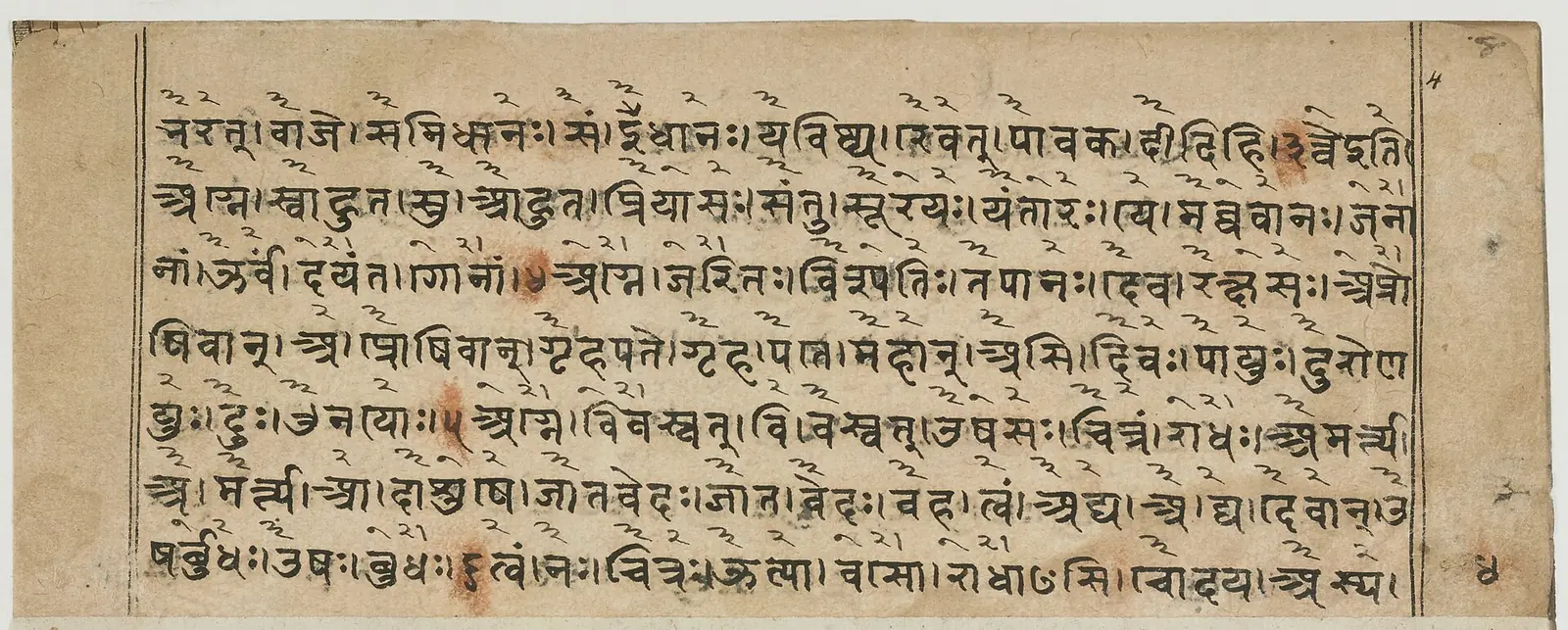
Chhandas, metre, is one of the six Vedangas, because a mantra chanted in the wrong metre is a different mantra. Pingala’s sutras mark each syllable laghu or guru. In chapter 8 he gives four operations: prastara, laying out all patterns of a given length in order; sankhya, counting them; nashta, finding the pattern at a given serial number; and uddishta, finding the number of a given pattern. Write laghu as 0 and guru as 1, read the pattern backwards, and the serial number minus one is that pattern in binary.
02The commentators’ triangle
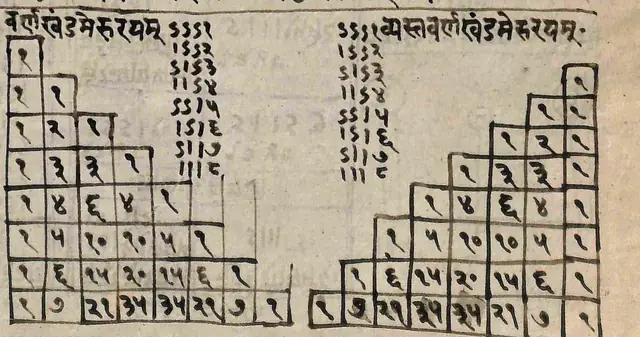
Pingala’s sutras are terse, almost a code. Halayudha’s Mritasanjivani commentary of the 10th century spells them out and builds the meru-prastara, a staircase of numbers in which each is the sum of the two above it. This gives how many metres of n syllables have exactly k long ones, the table Europe calls Pascal’s triangle after 1654. Later prosodists, Virahanka and then Gopala and Hemachandra, counted metres by duration (matra) and found the series 1, 2, 3, 5, 8, 13 a few centuries before Fibonacci’s rabbits.
03How far to take it
Pingala did not invent the computer, and the site will not say so. He had no symbols 0 and 1 and no arithmetic of binary numbers; his object was poetry. What his rules contain is a complete, mechanical correspondence between two-valued strings and the counting numbers, which is the idea underneath binary notation. Leibniz worked out binary arithmetic in Europe around 1700 from other sources, and there is no evidence he knew of Pingala. The meru-prastara itself is clearer only in Halayudha, so the triangle should be credited to the commentators.
In the texts
- Chhandahshastra of Pingala, ch. 8
- Mritasanjivani of Halayudha
- Vrittajatisamuccaya of Virahanka