Cite
MLA
“Bhaskaracharya and the Lilavati.” Hindu History, 2026, https://www.hinduhistory.in/vijnana/bhaskara-ii-lilavati/. Accessed .
APA
Hindu History. (2026). Bhaskaracharya and the Lilavati. Retrieved , from https://www.hinduhistory.in/vijnana/bhaskara-ii-lilavati/
01Four books
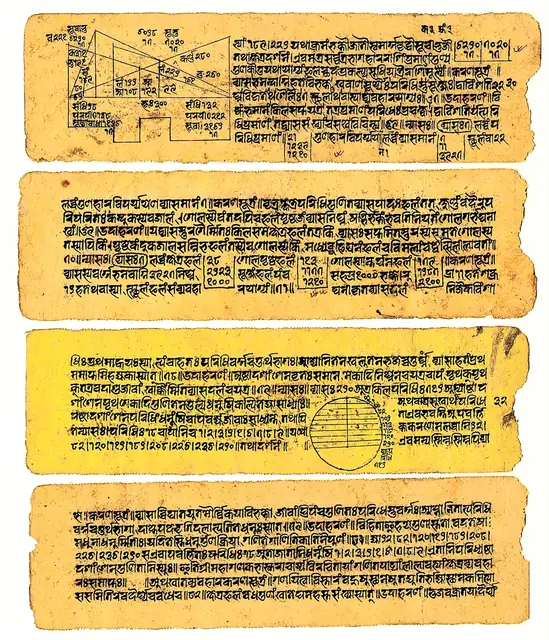
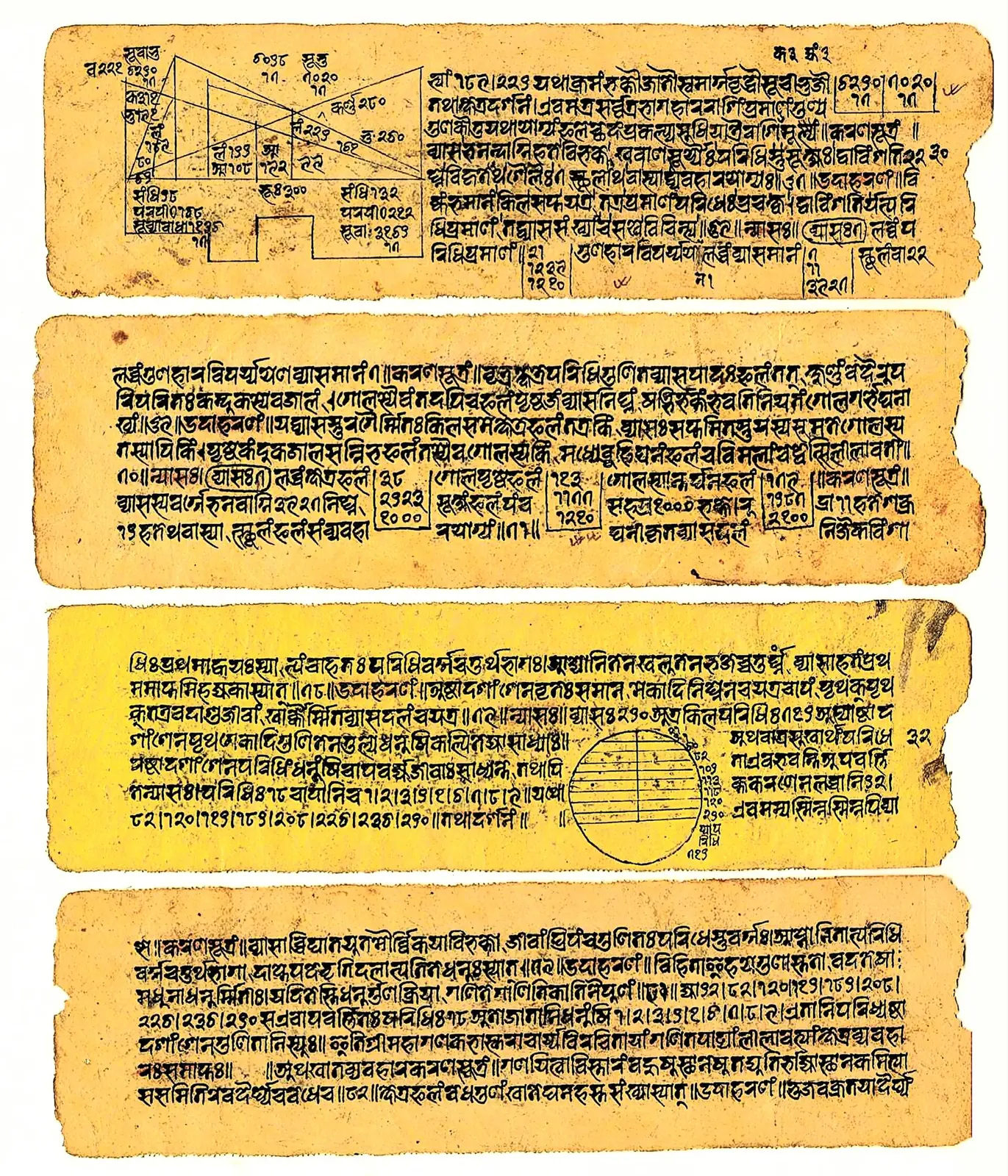
Bhaskara says he was born in Shaka 1036 (1114 CE) and wrote the Siddhanta Shiromani at 36. It has four parts: Lilavati (arithmetic and measurement), Bijaganita (algebra), Grahaganita (planetary computation) and Goladhyaya (the sphere). The Lilavati poses its problems to a girl, in verse: a swarm of bees, a peacock and a snake, a lotus whose tip stood a span above the pond until the wind bent it under. The Bijaganita gives the chakravala method for equations such as 61x² + 1 = y², solved in Europe only in the 18th century.
02The proof on stone
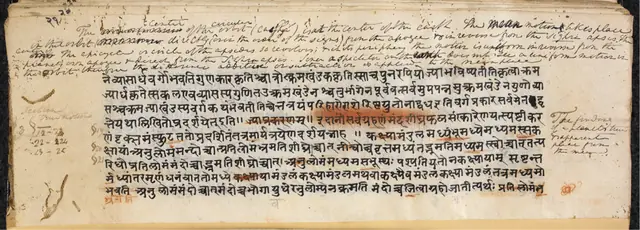
Bhaskara’s grandson Changadeva founded a matha at Patan near Chalisgaon to teach his grandfather’s works. An inscription of 1207 CE, found there, records the grant and names Bhaskara and his ancestors, a rare case of a mathematician’s family recorded in stone. Hundreds of Lilavati manuscripts survive across Bharat in Devanagari, Grantha, Newar and other scripts, and commentaries were written in Sanskrit, Marathi, Telugu and Kannada.
03Persian and English
At Akbar’s order the poet Faizi put the Lilavati into Persian in 1587, and the Bijaganita was translated into Persian in Shah Jahan’s reign. Henry Thomas Colebrooke published English versions of the Lilavati and Bijaganita, with Brahmagupta’s algebra, in London in 1817. That book first showed European mathematicians how much of their algebra had an older Indian form. Whether any of Bhaskara’s methods reached Europe before then has not been shown.
In the texts
- Siddhanta Shiromani (Lilavati, Bijaganita, Grahaganita, Goladhyaya)
- Karanakutuhala