Cite
MLA
“Bhaskara I and the sine formula.” Hindu History, 2026, https://www.hinduhistory.in/vijnana/bhaskara-i-sine-formula/. Accessed .
APA
Hindu History. (2026). Bhaskara I and the sine formula. Retrieved , from https://www.hinduhistory.in/vijnana/bhaskara-i-sine-formula/
01The commentator of 629
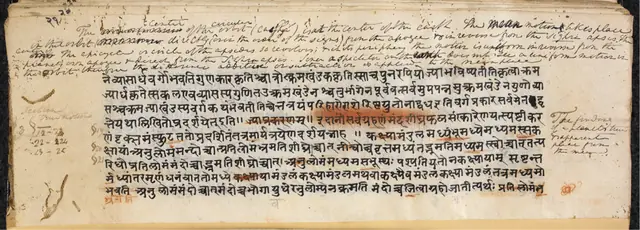
Bhaskara I wrote his commentary on the Aryabhatiya in 629 CE, a date he gives himself, and two manuals of astronomy, the Mahabhaskariya and the Laghubhaskariya. He worked in western India, probably in Saurashtra or near Ashmaka. His commentary is the oldest surviving explanation of Aryabhata, and in its worked examples he writes numbers in place value with a round sign for zero, an early dated witness to the system in use.
02The formula
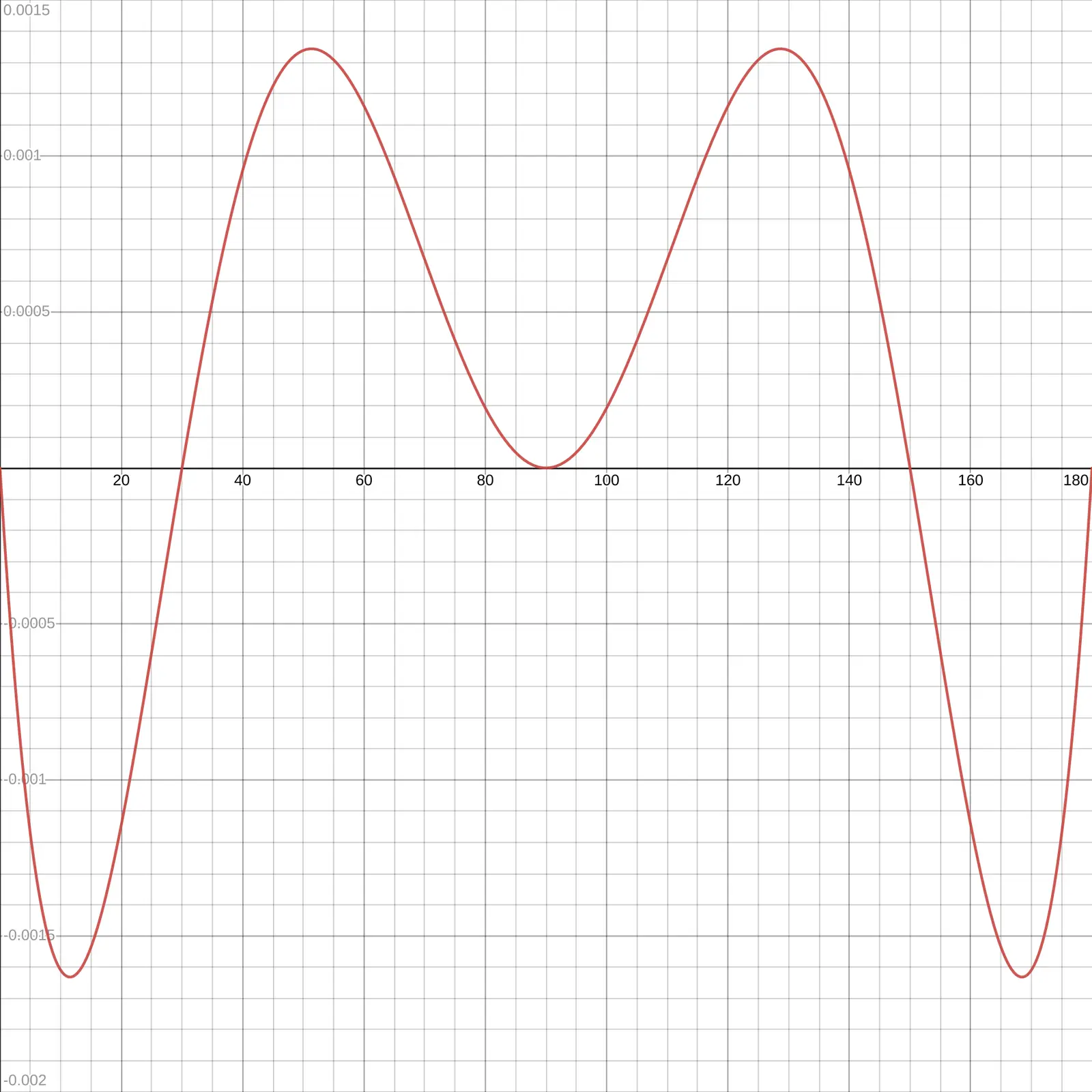
In the Mahabhaskariya (7.17–19) Bhaskara gives a rule that, in modern form, reads: sine of x is about 16x(π − x) divided by 5π² − 4x(π − x), for x between 0 and π. Its greatest error is about 0.0016, so a calculator with nothing but multiplication and division gets the sine to two decimal places anywhere in the half-circle. How he found it is not stated; historians have proposed several geometric routes. Brahmagupta and later Indian authors repeated the rule in their own works.
03Why it mattered
Indian astronomy ran on sines, called jya from the bowstring, and on tables of 24 values at intervals of 3¾ degrees. A formula that needed no table made quick work of planetary corrections in the field. The word jya itself travelled: Arabic took it as jiba, written jb, which a Latin translator in the 12th century misread as jaib, a fold, and rendered sinus. That is the origin of the English word sine.
In the texts
- Mahabhaskariya
- Laghubhaskariya
- Aryabhatiyabhashya (629 CE)