Cite
MLA
“Sant Bahinabai.” Hindu History, 2026, https://www.hinduhistory.in/people/bahinabai/. Accessed .
APA
Hindu History. (2026). Sant Bahinabai. Retrieved , from https://www.hinduhistory.in/people/bahinabai/
Life in moments
- 011628
Born 1628 at Devgaon near Ellora to Aaudev Kulkarni and Janaki.
- 02
Married at three to Gangadhar Pathak, a widower of thirty.
- 03473
Her Atmanivedana has 473 verses, of which the first 78 tell her own life.
- 041649
Took Tukaram as guru in a vision; fasted eighteen days at Dehu after his passing in 1649.
- 051681
Stayed with Samarth Ramdas until his death in 1681; died at Shirur in 1700.
01A child bride on the roads
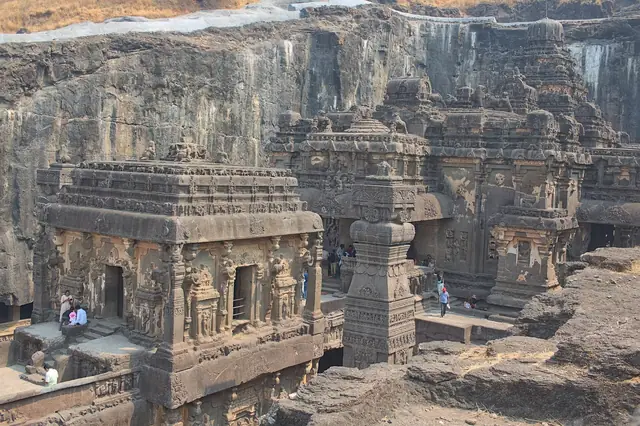
Everything we know of her she tells herself, in the Atmanivedana, the ‘self-offering’, also called the Bahinabai Gatha. Its 473 verses describe twelve earlier births, and the first 78 tell this one. She was born in 1628 at Devgaon, near Verul (Ellora), to Aaudev Kulkarni and Janaki. At three she was married to Gangadhar Pathak, a learned widower of thirty, and stayed with her parents. When she was about nine a family quarrel drove them all out of the village. They wandered along the Godavari with pilgrims, begging grain, passed through Pandharpur, and at eleven came to rest in Kolhapur. There she heard Hari-kirtan and the Bhagavata Purana for the first time.
02The calf and the vision of Tukaram
In Kolhapur her husband was given a cow, and its calf followed the girl everywhere, even to the kirtan of the swami Jayaram, who patted both their heads. Her husband dragged her home by the hair, beat her and tied her up. The cow and calf stopped eating, and the calf died. Bahinabai lay senseless for days, and woke from a vision of Vitthal and of Tukaram, who fed her nectar and gave her the mantra ‘Rama Krishna Hari’. She took him as her guru. Her husband raged that a Brahmin’s wife should follow a Shudra, and the Brahmins of Dehu, when the family went there, threatened to cast them out. She turned the struggle into verse: her duty to her husband on one side, her love of Vitthal on the other, and at last the resolve to serve both.
03Dehu, Ramdas and Shirur
Her husband, the account says, at last repented and accepted her path. At Dehu she bore a daughter, Kashibai, and later a son she named Vithoba. The family settled at Shirur, where she kept a vow of silence for a time. When Tukaram left the world in 1649 she went back to Dehu and fasted for eighteen days, and says she saw him once more. She then went to Samarth Ramdas and stayed in his company until his death in 1681, before returning to Shirur. Unlike most women saints of the bhakti path, she never left her marriage, and her abhangs are honest about what that cost. She died in 1700, foretelling her end to her son.