Cite
MLA
“Mahapurush Madhavdev.” Hindu History, 2026, https://www.hinduhistory.in/people/madhavdev/. Accessed .
APA
Hindu History. (2026). Mahapurush Madhavdev. Retrieved , from https://www.hinduhistory.in/people/madhavdev/
Life in moments
- 011489
Born May 1489 at Letekupukhuri, Lakhimpur, Assam, to Govindagiri Bhuyan and Manorama.
- 021532
Accepted Srimanta Sankardev as guru in 1532 after a debate of four and a half hours.
- 031568
Named successor by Sankardev in 1568; led the Ekasarana Dharma until 1596.
- 04191
Wrote the Naam Ghosha (about a thousand verses), the Bhakti Ratnavali and about 191 Borgeets.
- 051596
Died at Madhupur Satra, Koch Bihar, in 1596.
01Letekupukhuri to Dhuwahat
Madhavdev was born in May 1489 at Letekupukhuri, in today’s Lakhimpur district of Assam, to Govindagiri Bhuyan and Manorama. War between the Bhuyans and the Kacharis had made the family homeless, and an officer of the Chutiya kingdom gave them shelter there. Famine moved them again, to Habung near Dhakuakhana, and then down the Brahmaputra. He studied at Banduka, in today’s Bangladesh, under a teacher named Rajendra Adhyapak, and became learned in the Tantras, logic and the Puranas, a devout worshipper of the Devi. He traded in betel leaf and areca nut for a living and lived with his sister Urvasi and her husband Gayapani at Dhuwahat, on the north bank of the Brahmaputra.
02Four and a half hours with Sankardev
When his mother fell ill he vowed two goats to the Devi. Gayapani, who had become a follower of Sankardev and taken the name Ramadasa, refused to fetch them, and took his brother-in-law to the guru to settle the matter. The debate ran for four and a half hours. Then Sankardev recited a verse of the Bhagavata Purana on watering the root of a tree to nourish all its branches, and Madhavdev gave in. That was in 1532, when he was thirty-two. He broke off his betrothal, never married, and walked beside Sankardev ‘like a shadow’ for the rest of the guru’s life. Sankardev called him his prana-bandhava, the friend of his soul, and in 1568, near the end, named him his successor.
03Naam Ghosha and the Borgeets
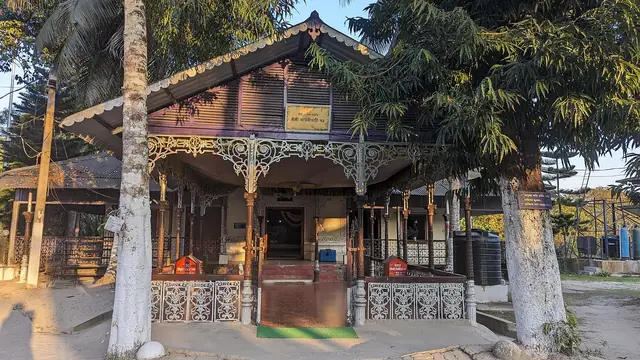
His great work is the Naam Ghosha, the book of the Name, also called the Hazari Ghosha for its thousand verses; Assamese Vaishnavas set it beside Sankardev’s Kirtan Ghosha. He wrote the Bhakti Ratnavali, the Janma Rahasya on creation and dissolution, an Assamese Adi Kanda of the Ramayana, and the long Guru Bhatima in praise of his guru. He composed about 191 Borgeets, the ‘noble songs’ still sung in the satras, and short plays such as Arjun Bhanjan and the jhumuras Chordhara and Bhojan Bihar, which live on in Sattriya dance. Barpeta Satra traces its kirtan ghar to him. A rival party under Damodardev refused his leadership, and he broke with them. He died in 1596 at Madhupur Satra in Koch Bihar, aged over a hundred.