
Cite
MLA
“East Africa and the Gulf: the Monsoon Diaspora.” Hindu History, 2026, https://www.hinduhistory.in/world/east-africa-and-gulf-diaspora/. Accessed .
APA
Hindu History. (2026). East Africa and the Gulf: the Monsoon Diaspora. Retrieved , from https://www.hinduhistory.in/world/east-africa-and-gulf-diaspora/
01Bhatias in the customs house of Zanzibar
By the early 19th century Indian merchants were settled in small numbers at every trading post on the coast, and Sayyid Said bin Sultan, ruler of Muscat and Oman, who made Zanzibar his second capital, favoured them. The richest was Jairam Sewji, a Bhatia from Mundra in Kutch, whose firm farmed the customs of Zanzibar for the sultan for decades; the sources differ on when it began, between 1819 and the 1830s. His partner Ladha Damji, as customs master, was called the most important man on the island after the sultan. In the 1870s Sultan Barghash took the customs from them and gave them to the Khoja merchant Tharia Topan. Houses built by the Indian traders of that age still stand in Stone Town. Hindu families kept their worship in their homes for generations; the Shree Shiv Shakti temple of Stone Town was founded in 1958.
02The Uganda Railway and the dukawallas
When Britain created the East Africa Protectorate in 1895, it ran the new colony almost as a branch of British India: the rupee was its currency and Indian law its code. Between 1896 and 1901 about 32,000 indentured labourers, recruited mostly around Lahore and shipped from Karachi, built the railway from Mombasa towards Lake Victoria; some 2,500 died in the work, and 6,724 chose to stay when it was done. Behind them came the traders, mostly Gujaratis from Kutch and Kathiawar, who opened dukas, shops, at every railway halt and up-country market, and Punjabis who filled the police and the railway workshops. By 1962 people of Indian origin were a third of the population of Nairobi and owned nearly three-quarters of the private non-farm assets of Kenya. Most of them were Hindus, and they built temples, schools and community halls in every town they lived in.
03Ninety days in 1972
Independence brought hard years. In Kenya, after 1963, Asians were given two years to take Kenyan citizenship and give up British passports; of about 1,80,000, fewer than 20,000 had applied by the deadline, and Africanisation pushed many out of jobs and trade. In Uganda, on 4 August 1972, President Idi Amin ordered the Asians who were British subjects to leave within ninety days, and on 9 August widened the order to citizens of India, Pakistan and Bangladesh. About 80,000 people of South Asian origin lived in Uganda then. Each could take 120 dollars and 220 kilograms of belongings; 5,655 firms, farms and estates were seized. About 27,200 went to Britain, many of them Gujarati Hindus who settled in Leicester and north London, 6,000 to Canada, and 4,500 to India. Some returned in the years after 1986. In 2017 Kenya recognised its Asians as the country’s 44th tribe.
04Hindus of Muscat
Hindu trading families lived in Sur, Sohar, Muttrah and Muscat at least from the 17th century, dealing in pearls, grain and dates, lending money and farming customs. The Danish traveller Carsten Niebuhr, who was there in 1765, wrote that in no other Muslim city were the Indians so numerous as in Muscat, about 1,200, and that they were allowed to live by their own laws, bring their wives, keep their images in their rooms and burn their dead. Early in the 19th century there were at least 4,000. An attack on the Hindu quarter in 1895, during an Ibadi rising, drove many away, and by 1900 about 300 remained. The Motishwar Mandir in Old Muscat, a temple of Shiva near the Al Alam palace, is held to have been built by Bhatia merchants from Kutch between the 1890s and 1909; the sources differ. Oman also has a Krishna temple, and a small number of Hindu families hold Omani citizenship.
05Shrinathji in Manama
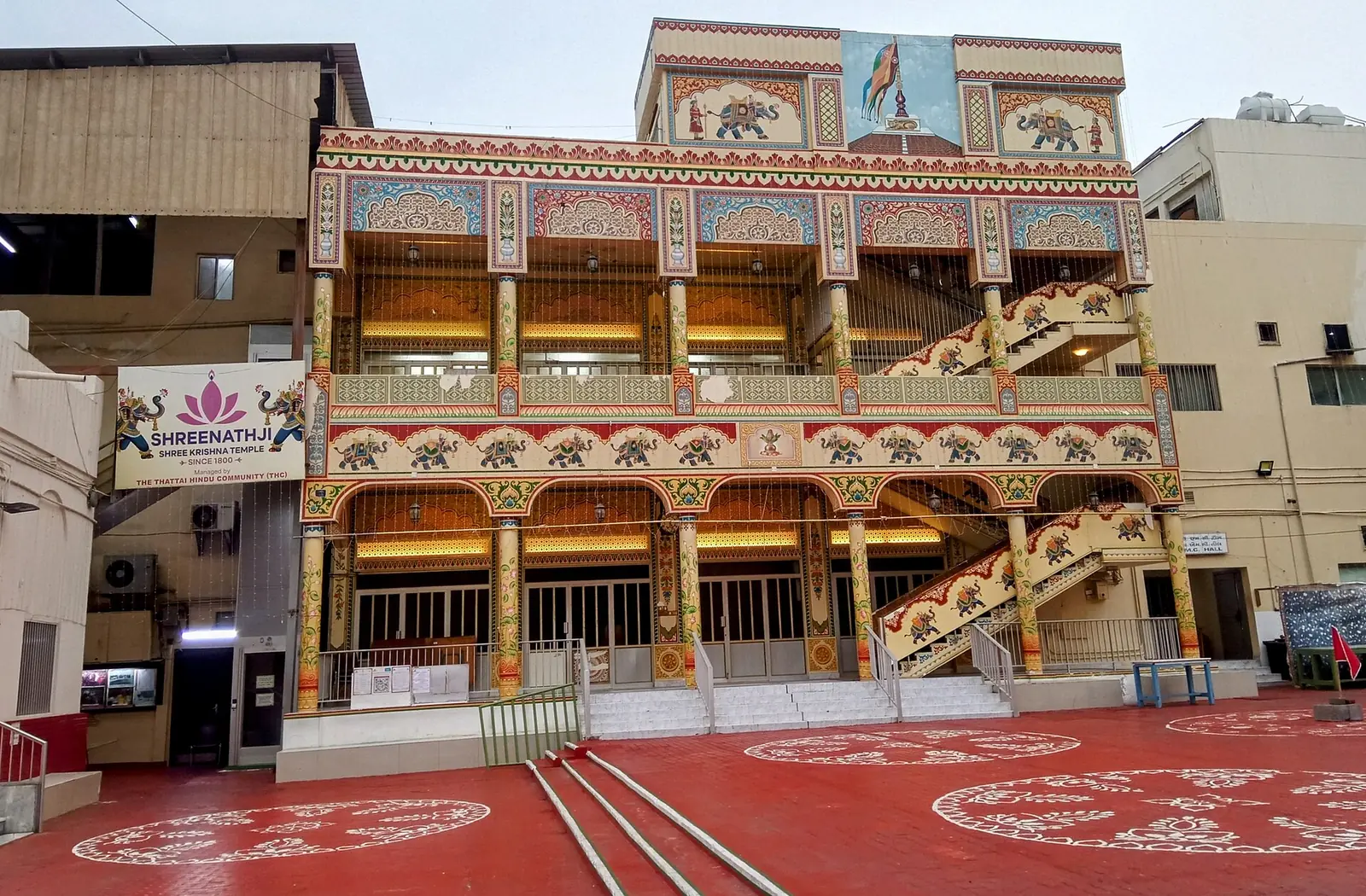
In the old market of Manama, in Bahrain, stands a temple of Shrinathji, Krishna as the child who lifted Govardhan, in the Pushti Marg tradition of Nathdwara. Its founding is traditionally dated to 1817, by the Thattai Bhatia merchants who came to the Gulf from Thatta in Sindh, and the community still owns and runs it; it is often called the oldest Hindu temple in the Gulf, though such claims are hard to test. Bahrain’s own tourism board describes it as a temple some two hundred years old. In August 2019 India’s Prime Minister Narendra Modi took part in Janmashtami there and launched a renovation of about 4.2 million dollars. The Thattai Bhatias, like the Bhatias of Muscat, were among the merchant families that linked the Gulf’s pearl and grain trade to the ports of Sindh, Kutch and Bombay before oil was found.
06Seven shikharas at Abu Mureikhah
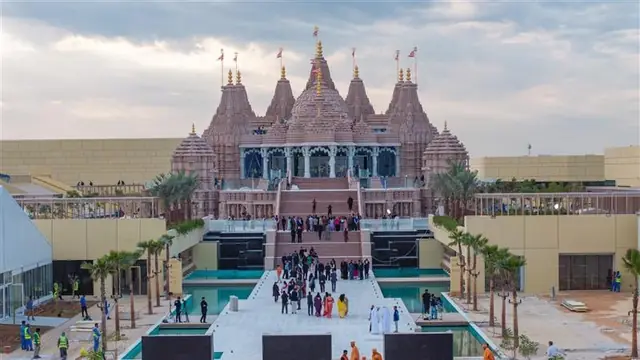
Oil changed the Gulf from the 1970s, and millions came from Kerala, Tamil Nadu, Andhra, Gujarat and beyond to work, most of them on contracts that let them stay but not settle. In Dubai the Shiva and Krishna mandir in Bur Dubai had served Hindus since 1958; a new temple at Jebel Ali opened on 5 October 2022, and the Shiva shrine moved there in 2024. In Abu Dhabi, Pramukh Swami Maharaj of BAPS had spoken of a mandir in 1997. In 2015 Sheikh Mohammed bin Zayed Al Nahyan gave twenty-seven acres at Abu Mureikhah, by the highway to Dubai, and building began in December 2019. The mandir, of Rajasthani pink sandstone and Italian marble, 108 feet high, has seven shikharas for the seven emirates and seven shrines: Swaminarayan and Gunatitanand Swami, Radha-Krishna, Sita-Rama, Shiva-Parvati, Venkateswara, Jagannath and Ayyappa. Mahant Swami Maharaj consecrated it on 14 February 2024, and it drew more than 2.2 million visitors in its first year.
About 1,00,000 Kenyans of Asian origin, most of them Hindu, and more than 60,000 Tanzanians of Indian descent keep temples from Mombasa to Dar es Salaam. In the Gulf, Hindus are about 5.5 per cent of Oman’s people by one estimate and between 6.6 and 15 per cent of the UAE’s by others, nearly all of them workers and families from India and Nepal; the Abu Dhabi mandir and the Shrinathji temple of Manama are their best-known shrines.