Cite
MLA
“Jai Singh’s observatories.” Hindu History, 2026, https://www.hinduhistory.in/vijnana/jantar-mantar-observatories/. Accessed .
APA
Hindu History. (2026). Jai Singh’s observatories. Retrieved , from https://www.hinduhistory.in/vijnana/jantar-mantar-observatories/
01Instruments of masonry
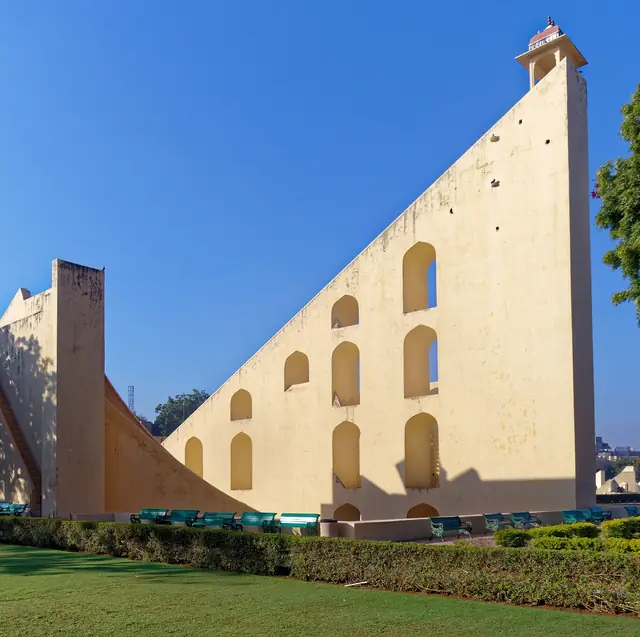
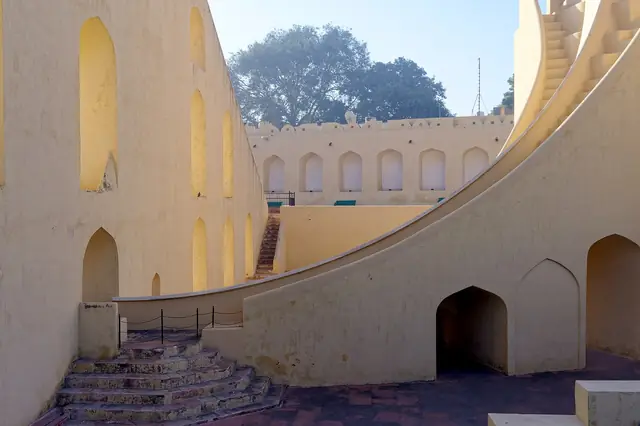
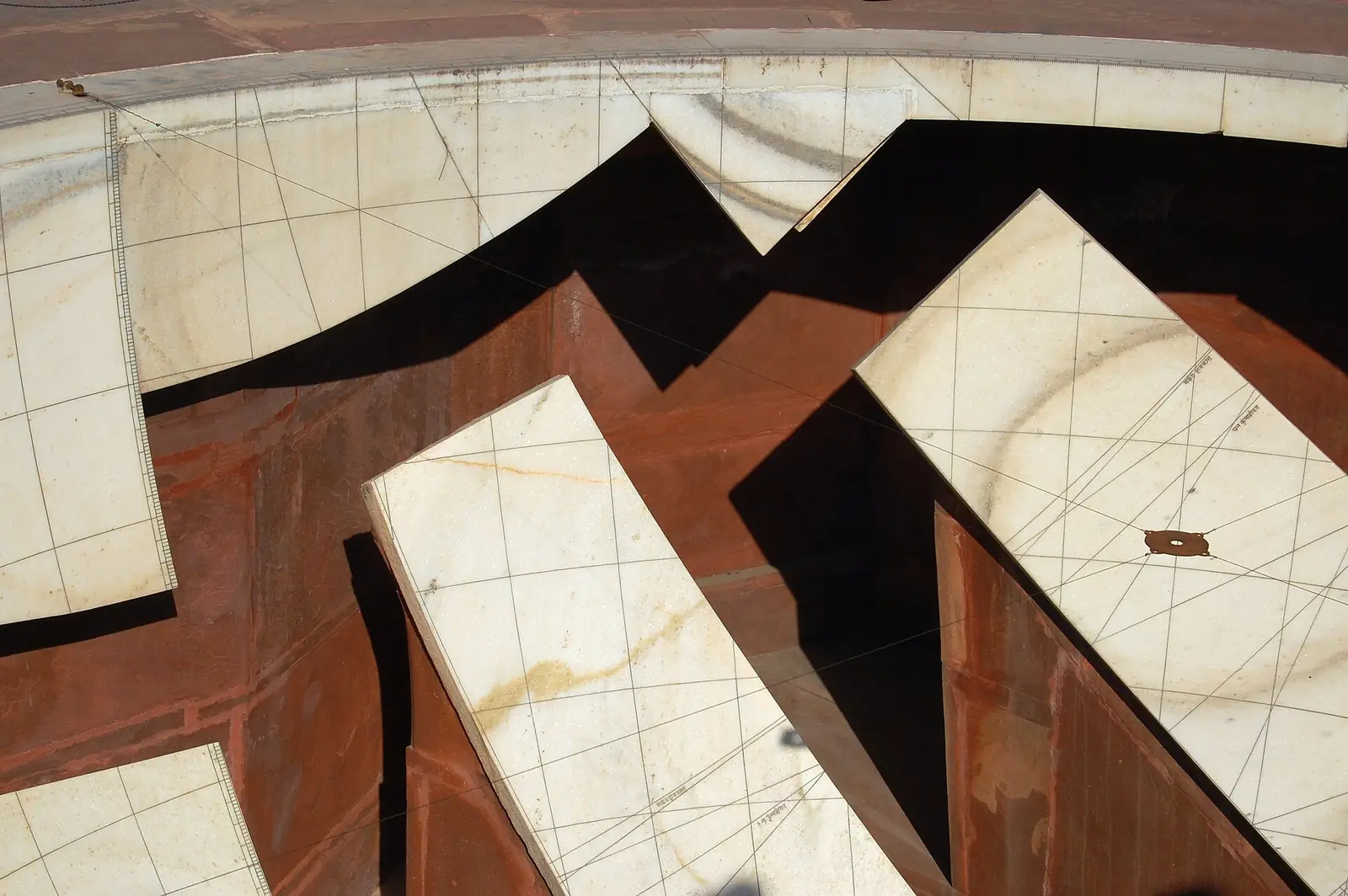
Jai Singh found the brass instruments of his day too small and too easily bent to give the accuracy he wanted, so he built in masonry. The Delhi observatory came first, in 1724; Jaipur’s followed in the late 1720s and 1730s and is the largest, with about 20 instruments. Its Vrihat Samrat Yantra is an equinoctial sundial with a gnomon about 27 metres high; its shadow moves about 6 cm a minute, and the time can be read to around two seconds. The Jai Prakash Yantra, two sunken hemispheres, maps the sky in reverse.
02Three traditions in one court
Jai Singh read the Sanskrit Siddhantas, had Ulugh Beg’s Samarkand tables of the 15th century studied in Persian, and sent a mission to Portugal that brought back Philippe de La Hire’s tables of 1702. His own tables, the Zij-i Muhammad Shahi, were dedicated to the Mughal emperor Muhammad Shah. His pandit Jagannatha Samrat translated Ptolemy’s Almagest from Arabic into Sanskrit as the Samrat Siddhanta. The observatories are thus an Indian synthesis of Indian, Islamic and European astronomy.
03What critics point out
By the 1720s Europe was already using telescopes, which Jai Singh’s instruments did not employ, and his tables did not adopt Kepler’s ellipses or the heliocentric model. Historians therefore see the observatories as the high point of naked-eye astronomy, not a step into the new science. The Mathura observatory is gone. Jaipur’s was restored in 1901 and is still used each year by astrologers to forecast the monsoon from the wind on Ashadha Purnima; UNESCO inscribed it in 2010.
In the texts
- Zij-i Muhammad Shahi
- Samrat Siddhanta of Jagannatha Samrat