Cite
MLA
“Aryabhata’s astronomy.” Hindu History, 2026, https://www.hinduhistory.in/vijnana/aryabhata-astronomy/. Accessed .
APA
Hindu History. (2026). Aryabhata’s astronomy. Retrieved , from https://www.hinduhistory.in/vijnana/aryabhata-astronomy/
01The book and its date
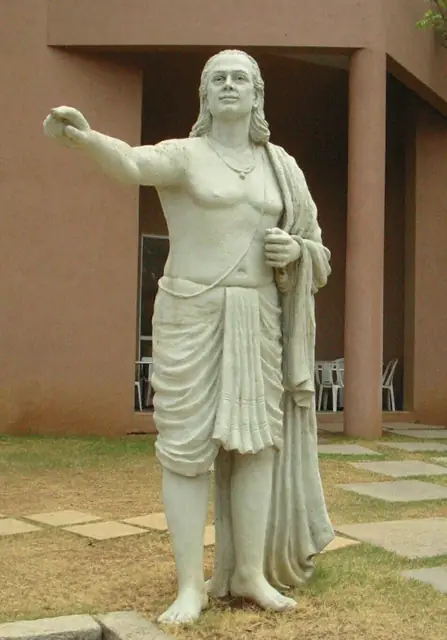
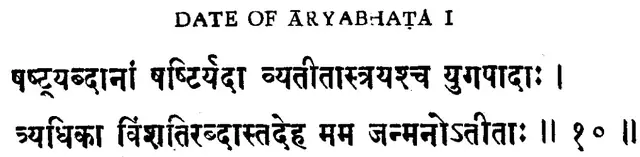
The Aryabhatiya has four parts: the Gitikapada with its number-code and parameters, the Ganitapada on mathematics, the Kalakriyapada on time, and the Golapada on the sphere. Aryabhata says he was 23 years old when 3,600 years of the Kali Yuga had passed, which is 499 CE, and that he taught at Kusumapura, Pataliputra. He packed huge numbers into syllables with his own alphabet code, so that a verse could carry the count of the moon’s revolutions in a yuga.
02The turning earth
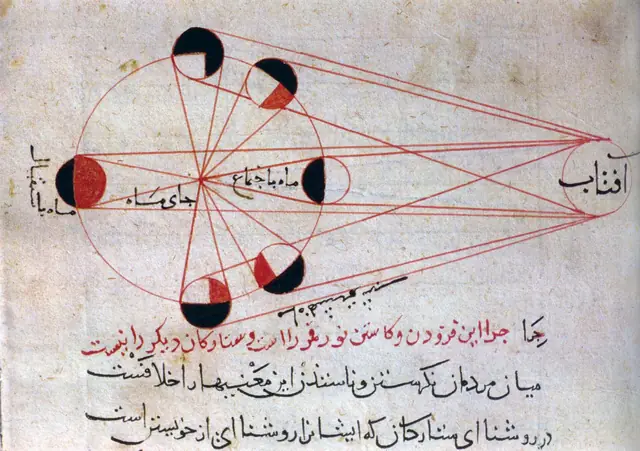
Golapada 9 gives the image of a man in a boat who sees the trees on the bank move backwards: so the fixed stars seem to move west to a man at Lanka. The earth turns on its axis. Aryabhata also says the moon and planets shine by reflected sunlight and that eclipses happen when the moon enters the earth’s shadow or covers the sun. He gives pi as 62,832 divided by 20,000, that is 3.1416, and calls the value asanna, “approaching”. Later Indian astronomers, Varahamihira and Brahmagupta among them, rejected the turning earth.
03Into Arabic and beyond
Aryabhata’s parameters reached Baghdad through Indian astronomical works translated under the Abbasids in the 8th century, and al-Biruni in the 11th century knew him as Arjabhad and discussed his rotating earth. His sine table and his kuttaka method for indeterminate equations passed into the whole later Indian tradition. In Kerala, commentaries on the Aryabhatiya continued to be written into the 16th century, and Nilakantha Somayaji’s Aryabhatiyabhashya is among the longest. India named its first satellite after him in 1975.
In the texts
- Aryabhatiya
- Aryabhatiyabhashya of Bhaskara I
- Aryabhatiyabhashya of Nilakantha Somayaji