Cite
MLA
“The Siddhantas and the meridian of Ujjain.” Hindu History, 2026, https://www.hinduhistory.in/vijnana/siddhanta-astronomy-ujjain/. Accessed .
APA
Hindu History. (2026). The Siddhantas and the meridian of Ujjain. Retrieved , from https://www.hinduhistory.in/vijnana/siddhanta-astronomy-ujjain/
01Five Siddhantas in one book
Varahamihira of Ujjain summarised five earlier systems in the Pancha-siddhantika, whose epoch is 505 CE: the Paitamaha, Vasishtha, Romaka, Paulisha and Saura. He named the Romaka and Paulisha openly, and they show contact with Greek astronomy, which Varahamihira respected. The Saura, an early form of the Surya Siddhanta, he judged the most accurate. The Surya Siddhanta known today, in 14 chapters, is a later revision, and panchanga-makers still compute from it.
02Ujjain, the zero line
Every Siddhanta needs a reference line for longitude. Indian astronomers drew theirs from Lanka, the point on the equator, north through Ujjain to Meru, and corrected for a town’s distance east or west of it, the deshantara. Ujjain was also where the Tropic of Cancer was taken to pass. Sawai Jai Singh II built an observatory there in the 1720s, the Vedh Shala, and the Madhya Pradesh government still keeps it as a working observatory.
03Borrowing both ways
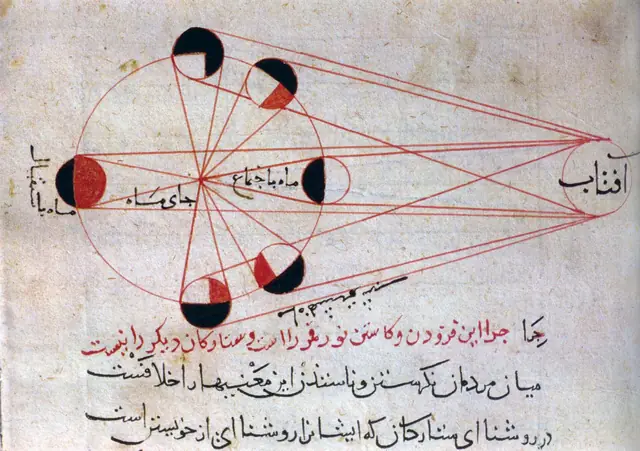
The Siddhantas are a good place to be honest. The zodiac of twelve rashis and some planetary models came into India from Hellenistic astronomy, and Varahamihira’s Yavana terms such as hora and kendra show it. In return, Indian trigonometry, the sine, and Indian parameters went west to Baghdad and on into the astronomy of the Islamic world. Al-Biruni spent years in the Ghaznavid lands studying the Siddhantas and wrote that Indian astronomers were the best he knew in arithmetic.
In the texts
- Pancha-siddhantika of Varahamihira
- Surya Siddhanta
- Brihat Samhita