01A king who watched the sky
Jai Singh found that the positions of the planets given in the astronomical tables of his day did not match the sky. Small brass instruments, he decided, could not be read finely enough, so he built in stone and on a giant scale. He raised observatories at Delhi around 1724, then at Jaipur, Ujjain, Varanasi and Mathura; Jaipur’s, built from about 1728 and finished by 1738, became his main one, with some two dozen astronomers at work in the 1730s. From their observations came the tables of the Zij-i Muhammad Shahi, dedicated to the emperor and used across India for a century. His court astronomer Jagannath Samrat rendered Ptolemy’s Almagest into Sanskrit as the Samrat Siddhanta.
02The instruments
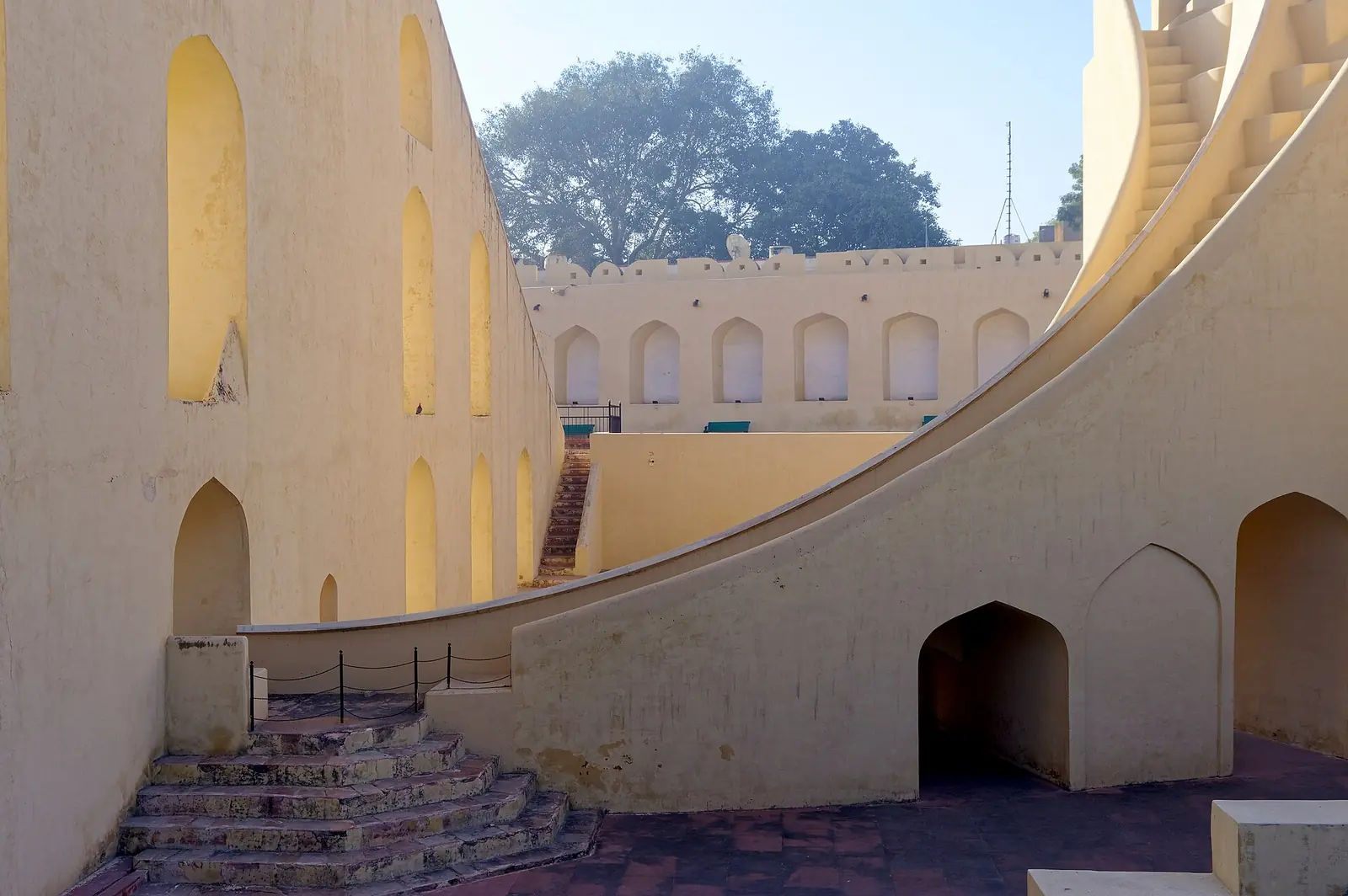
The Vrihat Samrat Yantra is a great right-angled triangle whose hypotenuse points at the pole star, with quadrants on either side marked so finely that its shadow tells local time to about two seconds. The Jai Prakash Yantra is a pair of hollowed hemispheres, a map of the sky turned inside out, in which an observer can stand. The Rashi Valaya Yantras are twelve instruments, one for each sign of the zodiac. After Jai Singh’s death in 1743 the observatory was neglected; Ram Singh II restored it in 1876, lining some scales with lead and rebuilding plaster in stone, and Madho Singh II repaired it again in 1901. UNESCO inscribed it in 2010.
The life of this place
- c. 1728The first instruments at Jaipur are built.
- 1738Construction of the instruments is completed.
- 1876Ram Singh II restores the observatory.
- 1901Madho Singh II repairs it again.
- 2010Inscribed as a UNESCO World Heritage Site.
Beside the City Palace; go near noon to see the Samrat Yantra’s shadow move along its scale.