Cite
MLA
“The Charaka Samhita.” Hindu History, 2026, https://www.hinduhistory.in/vijnana/charaka-samhita-medicine/. Accessed .
APA
Hindu History. (2026). The Charaka Samhita. Retrieved , from https://www.hinduhistory.in/vijnana/charaka-samhita-medicine/
01A book with three hands
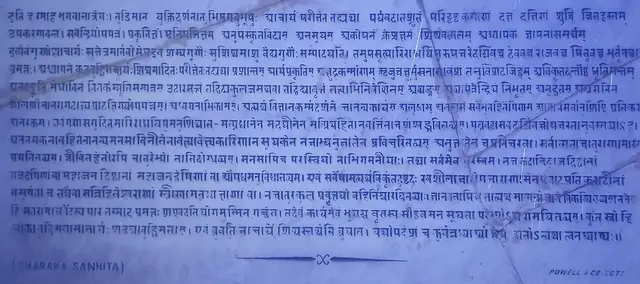
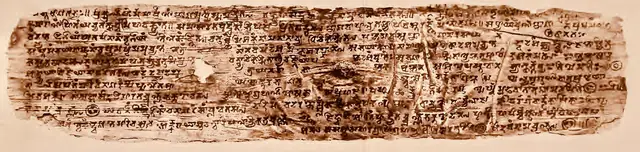
The Charaka Samhita says of itself that Atreya Punarvasu taught it to his pupil Agnivesha, that Charaka revised Agnivesha’s work, and that Dridhabala of Panchanada in Kashmir restored the missing chapters, 17 of the Chikitsasthana and the whole of the Kalpa and Siddhi sections. Its eight sthanas run from principles (Sutra) through causes (Nidana), measures of the body (Vimana), anatomy (Sharira), prognosis (Indriya) and therapy (Chikitsa) to pharmacy (Kalpa) and purification (Siddhi).
02Method, not magic
The text insists on examination. Vimanasthana 8 lists ten things a physician must assess in a patient, from constitution (prakriti) to strength, age and digestive power, and lays out how to debate in a medical assembly. It names 50 groups of ten herbs by action, gives the six tastes and their effect on the doshas, and sets rules of diet by season. Its oath for the student, in Vimanasthana 8, forbids harming the patient, betraying a household’s secrets or treating a woman without her guardian present.
03In Arabic and Persian
Under the Barmakid viziers of Harun al-Rashid, Indian physicians worked in Baghdad, and Ibn al-Nadim’s Fihrist of 987 lists a book of “Sharak” among the Indian works put into Arabic. Ali ibn Sahl Rabban al-Tabari’s Firdaws al-Hikma of about 850 ends with a long summary of Indian medicine drawn from Charaka, Sushruta and others. The date of Charaka himself is argued over, from the 2nd century BCE to the 2nd century CE, and the text grew in layers by its own account.
In the texts
- Charaka Samhita
- Chakrapanidatta’s Ayurveda Dipika commentary