
Cite
MLA
“Karva Chauth.” Hindu History, 2026, https://www.hinduhistory.in/utsav/karva-chauth/. Accessed .
APA
Hindu History. (2026). Karva Chauth. Retrieved , from https://www.hinduhistory.in/utsav/karva-chauth/
How it is kept
- 01
Sargi eaten before sunrise
- 02
A waterless fast through the day
- 03
Evening katha and the passing of puja thalis in a circle
- 04
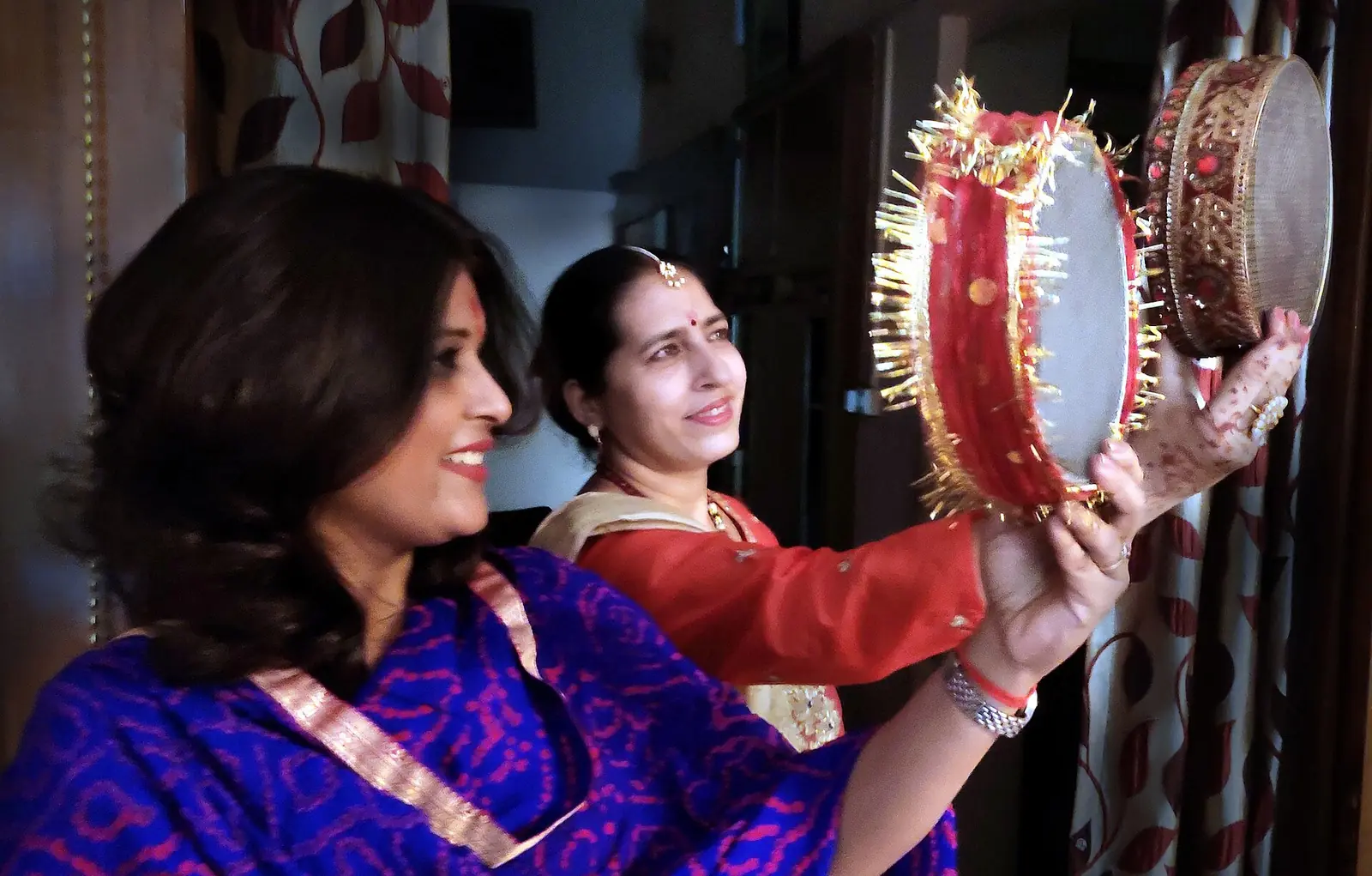
Arghya to the moon from the karva, seen through a sieve
01Karva and Veeravati
The karva is the clay pot with a spout, filled with water and offered to the moon. The katha most often told is of Veeravati, a young wife with seven brothers, who grew faint from the fast. Her brothers lit a fire behind a tree and held a sieve before it so she would think the moon had risen; she broke her fast, and word came that her husband had died. She kept the vrata faithfully for a year, and by Parvati’s grace he was restored. The fast is waterless, and women worship Shiva, Parvati, Ganesha and Kartikeya painted on the wall or on a cloth.
02Sargi to moonrise
Before dawn the mother-in-law sends sargi, a meal of fruit, sweets and mathri, eaten before the sun is up. The day goes in mehndi and dressing as a bride. In the late afternoon the women sit in a circle, the eldest tells the katha, and the thalis go round seven times to a song. When the moon is up, the wife looks at it through a sieve, then at her husband’s face, offers water from the karva and takes her first sip from his hand.
Punjab, Haryana, Delhi, Rajasthan, Uttar Pradesh, Madhya Pradesh, and north Indian families abroad