Cite
MLA
“Swami Vedanta Desika.” Hindu History, 2026, https://www.hinduhistory.in/people/vedanta-desika/. Accessed .
APA
Hindu History. (2026). Swami Vedanta Desika. Retrieved , from https://www.hinduhistory.in/people/vedanta-desika/
Life in moments
- 011268
Born Venkatanatha at Thoopul near Kanchipuram; the sampradaya dates him 1268–1369.
- 02
Pupil of his uncle Kidambi Appullar (Atreya Ramanuja), of Ramanuja’s line.
- 03
Saved Sudarshana Suri’s sons and his Sruta Prakasika during the sack of Srirangam in the 1320s.
- 04
Over a hundred works, among them the Rahasya Traya Sara, Paduka Sahasram and Sankalpa Suryodaya.
- 05
The chief acharya of the Vadakalai Sri Vaishnavas.
01Venkatanatha of Thoopul
He was born at Thoopul, near Kanchipuram, in a family of the Vishvamitra gotra, and named Venkatanatha after the Lord of Tirumala; Sri Vaishnavas hold him to be the avatar of the bell in Venkateswara’s temple. The sampradaya’s dates are 1268 to 1369, a span of a hundred years, and modern writers give much the same, c. 1269–1370. His maternal uncle Kidambi Appullar, also called Atreya Ramanuja, stood in the line of disciples from Ramanuja, and taught him until he was twenty. He married Tirumangai and their son, Varadacharya, called Nainar, was born when he was forty-six. Tradition says he received the mantra of Hayagriva, the horse-headed form of Vishnu who is Lord of learning, and worshipped him all his life; his Hayagriva Stotra is still recited before study.
02Srirangam in the years of the sack
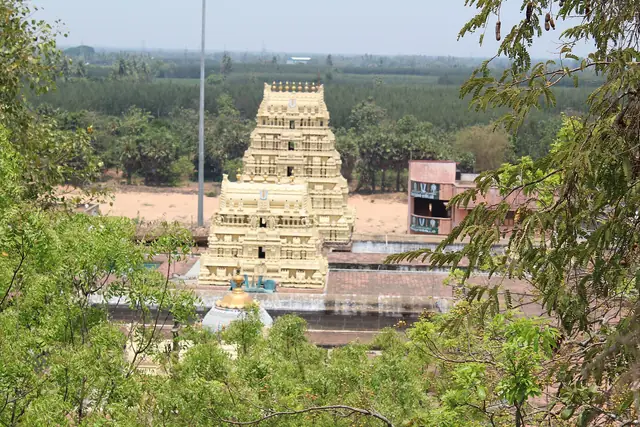
He lived through the darkest years of the South. In the 1320s an army of the Delhi Sultanate fell on Srirangam; Sri Vaishnava accounts tie the worst of it to 1323, though the sources differ on the year. The utsava murti of Sri Ranganatha was carried away into hiding by the temple’s servants. Sudarshana Suri, the old commentator on Ramanuja’s Sri Bhashya, was killed, and before he died he gave his two young sons and the only manuscript of his Sruta Prakasika into Desika’s keeping. Desika took the boys and the manuscript north-west to Satyamangalam and later to Melkote. His Abhiti Stava, a prayer for freedom from fear, belongs to these years. In his last years he was again at Srirangam, and he passed away there.
03Prapatti and a hundred books
More than a hundred works are counted as his. In philosophy there are the Tattva Mukta Kalapa, the Nyaya Siddhanjana and the Shatadushani, a hundred arguments against Advaita; the Tatparya Chandrika on Ramanuja’s Gita commentary; the Seshvara Mimamsa, which reads the Purva Mimamsa as a theistic system leading into Vedanta. In poetry there are the Yadavabhyudaya on Krishna, the allegorical play Sankalpa Suryodaya, the Hamsa Sandesha, and 862 verses on the deities of the temples in twenty-two metres. Tradition says he composed the Paduka Sahasram, a thousand and eight verses on the sandals of Sri Ranganatha, in one night. His Rahasya Traya Sara, in Manipravala, sets out prapatti, total surrender, as a path to moksha in its own right, open to those who cannot walk the Vedic road. Reading Gita 18.66, he taught that the one who surrenders gives up even the sense of being the doer.